A four-legged robot has learned to jump through narrow passages
English translation from Unibot. Source published 2026-09-02.
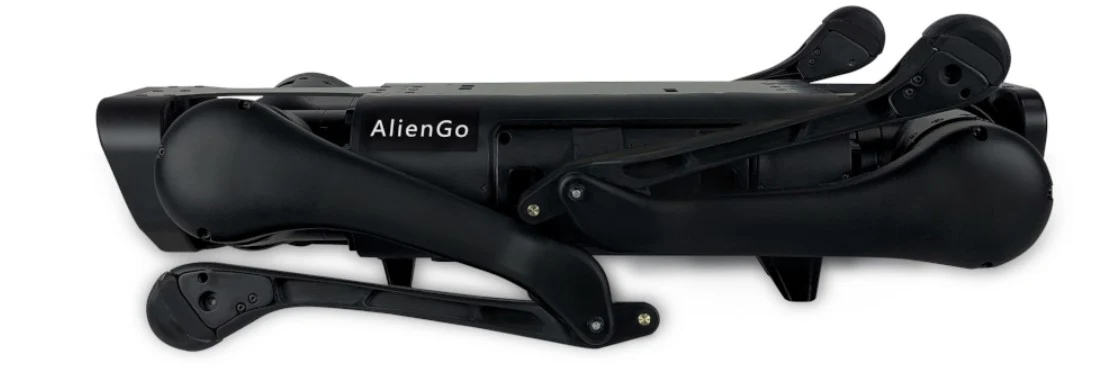
The four-legged robot Unitree Aliengo has learned to independently find a narrow opening, accelerate and jump through it, relying only on on-board vision. The development belongs to researchers from the University of Hong Kong and the Oxford Robotics Institute.
Animals evaluate the jumping point, make a decision and tuck their paws in the air without the slightest thought. Teaching a 22kg machine to do the same was the team's goal.
Jump like aerobatics
Cats, dogs, wolves and other agile four-legged animals easily jump and squeeze through narrow cracks at high speed. It has not yet been possible to reproduce such dexterity in four-legged robots.
Researchers from the University of Hong Kong (HKU) and the Oxford Robotics Institute have developed a learning approach that allows a four-legged robot to independently and quickly navigate through a narrow gate. Their method, described in a paper published in Advanced Robotics Research, was first tested on a four-legged robot called Aliengo.
“Our group at HKU's Adaptive Robot Control Laboratory (ArcLab) is working on both flying and walking machines,” Peng Lu, senior author of the paper, told Tech Xplore. - For drones, flying through a narrow gap has long been considered aerobatics: it forces perception, decision-making and control to work in a split second. We kept asking ourselves why no one had given the same task to a ground robot.”
The new work by Professor Lu and his colleagues also relies on the behavior of dogs. Namely, the dog’s well-known ability to accelerate in front of the hoop, estimate the jumping point on the fly, tuck its paws in the air and land while running.
“Four-legged robots are mechanically capable of this, but usually use only a small part of their hardware capabilities,” Lu explained. “So our goal was for a 22-kilogram robot to independently detect an opening approximately its own size, decide when and at what speed to jump, and fly through it - on real hardware, not just in a simulation.”
Two levels of training
Lu and his ArcLab colleagues developed a new teaching method together with Ioannis Havoutis from the University of Oxford. The proposed approach relies on two key components: a low-level controller and a discriminator network.
“The bottom-level controller learns how to move: Instead of manually designing a jump, we let the robot imitate the motion capture data of a real dog - trot, gallop, turn, and jump - using adversarial imitation learning,” Lu explained. “The discriminator network evaluates whether the robot’s movement is similar to that of an animal, and this assessment becomes part of the reward.”
Instead of keeping each skill separate and accessing it individually, the team's approach allows skills to be continuously mixed. As a result, the transition from a slow walk to a full run, jumping and landing into a run arises simply from the speed that is given to the robot.
“The top-level controller then learns what to do: working ten times per second, it looks at the gate detected by the on-board RGB-D camera and only outputs forward speed and turning speed,” Lu said. “It’s a very small, meaningful solution space, so learning takes about six hours rather than wading through raw joint commands.” The most telling thing about a real robot is not any single number, but the fact that the machine actually takes over this maneuver.”
When the controller was applied to the four-legged Aliengo, the researchers noticed that it accelerated towards the gate until the rear motors were close to saturation, and then pressed its legs tightly in the air so that they passed the frame. It is noteworthy that the team never specified exactly when to lift off the ground or which limbs to tuck; the robot itself found the correct sequence of actions.
Generalization instead of memorization
The research team's new controller and learning approach could bring robots closer to the agility displayed by dogs and other four-legged animals. The same training scheme is potentially applicable to reproducing other rapid movements of walking machines.
“To the best of our knowledge, this is one of the first demonstrations where a walking robot autonomously jumps through a confined space with a true flight phase, all validated on real hardware rather than in simulation,” says Lu.
“We found that the controller works in a general way, rather than just learning one rehearsed scene: the gate can be placed anywhere in the room, at any height within the robot’s reach, and it finds its own approach. For a higher opening, it lengthens the run-up and bends the joints more strongly, and if the gate is shifted to the side, it crosses them diagonally. It even copes when the gate is moved while the robot is already running towards it, re-planning the trajectory on the fly.”
Another advantage of the approach is that the library of low-level skills it relies on is reusable. This means that the same robot can be reconfigured to jump over barriers, vertical walls or gaps simply by reconfiguring a high-level module, without retraining the movement policy.
“The broader point is to apply robots to cluttered human-scale environments, such as collapsed structures and industrial sites, where the ability to decide to maneuver dynamically rather than slowly navigate each obstacle is what makes a route possible at all,” Lu adds.
Future plans
The researchers are now planning further work to improve their method. For example, the proposed approach still relies on an external motion capture system, but they want the robot to cope with cluttered spaces and effectively jump over partially hidden obstacles based only on data from on-board sensors.
“We also want to expand the skill repertoire so that the same framework covers a wider range of tight workspaces,” says Lu.
“Also, the design is built around a four-legged robot, but there is nothing in it that is specific to four legs. We're wondering if the same 'imitate first, decide later' structure will carry over to humanoids, where the flight phase is even less forgivable."