A miniature robot has been created with precise control of jump height
English translation from Unibot. Source published 2026-09-25.
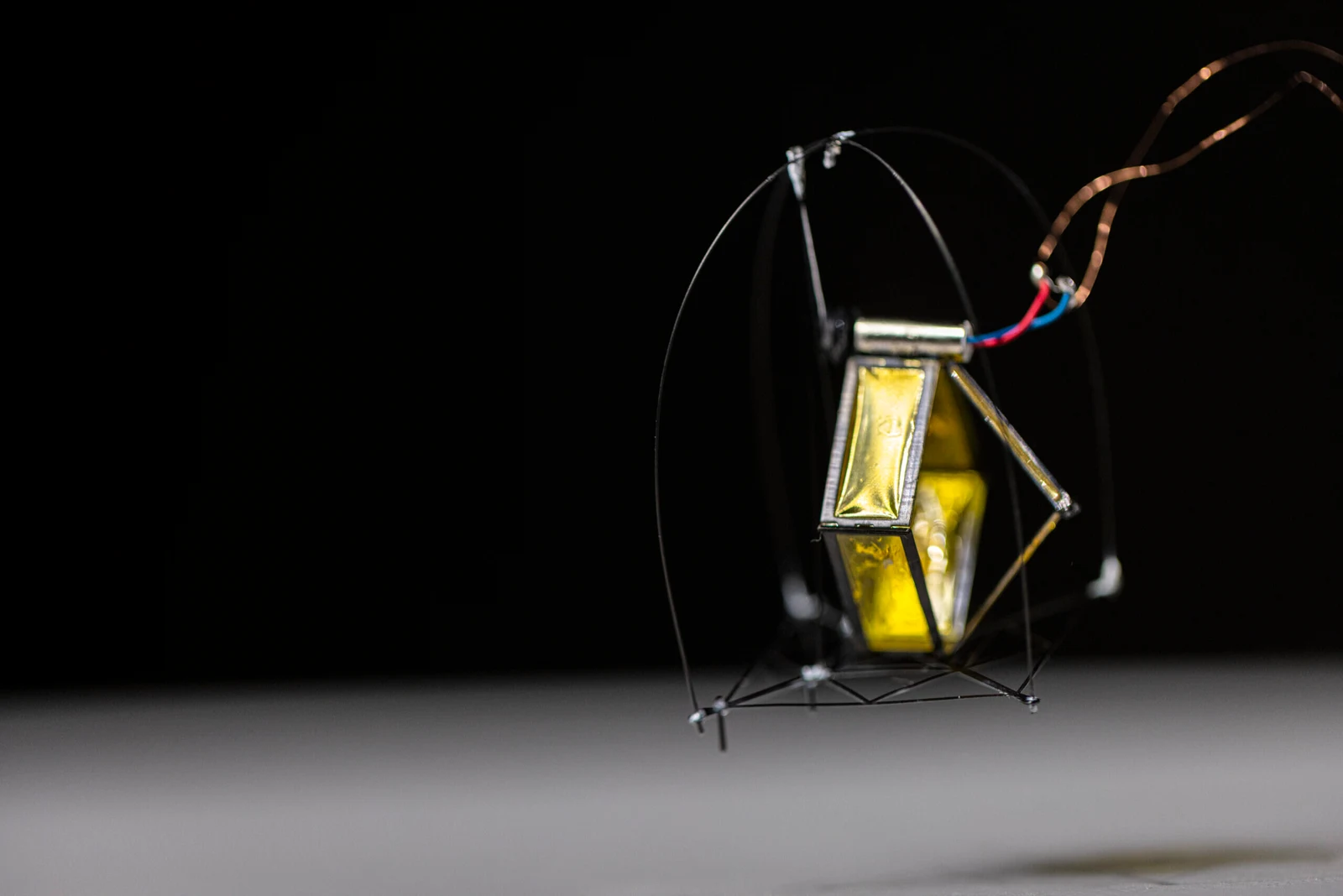
DirectHop, a one-gram jumping robot developed at the University of Washington, takes off from the table. Unlike more conventional spring jumpers, DirectHop is driven directly by a tiny motor - and therefore can precisely set the height of the jump.
Why is jumping better than flying?
The sky is increasingly crowded with buzzing, hovering, fluttering drones. But let's also remember the humble jumping robot. Jumping, a popular method of movement in the world of insects and amphibians, is almost two orders of magnitude more energy efficient than flying.
The mosquito has to constantly spend energy to stay in the air. The flea works only at the moment of the jump.
These savings can pay off in robotics as well. A group of small, simple jumping robots can survey an area much cheaper than flying drones. They could look for gas leaks in an oil refinery, monitor water and fertilizer consumption on a farm, or even explore other planets.
What DirectHop can do
It was with this in mind that University of Washington engineers created DirectHop, a robot weighing about 1 gram (0.04 ounces) that can make multiple jumps in a row and rise high enough to clear a standard stair step.
A tiny electric motor and three folding legs allow it to jump to a given height with an accuracy of 1 centimeter (0.4 inches). Once DirectHop lands, it can jerk, get back to its feet, and prepare for the next jump.
The prototype fits in the palm of your hand. This is just one of many steps towards an autonomous jumping robot capable of moving in a wide variety of conditions.
“In my opinion, the three biggest challenges for jumping robots are changing the length of their jump, getting up on their own, and recharging for a series of jumps,” said senior author Sawyer Fuller, an assistant professor of mechanical engineering at the University of Washington. “DirectHop overcomes all three obstacles with a completely new design, and we are already well on our way to solving other challenges - on-board power, control and navigation.”
Fuller and his team will present a paper on DirectHop on September 30 at the International Conference on Intelligent Robots and Systems (IROS 2026).
Moving beyond springs
Most jumping robots imitate insects like fleas - those that literally run on springs. The flea squeezes and then releases parts of its exoskeleton to jump a distance of 50 times its own height.
Robots with springs and latches can also jump impressively far. But calibrating the length of the jump is not easy for them: the discharge of the spring is, as Fuller put it, “all or nothing.” In addition, springs and latches are complex mechanisms that are difficult to assemble and maintain on a small scale.
DirectHop's solution is to eliminate the spring entirely.
“We found that a very small electric motor can accelerate fast enough to directly power a jump, just as a frog's leg muscles directly power its jump,” said lead author Hanquan (John) Wang, a graduate student researcher in the Department of Mechanical Engineering at the University of Washington. “We also found that by adjusting the current supplied to the motor, we can make the robot jump a certain distance.”
How it works
The robot itself is a tiny electric motor attached to a stand with a piece of fishing line. As the motor accelerates, it quickly winds the line and pulls itself up the stand, pulling the rest of the robot's body into the air. As the motor rises, three articulated legs extend, keeping it aligned with the robot's foot.
Since the robot usually somersaults in the air, the researchers added a roll cage to support the body when falling on its side. From there, the team learned to get the robot on its feet 90 percent of the time: the motor is sent back down the stand, the center of gravity shifts, and the robot rolls back onto its foot, ready to jump again.
The design was inspired by box turtles - they turn over on their feet using a shell of a similar shape.
Limitations and plans
The current prototype has limitations. Power is supplied through wires, but it does not know how to steer or at least navigate - it only twitches randomly.
However, Wang and Fuller are already working on a solution: solar cells and a battery on board, a vibration motor to spin in place, tiny retractable legs to adjust the angle of the jump, a camera and electronics for navigation.
At full power, DirectHop jumps high enough to jump over a standard step. Photo: Andre Quiles/University of Washington
“One of our goals is fully autonomous stair climbing,” says Fuller. - The camera looks at the step, the processor estimates how high to jump, the robot levels itself, jumps, stands on its paws, levels itself again - and so on in a circle. Simple sensors and actions add up to a complex problem.”
Ten dollars for a robot
Wang considers it quite possible to assemble a full-fledged DirectHop for about $10 - the parts are very small and inexpensive. For that kind of money, robots can be a great semi-expendable addition to larger, more capable and more expensive machines.
“We could send a hundred or even a thousand of these robots into the field,” Wang says. - If a part gets lost or fails, it is not a failure. The team will complete its task."