AGIBOT A2: humanoid robot debuts in Jakarta and aims for industrial tasks
English translation from Unibot. Source published 2026-05-26.
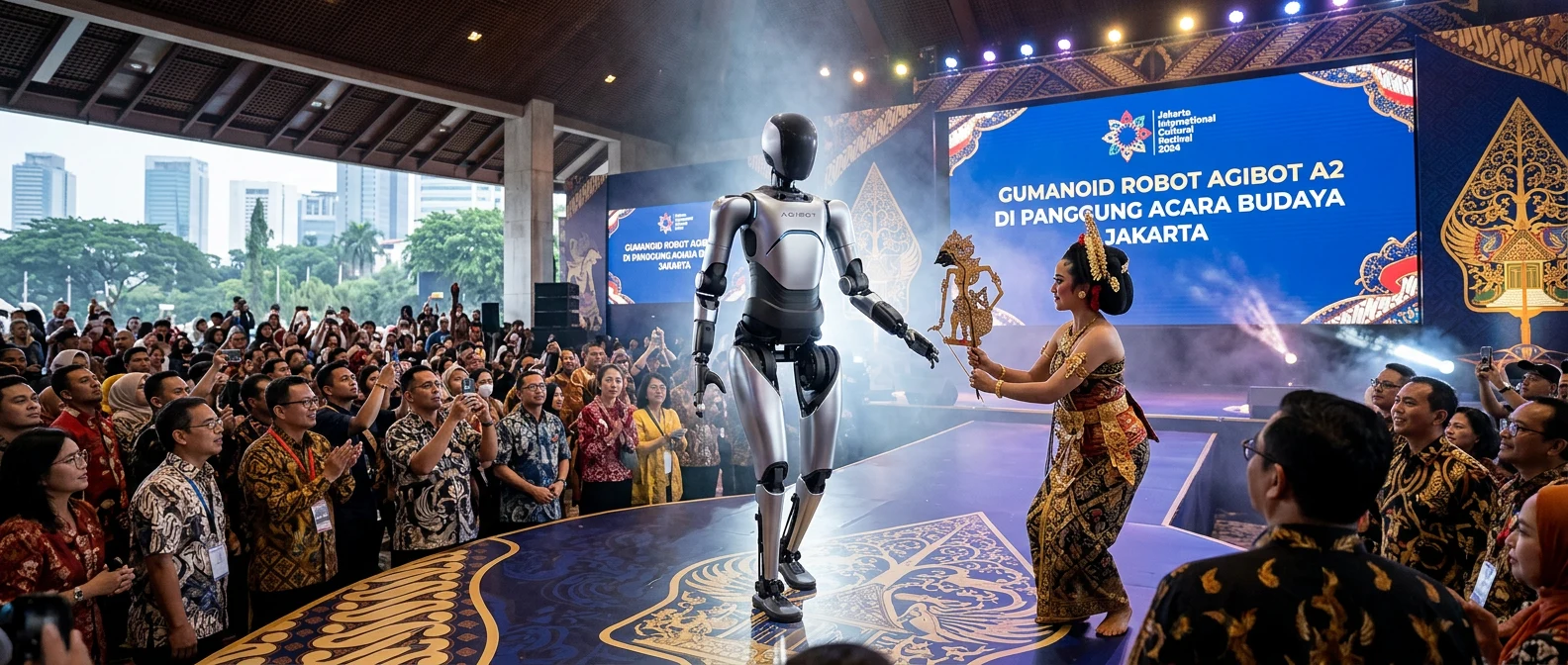
Humanoid AGIBOT A2 makes its cultural debut
The humanoid robot AGIBOT A2 took to the stage at a cultural event in Jakarta on May 21, performing live calligraphy, dancing and leading part of the program while interacting with participants in real time. The demonstration was not just a spectacle: it was part of AGIBOT's entry into the Indonesian market, with the company and local partner ASIX positioning the robot as a potential worker for factories, logistics, hospitality and other public spaces.
According to an MSN summary citing Interesting Engineering, the robot wrote the phrase "Tea for Harmony" along with human artists. This fact is important: calligraphy clearly requires brush control and precision of movement, and the machine was presented at the event as capable of collaborating in an artistic environment rather than simply executing a pre-programmed number.
The appearance in Jakarta also brought together several forms of interaction in one space. Dance, calligraphy, and live performance test different aspects of the humanoid system: whole-body coordination, fine motor skills, and the ability to interact with people in a public environment. For a company entering a new market, this combination serves as a practical demonstration of both technical range and social presence.
Entering the Indonesian market involves local adaptation
The event was held with the participation of the Indonesian AI accelerator ASIX, which the source calls a partner in adapting humanoid robotics to local markets. AGIBOT emphasizes that the focus is not just about hardware deployment. The company also pays attention to cultural sensitivity and social acceptance, which indicates a strategy aimed not only at proving the machine's functionality, but also at integrating it into the local environment.
This is important because the early adoption of humanoids in service industries and public spaces depends on more than just task completion. Hospitality, education and retail require a sense of comfort among staff, customers and others. According to the source, company executives described the show as a step towards introducing embodied AI solutions to improve productivity in Indonesian factories, commercial spaces and everyday life - meaning localization and user adoption are on par with productivity.
From public demonstration to industrial work
AGIBOT's ambitions, as follows from the report, go far beyond cultural events. The company envisions humanoids taking over loading on production lines, sorting in logistics, retail assistance, and security patrols. These environments are varied, but they share a common requirement: the robot must be able to work in a space designed for people and cope with tasks that may vary from cycle to cycle.
The source also points to previous industrial activity. Previously, in 2026, according to the report, AGIBOT's G2 humanoids were employed in an existing tablet production line at Longcheer Technology. MSN, citing Cryptopolitan, calls this one of the first large-scale applications of embodied AI in active consumer electronics manufacturing - a claim that, if proven true in day-to-day use, will give AGIBOT more than just a demo story as it expands into Southeast Asia.
What does the Jakarta demonstration signal for the acceptance of humanoids?
The Jakarta event reflects a broader pattern in the humanoid sector, where companies use public demonstrations to build awareness before reaching industrial and commercial deployments. In this case, the humanoid AGIBOT A2 was not presented as an entertainment object: it was positioned as a bridge between cultural interaction and operational application, supported by partnerships in the local market and links to factory projects already underway elsewhere.
What remains unclear is how quickly this transition will happen in Indonesia. The source himself notes that cost, infrastructure and public acceptance may slow down implementation, even if readiness for deployment appears within the expected time frame. At the same time, a combination of local partnerships, public trials, and early industrial applications indicates that Southeast Asia is becoming an important test bed for testing whether humanoids can move from ostentatious versatility to repeatable commercial work.