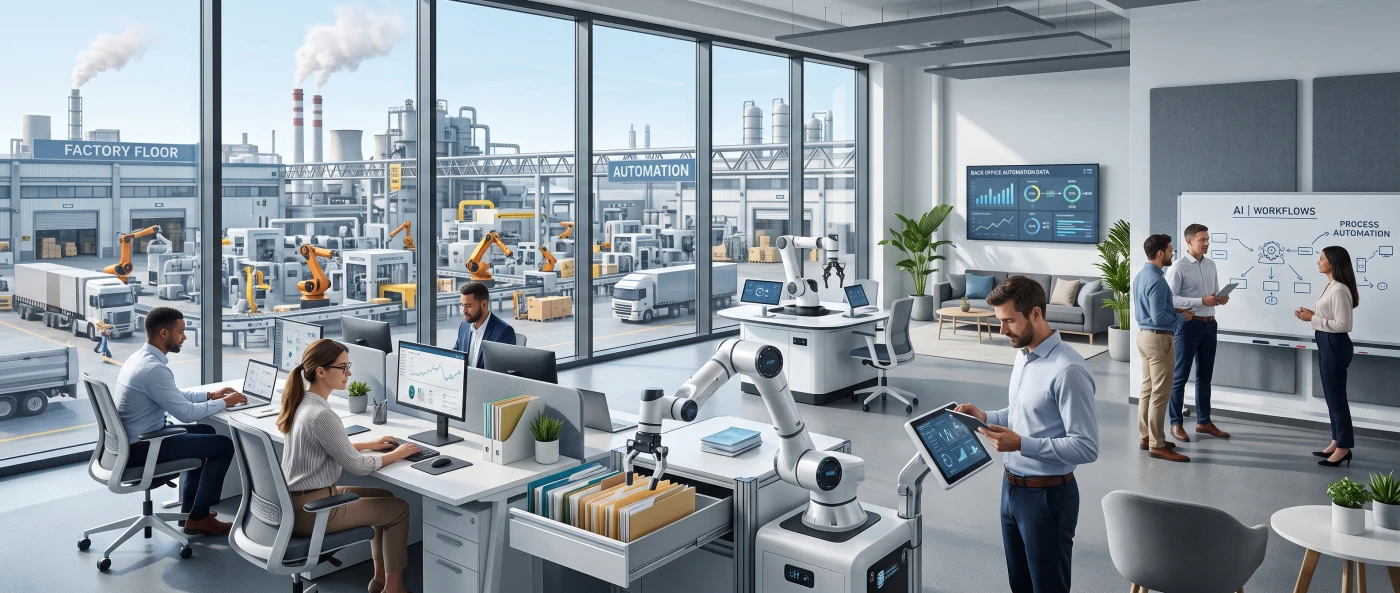
Automation leaves the factory floor and moves into the office
English translation from Unibot. Source published 2026-06-30.
For decades, automation has had a clear address. She lived in factory floors, warehouses and along conveyor lines. Now the same logic is making its way into offices where robots were not previously expected.
The new frontier of automation
Walk through a modern automated plant and the efficiency is obvious. Materials move on their own, machines coordinate actions, humans only observe.
Now take a look at the offices at the same plant. The opposite often prevails there. People spend hours typing data from one system to another, copying numbers from application to application, manually transferring information between departments.
Here it is - a curious gap. We have automated the physical movement of goods much more thoroughly than the digital movement of information. Back office, finance, purchasing, HR, customer service - this is still one of the largest reservoirs of routine work according to the rules.
Why did the office resist for so long?
The reason is not that no one tried. The problem is different: work is spread across many different software systems that were not originally created to work together.
A typical organization uses dozens of applications. Here is an ERP system, there are separate tools for CRM, finance, support and HR. Everyone lives on their own. Previously, combining them meant ordering custom development: expensive, slow, unreliable.
Therefore, companies fell back to the cheapest connector - a person with a keyboard. In fact, office workers have become the same integration layer, manually performing the same routine data transfers that robots have long taken over on the assembly line.
What do AI agents change?
The shift that reshapes this picture is the emergence of AI agents capable of working across software systems. If earlier automation tools required technical configuration, then modern platforms allow a person to describe the process in simple language.
Tools like Noca AI fall into this category. They're building AI agents—sometimes called digital collaborators—that take an instruction phrased as a manager would say it, and turn it into a reliable end-to-end process.
Conceptually, this mirrors production. Just as industrial robots eliminated repetitive physical movements, these agents eliminate repetitive digital operations. The key here is accessibility. Those who understand the process can increasingly assemble the automation themselves.
A familiar pattern in a new environment
Let's take a process that almost every manufacturer has. The deal is closed. The quote from NetSuite needs to be transferred to finance, a delivery project needs to be created in SAP, support and billing set up for the client. Previously, every step was a manual transfer between people and systems.
The AI integration platform collapses this into a single automatic flow, which is launched upon the closing of the transaction. It’s the same with HR integration: a new employee is introduced once, and his accounts, equipment and onboarding are configured automatically. Anyone who has seen a robotic cell replace manual assembly will immediately recognize the parallel.
What does this mean for the industry?
For robotics and automation professionals, this trend is important for two reasons. First: it expands the very definition of the field. Automation is no longer about physics. The same principles - throughput, reliability, error reduction - now apply to software processes.
Secondly, the discipline that has already developed in this industry is exactly what office automation lacks. Several principles transfer directly:
Design for observability. Like an assembly line, each worker process must log its actions and flag failures.
Build resilience. Software automations should expect API failures and handle them, rather than silently break down.
Leave control to the person. The factory model, where people supervise rather than perform, also applies to offices.
Restrict and secure every connection. Each integration is a data path and should only be given the access it needs.
The automation industry has been arguing for decades that repetitive work belongs to machines. This principle is now moving from the physical to the digital world, reaching office processes that have remained stubbornly manual. AI agents are a machine, and the possibilities are enormous. The back office, in a sense, is the next factory floor.
Frequently Asked Questions
How is this different from traditional office software?
AI agents move data between tools automatically, rather than having humans do it.
How does this relate to industrial automation?
The same principle of machines taking over repetitive work, only it is applied to digital processes.
Where should a company start?
With one frequent task - for example, order processing or onboarding.
Do you need engineers to set it up?
Less than before. The process can be described in simple language.
Is it safe?
Yes, if each connection is limited and logged correctly.
How quickly can you see results?
Often within a few days of automating the first process.