BMW expands deployment of humanoid robots in electric vehicle production in Leipzig
English translation from Unibot. Source published 2026-05-26.
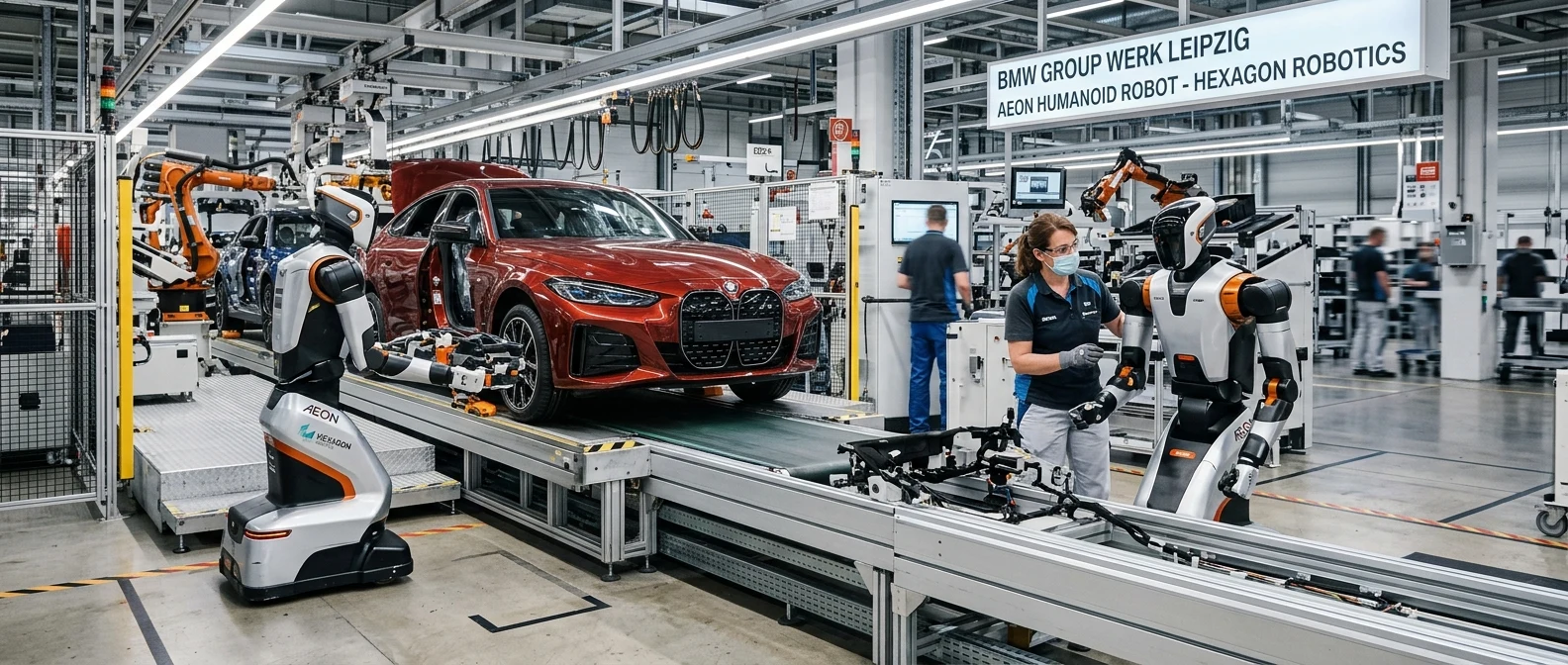
BMW has expanded the use of humanoid robots at its Leipzig plant in Germany, with Hexagon Robotics' AEON robots being tested in a real-life electric vehicle production environment, following an earlier pilot in Spartanburg, South Carolina. This expands the use of humanoid systems from a single-purpose trial format to a broader evaluation in live automotive production.
Humanoid robots enter Leipzig factory
According to Fox News, BMW is implementing projects with humanoid robots in Leipzig as part of the iFACTORY initiative, where the production of electric vehicles is already a priority. The company tests robots in real-life production environments rather than in a laboratory or demonstration area—an important distinction for manufacturers who are assessing whether humanoids can cope with the variability of the factory floor.
BMW is positioning the program as a practical test rather than an immediate replacement for human labor. Michael Nicolaides, who oversees BMW's production network, said the pilots are helping the company hone how AI robots learn on the job.
From Figure 02 pilot to AEON testing
Previously, a pilot in Spartanburg used Figure 02 humanoids for a specific operation—precisely positioning sheet metal during welding on a BMW X3 line. BMW reported that these robots contributed to the production of more than 30,000 vehicles, a result that the company considered sufficient to expand testing beyond one plant and one narrow task.
The Leipzig trial uses a different platform: the new AEON robots from Hexagon Robotics are designed to operate in an active factory environment without constant human supervision. According to the source, they rely on AI-based motion control and built-in sensors that interpret the environment in real time, allowing it to adapt to changing conditions instead of stopping for a reprogramming cycle. Hexagon calls this approach “Physical AI.”
Why Factory Integration Matters
The industrial appeal of humanoids in this context is obvious. Automotive factories are designed from the ground up for humans: tools and layouts are designed for human height and movement, workers walk from station to station, pick up parts and operate equipment. A humanoid system capable of operating in the same environment is likely to integrate more easily into existing workflows than a machine that requires a complete line redesign.
This is especially important in factories where conditions are less predictable than in commercials: parts don't always arrive in the same orientation, tools are moved around, workers are constantly moving around. According to the source, AI humanoids can respond more flexibly to such variability than traditional robots, which depend on strictly controlled conditions, although BMW has not yet disclosed detailed performance indicators for the Leipzig exhibition, limiting itself to a general argument in favor of testing.
What does this mean for industrial humanoids?
BMW isn't the only company testing humanoids, but the Leipzig project stands out because it follows a previous production pilot that the automaker says generated significant vehicle production. This gives the story a significance that extends beyond the confines of a single plant: it appears that some manufacturers are already considering humanoids as candidates for participation in actual production, and not just as objects of research or demonstration.
What happens next will depend on whether BMW expands its scope beyond material positioning and related production support, and whether the company discloses more about reliability, supervision requirements and shop floor integration. For the humanoid robotics sector, the key takeaway is not that factory implementation is a done deal, but that major manufacturers are now testing these systems in environments where production constraints rather than demonstration conditions are critical.