Boston Dynamics unveils four-fingered hand with 13 degrees of freedom for Atlas
English translation from Unibot. Source published 2026-10-08.
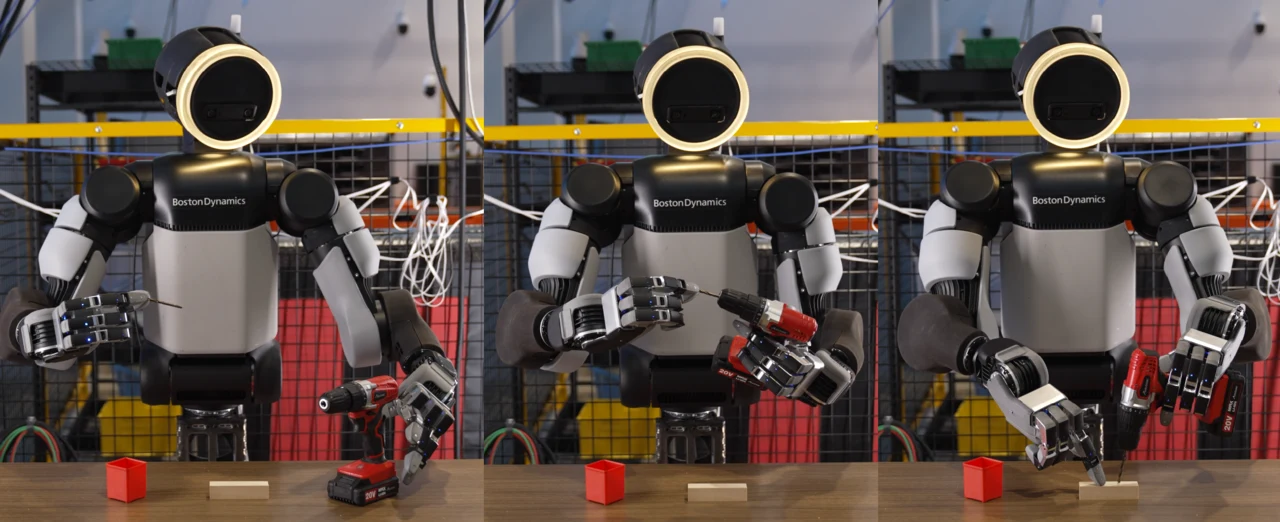
Boston Dynamics showed off a four-fingered hand for its Atlas humanoid robot. It has 13 degrees of freedom and tactile sensors - the robot can work with tools and manipulate small objects.
According to The Korea Herald, the hardware was not designed to copy the human hand, but for continuous and complex tasks in production.
How the hand works
The thumb has four degrees of freedom, and each of the other three has three. Tactile sensors on the fingertips and palm respond to the force of contact.
This allows Atlas to change finger position and grip strength to suit different shapes, materials and contact conditions.
What a robot can do on camera
In the video posted by Boston Dynamics, Atlas inserted a drill bit into a drill, pulled the trigger, and drilled a hole into the wood. The robot also tightened a small nut, rotating it between its fingers, spun a thin drumstick, and twirled two golf balls in one hand.
The scene shows a good range of skills: preparing the tool, working the trigger, spinning with your fingertips and controlling several loose objects.
True, it does not answer the question of how consistently the hand will repeat all this in long factory cycles. There, wear, contamination and inaccurate supply of parts are added - the tasks are much more difficult.
Why exactly four fingers?
Boston Dynamics says it considered design complexity, power consumption, cost, durability and maintenance when selecting the four-finger design. The hand, roughly the size of a human, is assembled from modular components, and the structure is simplified to make repairs more practical.
“We tested different options, including the number of thumbs and the need for a little finger, through experiments, simulations and 3D printed mockups.”
Alberto Rodriguez, head of Atlas behavior manipulation technologies at Boston Dynamics
Simulation and factory training
The company also applied the Sim-to-Real process: first, manipulation skills were trained in a virtual environment, and then transferred to physical hardware. The simulations simulated hardware properties and friction by varying motor torque, object geometry, and external noise during reinforcement learning.
Boston Dynamics recently opened the Robotics Metaplant Application Center, which recreates the production conditions of the Hyundai Motor Group. The center should collect data on Atlas performance and maintain the cycle: training, field application, feedback, retraining.
Repeated tests will show whether the new hand will maintain the stated accuracy under factory conditions.