British startup demonstrates humanoid robot Destiny for industrial tasks
English translation from Unibot. Source published 2026-04-22.
A small UK robotics company is promoting a humanoid robot platform aimed at industrial and service applications. With this project, it reflects the broader momentum surrounding the commercialization of robotics in human form.
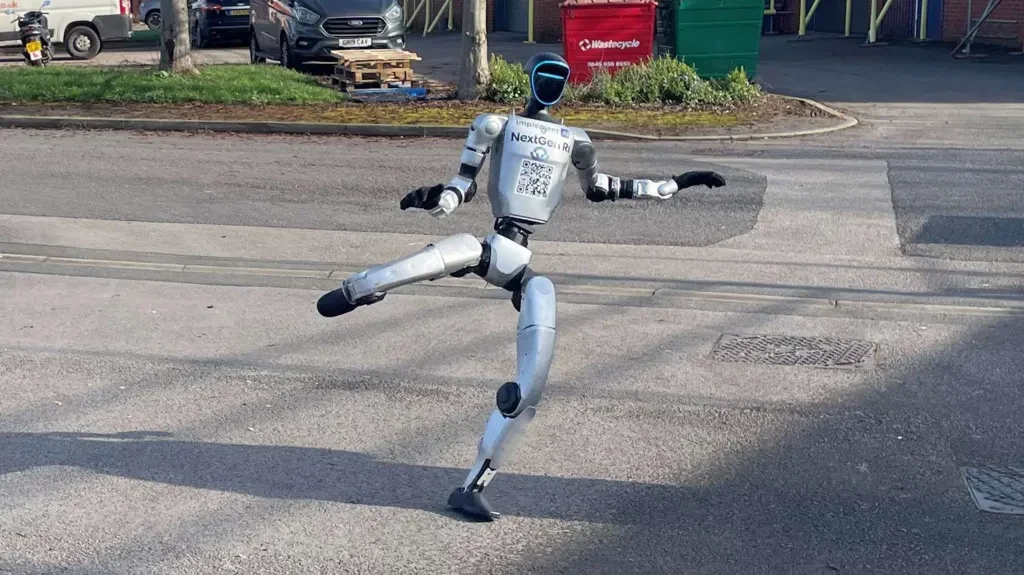
NextGen Ri is developing a robot called Destiny near the former Cotgrave coal mine in Nottinghamshire. Previously associated with coal mining, the site is now working on articulated humanoid systems designed for environments traditionally reserved for industrial robotics working alongside humans. According to Nathan Wallace, head of NextGen Ri's robotics department, the system should become a universal platform capable of performing tasks previously performed by humans. He described the robot as an embodied artificial intelligence system: it can speak, react to what is happening and physically influence the environment.
The current prototype demonstrates mobility and coordination during activities such as running, dancing and performing martial arts-style sequences. These demonstrations are not directly tied to specific work scenarios, but do highlight progress in balance, motor control, and whole-body coordination—critical for working in unstructured environments.
Wallace said the learning approach relies on reinforcement learning techniques: the robot improves efficiency through reward and penalty signals. For example, maintaining stability is stimulated, and loss of balance, on the contrary, is suppressed. This approach is becoming increasingly common in humanoid robotics, where adaptability to a variety of tasks is required.
NextGen Ri partners with hardware platforms manufactured in China and focuses on customization and integration for commercial use cases. Initial interest has come from companies exploring autonomous storage facilities: a humanoid could interact with customers while simultaneously operating physical infrastructure, such as storage lockers.
Potential applications may include hazardous environments. Wallace mentioned, in particular, the decommissioning of nuclear facilities and remote disposal of explosive devices. In such cases, the operator can control the humanoid remotely through virtual reality interfaces. These scenarios are consistent with industry efforts to deploy humanoids first in high-risk or labor-intensive environments and then expand their role to a broader range of service tasks.
The development fits into a more general trend. Humanoid robots are already being tested in warehouses, distribution centers and auto manufacturing plants in regions such as the United States and South Korea. Their use in health and social care is also being highlighted by research institutions including the University of Nottingham, especially as the population ages.
Policy issues and labor market impacts remain key. Unions warn that automation could displace workers or degrade the quality of employment if it is not managed properly. Proponents say humanoid systems could help close labor shortages and improve productivity while creating new roles in robot maintenance, programming and operation.
A UK government brief on humanoid robotics highlights both the potential and uncertainty surrounding the technology. Promising scenarios are highlighted in a variety of industries, including construction, education and emergency response. It identifies challenges related to security, cost-effectiveness, privacy and public acceptance.
The public's reaction to Destiny reflects this duality. The demonstrations have generated both enthusiasm and skepticism, highlighting the gap between technical capacity and public readiness. Despite lingering concerns about autonomy and control, developers stress that current systems operate within limits and can be designed to fail safely—including stopping if communication is disrupted.
As platforms like Destiny move from demos to implementation, the focus shifts from novelty effect to measurable practical benefit. For developers and operators, the key issues revolve around reliability, integration into existing workflows and total cost of ownership in real-world applications."