Clone Robotics Reveals Design Details for Protoclone V1 Humanoid
English translation from Unibot. Source published 2026-06-12.
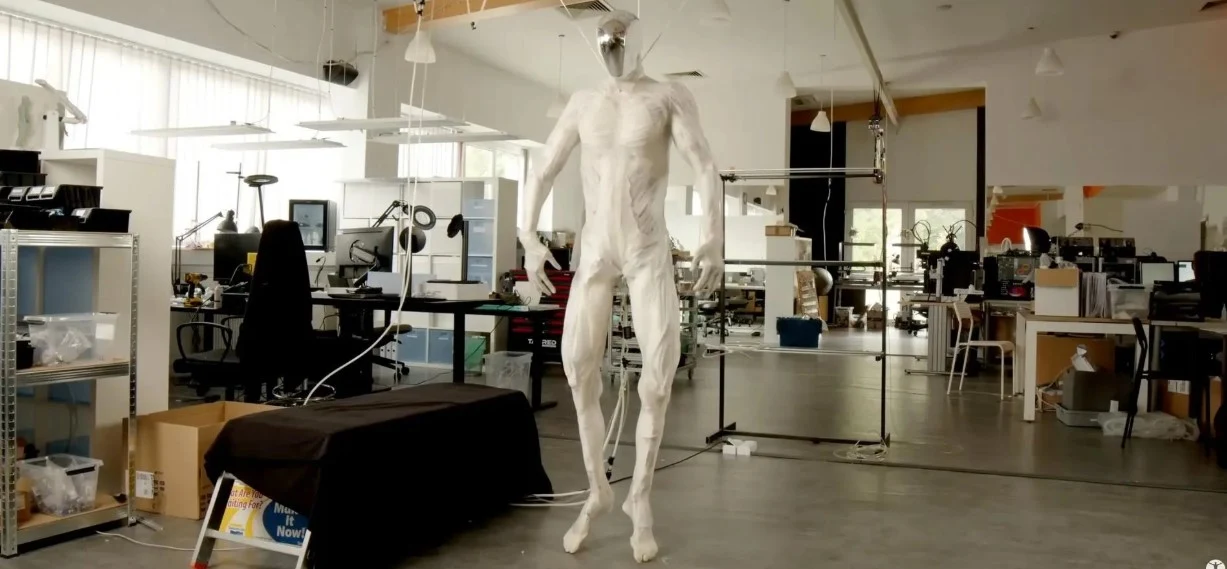
Clone Robotics has revealed details about its Protoclone V1 humanoid, which is built on biomimetic architecture rather than traditional rotating joints and metal limbs. The Warsaw-based startup uses a polymer skeleton, structural cables and synthetic muscle-tendon blocks.
Biomimetic approach instead of traditional design
Protoclone V1 is a full-size polymer chassis that replicates all 206 bones of the human body. The drive system uses more than 1000 myofibrils - synthetic muscle-tendon blocks weighing 3 grams each. They react faster than 50 milliseconds and develop a force of up to 1 kilogram.
The sensing layer includes 500 built-in sensors that monitor joint position, local torque, muscle length and structural load. The data is sent to NVIDIA Jetson chips.
The current prototype runs on pneumatics - compressed air. The Clone roadmap calls for moving to a closed-loop hydraulic system with a 500-watt water pump. The company believes fluid drive will provide greater force and finer tuning for overlapping muscle groups.
“We don’t collect tools. We are collecting bodies." - Dhanush Radhakrishnan, Founder, Clone Robotics
The path from a brush to a full-fledged body
Clone Robotics was founded in 2021 by Dhanush Radhakrishnan and CTO Lukasz Kozlik. The startup started with $500,000 in angel investment and then raised more than $7.1 million. Investors include Y Combinator co-founder Trevor Blackwell.
The development sequence is important for practitioners: Clone started with one of the most complex mechanical subsystems in humanoid robotics - the hand. The team spent 18 months replicating the coordination of 27 bones and dozens of tendons before assembling a durable robotic arm with artificial ligaments. It took another year to scale the architecture to a full-fledged building.
This approach is in stark contrast to most industrial humanoid programs, which typically optimize robust electromechanical joints, maintainability, and task repeatability. Clone is betting on the opposite: that copying biology can simplify mechanical design and improve the quality of movement in human-made environments.
Software as the main challenge
The first commercial version, Clone Alpha, enters limited production. The company's roadmap is aimed at a consumer version for the home, but the first deployments will be in industry, hospitality and nursing homes - before the robots appear in private residences.
The main engineering hurdle now is software control as physical hardware stabilizes. Clone builds simulators to simulate the interaction of synthetic tissues during biological movement, and then uses a digital twin to practice scenarios before transferring skills to a physical robot.
The control stack is described as a fundamental model trained on human motion recordings, egocentric video, and live teleoperation rather than rigid preprogrammed commands. An open technical question is whether the Protoclone V1 humanoid will be able to translate its anatomical precision into reliable locomotion and manipulation outside of controlled demonstrations.