Compact cobots: how they improve the performance of autonomous mobile robots
English translation from Unibot. Source published 2026-06-30.
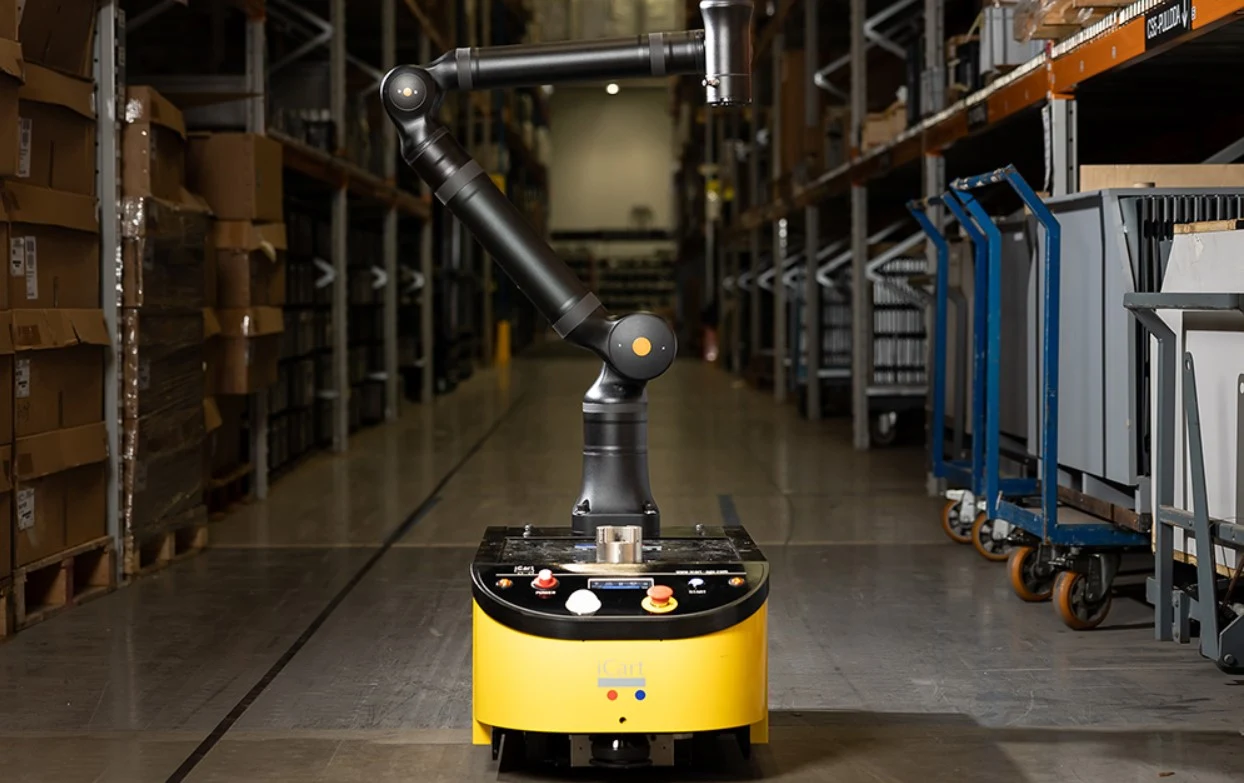
Kassow claims its cobots reach hard-to-reach places, lift heavier objects, and perform complex tasks with precision.
Automation of warehouse operations - selection and stacking of goods, palletizing and machine maintenance - has brought along new technologies. Robotics and automation are revolutionizing warehouse operations, with productivity rising and labor in short supply.
Now employees work side by side with autonomous mobile robots (AMR) and collaborative robots - cobots built into mobile manipulators. Cobots are rapidly changing the face of warehouse logistics, with their use increasing tenfold from 2018 to 2025.
Advantages of seven-axis cobots
Seven-axis models with limited strength and power are gaining particular popularity. They can be mounted on the AMR, allowing greater freedom of movement and access to hard-to-reach areas. Cobots improve precision in manufacturing by taking over monotonous tasks such as picking parts, assembling, screwing, marking and welding - and at the same time helping to solve the problem of staff shortages.
By placing such a robot on a mobile platform, its benefits extend throughout the warehouse: workflows become more accurate and the flow of operations becomes smoother. This reduces the number of fixed robotic stations and reduces manual and repetitive tasks for humans. For example, a mobile manipulator easily loads and unloads materials or transports carts between stations. Cobots are designed for flexibility and precision.
Kassow robots feature a built-in back drive for easy positioning and programming.
In some industries, conventional cobots are replaced by seven-axis manipulators with AMRs - this improves the range of motion and makes more efficient use of the workspace. Such robots develop sufficient force, easily penetrate and go around obstacles, and also work close to their own base - something that is inaccessible to six-axis arms. This flexibility allows the system to perform more tasks with high precision and in a variety of positions.
New generation of controllers
Previously, the main problem with mobile cobots was the controller. For stationary models it is bulky and is located in a separate closet nearby. But in the new generation of cobots that are installed on AMR, the controller is built directly into the base of the manipulator - the cabinet is no longer needed.
Moreover, such cobots are powered directly by AMR batteries. This makes the structure more compact, improves its functionality and reduces the space required in the warehouse.
Consider infrastructure and personnel
Factory workers have been taught for years strict safety rules when working around large industrial robots. With compact mobile solutions, everything is different: here, on the contrary, interaction and collaboration are encouraged. The reason is simple: unlike industrial robots, speed is not the main thing here.
This makes everyday contact with technology safer and easier - built-in cobots and AMR require fewer precautions. True, work cells, parts and processes still need to be assessed for safety.
As AMRs move through the warehouse, employees must remember that robots have priority at intersections. This way they get to the right points without interference. Today, physical barriers in infrastructure are no longer as critical as they were in the days of the first automated vehicle vehicles (AGVs).
Those AGVs required more driving aids - such as lane changes. Magnetic or lead tape dictated the route, and later safety sensors were added to detect people and obstacles. AMRs do not require physical guides; they are guided using built-in lidar. This autonomous mobility paired with a flexible seven-axis cobot makes moving cargo much more efficient. Recent examples of mobile manipulators include Brightpick's Autopicker, Mantis Robotics' new system, and Locus Array.
Implementation of cobots on AMR
Kassow cobots have a compact base for working in tight spaces.
Warehouse automation has been gaining momentum for several years now, despite skepticism about the prices, integration and payback of robots. However, cobots paired with autonomous mobile robots (AMRs) are a cost-effective solution for routine manual tasks. They free up employee time for more complex tasks, which is especially important given the shortage of personnel in warehouses.
Working alongside robots has been shown to increase job satisfaction, reducing physical strain and reducing the risk of injury. This, in turn, helps reduce staff turnover. In one of the studies, the International Federation of Robotics (IFR) noted: robotization can increase the competitiveness of a warehouse by improving quality. Another report from Exotec found that 98% of workers consider automation a factor in their productivity.
Coordinated work requires a delicate balance between people and new technologies - mobile manipulators and humanoid robots. As leaders evaluate future investments in automation, they should look at how seven-axis cobot-AMR combinations can improve their operations while maintaining a skilled workforce.
While repetitive tasks and productivity remain the main focus in warehouses, integrating cobots into AMR can both increase productivity and preserve worker health.