Drone uses touch to perch on branches like a bird
English translation from Unibot. Source published 2026-09-01.
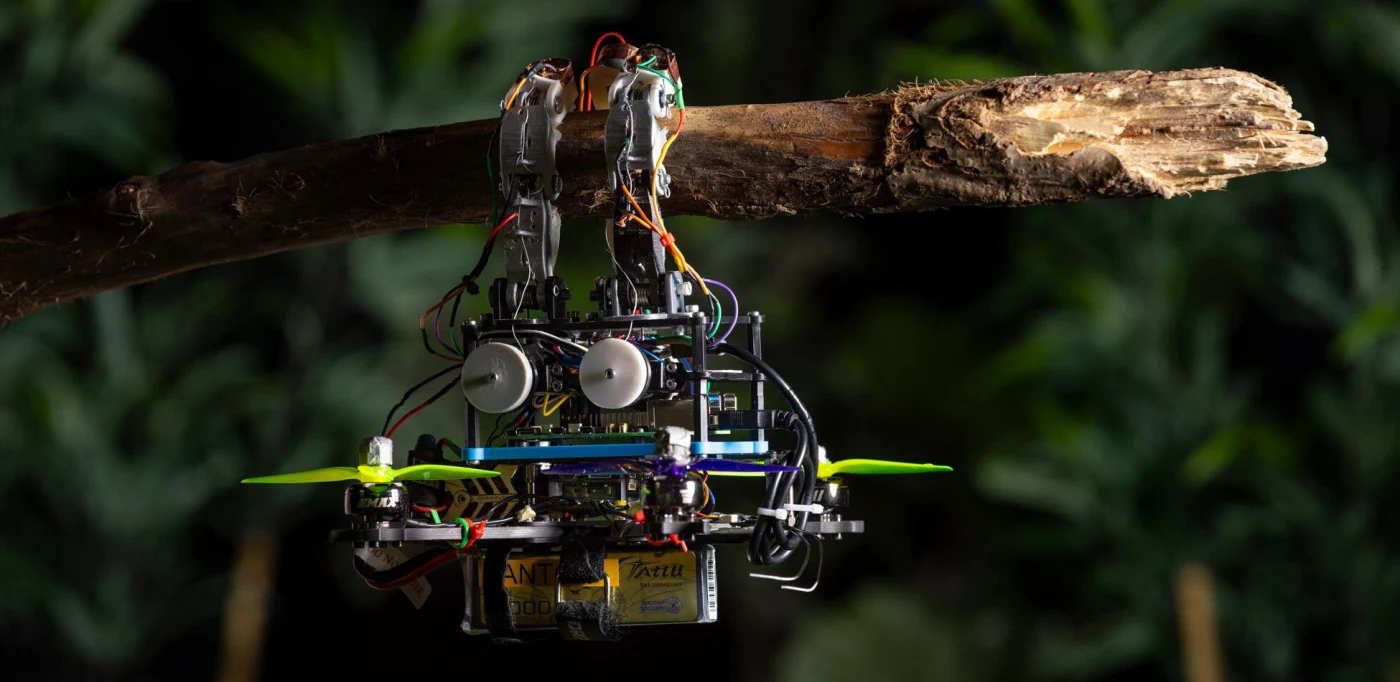
A grappler drone hanging on a branch. Photo: TU Delft - Studio Oostrum
Drones usually hover in the air, making noise and buzzing. They already know how to do a lot, but not when silence is needed. And the battery would last longer if they could “take a break” from time to time.
But when the drone is monitoring a rainforest, its gripper and dense foliage become too challenging for the camera. This has been the case until now.
Researchers from TU Delft in the Netherlands have created a drone that behaves more like a bird: it probes a branch before landing. Soft tactile sensors built into the humanoid hand detect contact with the branch, determine its position and orientation, after which the device is aligned and securely grasped. You can turn off the engines and rest.
The work was published in the journal npj Robotics. It proposes a new approach to autonomous landing, where the sense of touch becomes a source of information for action.
This haptic-grip drone probes a branch. Having found it, it quietly grips the branch and turns off the engines to conserve charge.
Search, Touch, Align, Grab
Previously, drones relied primarily on vision. They need a clear view or an accurate model of the branch before perching. But when approaching the target, such devices become “blind”: the grip and branches block the view. Essentially, all previous research relying on vision in the real world is useless.
This haptic drone starts with a rough estimate of where the target might be and refines it through touch. It flies in a figure-eight trajectory, opening and closing its three-fingered hand.
The first touch of the fingers reveals the position and inclination of the branch. The drone rotates until the sensors on all three fingers confirm stable contact, and only then turns off the motors. If the capture fails, the device retreats to a safe hover and tries again.
Reach without seeing
Nature suggested the idea. In the last moments of landing, birds rely on touch: they feel the branch with their paws and adjust their grip on the fly. Associate Professor Salua Hamaza decided to give this ability to flying robots.
A new drone with haptic grip hangs on the arm of TU Delft researcher Anton Bredenbeck. Photo: TU Delft - Studio Oostrum
“Vision tells you where the object is until the most important moment, and then your grip blocks the view. Animals don't have this problem because they complete the loop through touch. This is exactly what we wanted to give the drone: the ability to penetrate into a space it can’t see, sense what’s there, and correct itself once in contact,” says Associate Professor Hamaza.
The result is a lightweight anthropomorphic hand designed for flight. It has three fingers, each with three phalanges, proportions copied from the human hand.
The torsion springs themselves close the fingers, so the drone stays in perched mode without wasting energy. One tendon cable per finger opens the hand, and soft silicone pads provide friction and allow the hand to adapt to different surfaces and textures.
Nine sensors for the entire hand
On each phalanx there is a tactile sensor: a small copper electrode under silicone. When touched, the electrical signal changes, giving a simple "yes" or "no" response. By itself it doesn't say much.
But since the drone knows the shape and position of its fingers, it calculates the exact location of the contact. A simple signal turns into a point in space and a direction of movement.
A close-up of the new drone's tactile sensors. Photo: TU Delft - Studio Oostrum
“Each sensor only says, ‘There’s something here.’” But if you know the shape of your own hand, this is enough to reconstruct where the branch is and how it is inclined. The drone builds an increasingly accurate “picture” of the target simply by bumping into it,” explains Anton Bredenbeck from TU Delft.
Touch as an asset, not a liability
The method is reliable because the sense of touch corrects errors of perception. In field tests, the drone remained stable even when the target's position, orientation, and size were incorrectly determined. A conventional camera-based system would quickly fail under such conditions.
The work paves the way for drones that can monitor conditions for hours where vision alone fails. Forest crowns, cluttered industrial structures, rooms without motion capture systems - these are their future elements.
Take a broader look - the research changes the very approach to contact in aerial robotics. Contact is no longer a risk to be avoided. It becomes a source of data that guides action.
Just like in wildlife: future drones may be groping for a landing spot that they can’t yet see.