Eka Robotics valued at $1.45 billion thanks to physical AI model
English translation from Unibot. Source published 2026-10-21.
Robots are still bad at picking things up. And this is with billions of dollars of investment and endless videos fed to deep learning models.
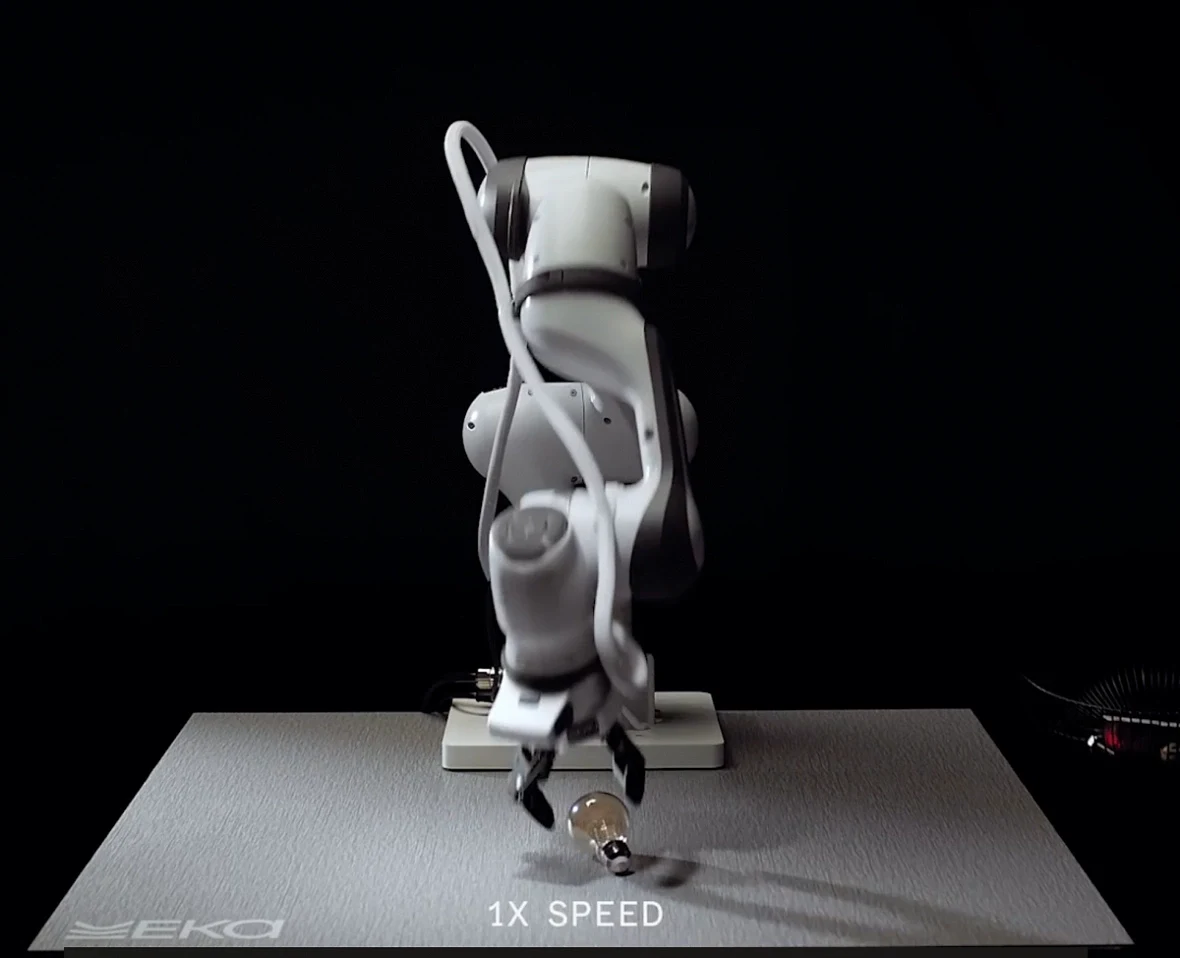
Looks like things are about to change. Eka Robotics has built a manipulation architecture: a force-sensitive gripper plus a new type of deep learning model.
The startup was founded by MIT professor Pulkit Agrawal and former Google DeepMind researcher Tuomas Haarnoja. They just closed a $150 million Series A - at a valuation of $1.45 billion post-money. Lead investors are venture funds a16z and F-Prime.
“They are already outperforming humans on some tasks, and we think within a few months they will outperform humans on many dexterous manipulation tasks,” Raghu Raghuram, general partner at a16z, who led the round with a colleague, told TechCrunch.
Wow effect for roboticists
In an era of endless robot demonstrations, Eka's capabilities will shock even seasoned roboticists.
Chris Hauser, a professor at the University of Illinois at Urbana-Champaign, says Eka has a "wow factor" compared to other recent demos. The robot "adapted to a bunch of different things without retraining," Hauser noted. And he added: there is something “human, eerie-human - he will try again and again if it doesn’t work out the first time.”
Another roboticist (who asked not to be named and works in a cutting-edge lab) told TechCrunch that looking at the Eka robot is an emotional experience. Much like five to ten years ago, when robots first learned to walk reliably on their feet. See for yourself:
Capture speed and reliability
What's so special about this? How smoothly and quickly does the robot move? In an hour, it picks about 1,500 objects weighing up to a kilogram. A person handles approximately 600. Eka claims: grip reliability is above 95 percent.
And the hand is strong enough to hurt itself at that speed. According to an observer from an advanced laboratory, this means that “they have a lot of confidence in their algorithm - it won’t break the robot. I wonder how many robots they broke along the way?”
When the same roboticist met the Eka robot, he handed it a raspberry, the lab's favorite test item.
“The feeling of a big heavy robotic hand rushing towards your hand, slowing down at the last moment and touching you very gently, I still carry that feeling in my body as we speak,” he told TechCrunch.
How to avoid crushing raspberries
Such possibilities are a consequence of how the basic model is built. This is not a vision-language-action model (it is taught to understand the relationship between language, visual input and actions). Here is the vision-force-action scheme: emphasis on the connection of language, force signals and actions.
Critics of the current trend of generative AI in robotics - such as Rodney Brooks - say that without an attempt to represent force and touch, such models will fail. Eka's results hint that the critics are right.
“Vision is not the main solution to the last millimeter problem,” Eka co-founder Agrawal told TechCrunch. - Vision tells approximately where the object is and what its pose is. And the capture itself, the search itself, occurs through forces.”
Eka had to design a unique robotic hand - more flexible than traditional grippers and with more force sensors. It responds to contact, which is why it does not crush the raspberries.
The founders do not elaborate on how exactly this was achieved: competition. But the point is a physics simulator that simulates the many forces involved in a grasping attempt. Based on it, they build a reinforcement learning environment that can be run at scale. According to them, thousands of hours of robotics experience are generated in minutes.
“Rather than being limited by data from, say, human demonstrations, Eka is pushing through a reinforcement learning approach where the robot can outperform whatever demonstrations are shown to it,” Hauser said. “The cool thing is that they are not limited by the data they are given to learn from.”
Bet on simulation
Agrawal and Haarnoja met in graduate school at the University of California, Berkeley. Both are leading researchers in the field of reinforcement learning for robot control.
Eka's main bet was that the method could be scaled through simulation, rather than relying on videos that crowdsourced workers or robot operators spend hours collecting. Simulation has become the key to reliable manipulation, a task that used to be much more difficult when one had to interact with objects rather than simply avoid them.
“Eka closes the gap between versatility and productivity, a gap that plagues all modern robotics,” says Agrawal.
How to make a universal robot useful
Right now, the most general physical AI models - those that take on many different tasks - are not particularly good at them. But models trained for one task are unlikely to justify the company’s business case. The promise of generative AI is different: the robot quickly masters several tasks, even new ones.
Current approaches are doing a good job of creating robots that are smarter than before. Astra, ChatGPT's latest language model, can control a robot in an unfamiliar environment and complete tasks - but it's slow and expensive.
The point of a model like Eka is that it handles the physics while the more general model decides how to approach the problem. Astra, for example, knows that plates are put in the cupboard after being washed. And the Eka model is able to pick up a plate without breaking it.
“Most of the industry is focused on planning,” says Eka co-founder Haarnøya. - They come from above: high-level intelligence, which is brought down to physics. But we think from the bottom up.”
Real production test
True, Eka has yet to prove itself in the field. The company is conducting closed pilots with several industrial customers - picking up and moving parts, working with wires. But the leap from laboratory to assembly line is almost as big as the gap between simulation and reality.
“The big challenge will be working with integrators on actual assembly lines, where everything has to run smoothly for a year,” says Hauser.
The second open question is: how transferrable are these methods to different tasks? I've seen grab and move, but a lot of value-added tasks in industry don't come down to that."
Agrawal is also thinking about deployment. Now, he says, the Eka gripper costs less than $1,000 and is designed to last 5 million cycles. But the goal is to reach the 20 million bar, which is set by standard industrial manipulators.
“We're engineering how to design entire workflows, but we're starting out very pragmatically,” Agrawal says. - We take two directions: capturing, sorting and placing, as well as working with wires. And we want to make them flawless. And when we do, the ceiling for our approach will be the sky.”