ETH Zurich turned the WUJI robotic hand into a mobile manipulator
English translation from Unibot. Source published 2026-10-22.
The robotic hand started moving on its own.
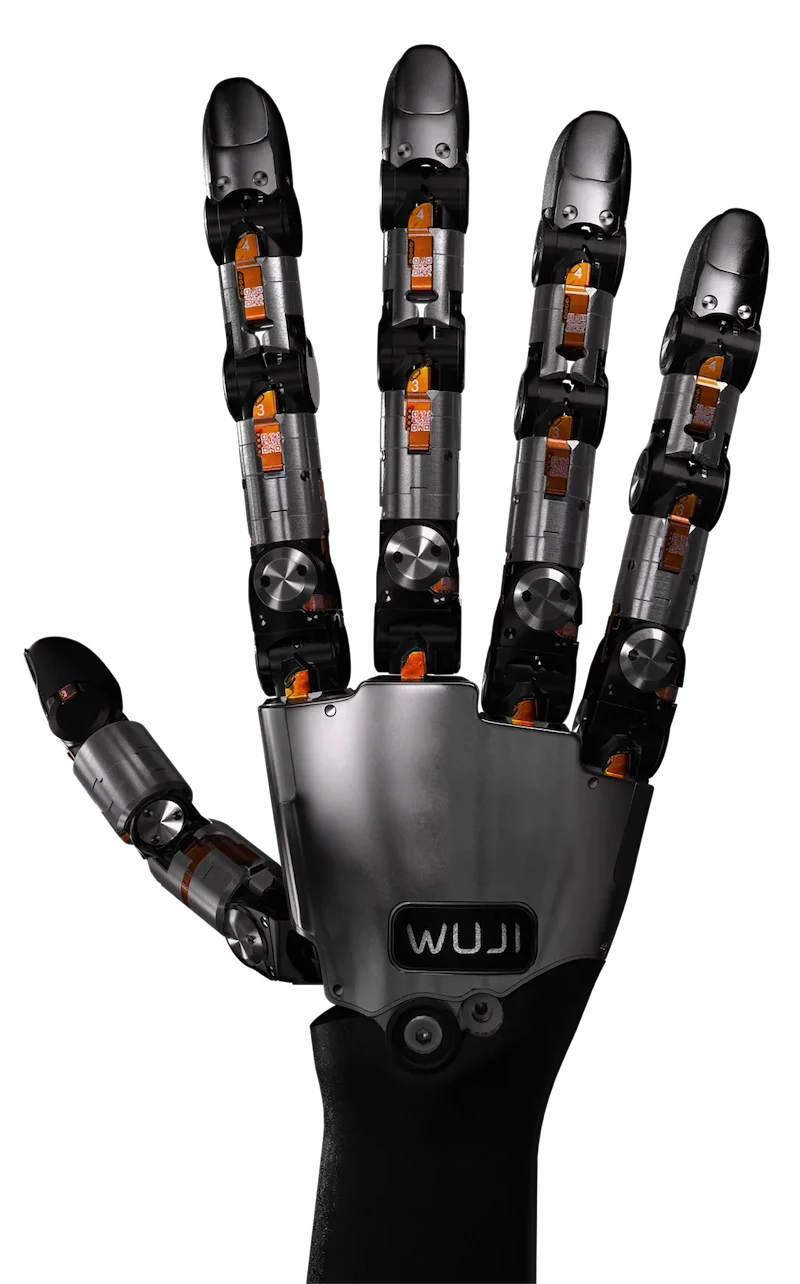
Researchers from ETH Zurich have shown that an anthropomorphic robotic hand can move with its fingers. It doesn't need a separate mobile platform. The fingers work not only for gripping, but also as legs. The hand can crawl, fall, rise and move in space.
Fingers instead of toes
The experiment is based on a ready-made model from WUJI, a developer of dexterous robotic hands and telecontrol systems. The scientists did not attach the hand to the usual manipulator or movable base. Instead, they trained it to support its own weight and walk with the same fingers that normally just grab things.
The result was a system. It can crawl without wires, steer and get up after falling. But the hand is capable of manipulating objects, even when it has to hold itself. For example, it presses keys on the keyboard one after another or pushes an object towards given targets.
The authors call their creation a “compact mobile manipulator.” A separate mechanism for movement is simply not needed. The results are presented in the article “Fingers as Legs: Learning Self-Supported Locomotion and Manipulation with an Anthropomorphic Hand,” written by Amirhossein Kazemipour, Hehui Zheng and Robert Katzschmann.
Reinforcement learning in simulation
Reinforcement learning was used to teach locomotion. The researchers took into account that fingers are different in size and properties. The training took place in simulation, and the virtual environment was calibrated using data from real hardware. According to the authors, their reward formula allowed the hand to move faster in the simulation than using customized rewards originally created for four-legged robots.
Power and a computer were built into the physical prototype. The platform works completely autonomously.
In manipulation experiments, the hand repeatedly pressed buttons on a keyboard without any vision at all. In another test, it used visual feedback from above to push an object into desired positions.
Hands as a platform for research
Isn't it strange to use the same mechanisms for both walking and physical interaction? This work highlights another trend. Commercially available dexterous hands are increasingly becoming a platform for robotics research.
WUJI is developing this direction further. Their WUJI Hand 2 and WUJI Glove are designed for real-time telecontrol and collection of motion and touch data for robot training. The company showed both systems at IROS 2026 in Pittsburgh, which ran from September 27 to October 1.
In the demo, WUJI Glove controlled a dexterous hand in real time. This way you can capture human movements and translate them into robotic actions. Such telecontrol systems are increasingly being used for more than just remote control. They work as data generators for training embodied AI and manipulation models.
By recording human actions, developers collect examples of objects being grabbed, moved, and transformed. This provides training data for systems that will perform the same tasks without human intervention in the future. WUJI is also among the hardware manufacturers that provide native support for NVIDIA Isaac Teleop, NVIDIA's framework for robotic teleoperation.
The hand that became a robot
Dexterity, telecontrol and reinforcement learning are changing the role of robotic hands. They are no longer just end effectors on manipulators. ETH Zurich's work takes this idea to the extreme. The researchers didn't give the robot a hand, but actually turned the hand itself into a robot.