Flexible robotic arms learn to predict their movements
English translation from Unibot. Source published 2026-10-24.
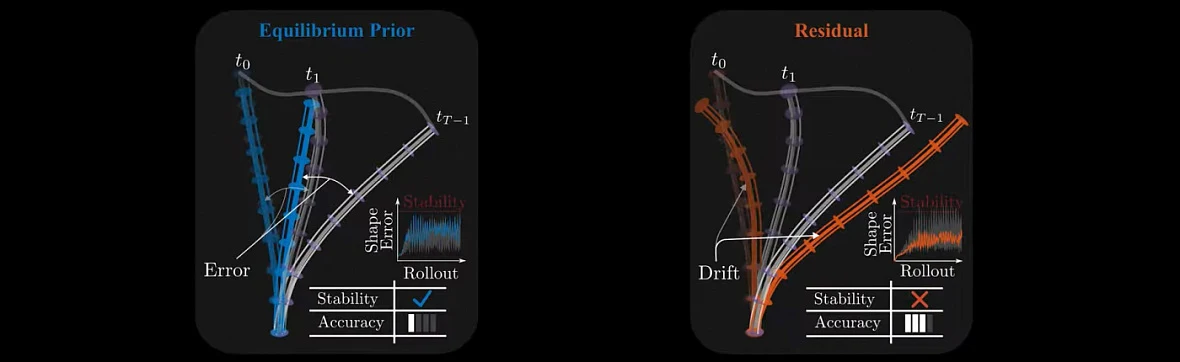
Three ways to predict where an arm will move. The blue forecast stays steady, but misses the range, the orange one goes sideways, and the green one, which connects both ideas, remains closest to the real movement (gray). Photo: Peking University
A robotic arm that bends like an elephant's trunk fits into narrow crevices and picks up fragile objects. It is more difficult to control: due to the smooth bend, it is not clear where it will go next. Now, researchers have come up with a method that keeps computer motion predictions on track - even when the arm moves faster than the model was taught.
Where did the work come from?
The work comes from a team of professors Xie Guangming and Zhang Feitian from the Department of Advanced Manufacturing and Robotics at Peking University. It was presented at the Robotics: Science and Systems (RSS 2026) conference, which took place in Sydney from 13 to 17 July 2026.
Now the article has been published in the collection Robotics: Science and Systems XXII, and details of the project are on the website.
Why predictions drift
Before a flexible robot moves, its controller often runs through possible commands in a computer model and selects the best one. Models trained on data predict one small step at a time, and each step starts from the previous one - this is how small errors accumulate.
After 200 steps, the prediction can go far, and the robot will work with a false picture of its own body.
Forecast reference point
The team's idea is to give the forecast a foothold. One model, the anchor, remembers the shape the arm takes when the control is held still. At every step, it brings the prediction closer to this form, and errors no longer grow like an avalanche.
But on the way to rest, the arm swings and bends, so the second, lightweight model - the residual - learns this dynamics from data on the movement of the arm. Together we get a hybrid model.
Simulation check
First, the idea was tested in a simulation - on a three-dimensional arm with a cable drive. It was asked to predict 6 seconds of movement, that is, 200 steps, far beyond what the model was trained on.
The hybrid reduced error by more than a quarter compared to a single anchor. It also outperformed the residual model alone and never failed in all 19 tests.
Test on a physical robot
Then it came to the actual machine: a hydraulic fish-shaped soft tail that sways from side to side when water is pumped into it. Here the error of the hybrid turned out to be half that of one anchor, and four times less than that of a single correction.
On standard benchmarks, it also completed every prediction, while the competing method sometimes failed.
The soft robotic tail swings from side to side when water is pumped into it. At both swing speeds, the green forecast from the combined method gives the smallest errors. Photo: Peking University
What does this give next?
More robust predictions give the robot controller something to trust. It can first go through many possible movements on the computer and choose the safest one - even before the real arm moves.
A robot that anticipates how its own body will bend plans the careful maneuver in advance. This can help flexible arms go where rigid machines can't reach - in tight spaces and with objects that break easily.
Ahsan Tanveer and colleagues. “Stabilizing the Deployment of 3D Continuum Manipulators Using Equilibrium Anchor and Residual Feature Learning with Feature Boosting,” Robotics: Science and Systems XXII (2026). DOI: 10.15607/rss.2026.xxii.106
Citation: Flexible robot arms learn to predict their next move (2026, October 23) retrieved 24 October 2026 from https://techxplore.com/news/2026-10-flexible-robot-arms.html