From cobots to autonomous solutions: how agentic AI is changing industrial robotics
English translation from Unibot. Source published 2026-03-26.
From factory floors to distribution centers, robots are moving from simply repeating instructions to making decisions on their own—and it is this transition that holds the biggest source of ROI for managers in the coming years.
From cobots to robot solvers
Over the past ten years, collaborative robots have been perceived as efficient, tireless assistants performing strictly programmed, repetitive tasks, while all significant decisions were left to humans. They welded seams along a given path, moved pallets along fixed routes and stopped when a sensor was triggered. This model provided an increase in efficiency, but at the same time set a ceiling for automation: any exception still required human intervention.
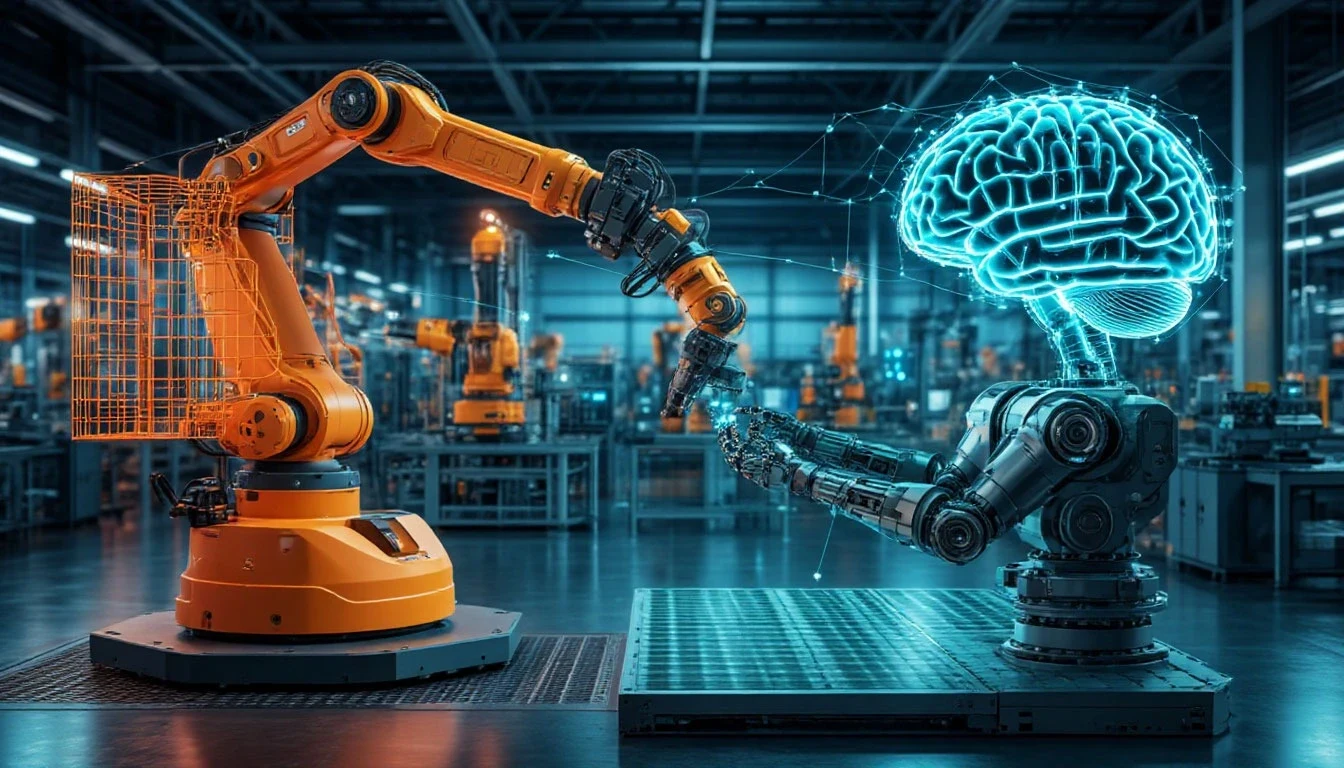
Agent-based AI is beginning to break down this barrier by giving robots limited autonomy to make their own micro-decisions. Instead of asking “What did the programmer specify?” the system asks the question “What do I see and what should happen next?” - and acts without stopping the line to wait for instructions. This is not science fiction or general artificial intelligence, but a pragmatic leap: robots are beginning to master the entire cycle of work, not just a single movement.
How robots learn from people and manuals
Two key advances are making this shift possible: video-based learning and language-based learning. In the first case, robots learn by observing the work of highly skilled operators: computer vision models transform human movements, tool use, and results into machine-understandable patterns. The robot does not simply repeat a recorded trajectory, but learns to associate specific visual and physical conditions with the correct next action.
On the language side, large language and visual language models process the same instructions and work procedures used by technicians, turning cumbersome documentation into operational playbooks. Instead of a human reading a 200-page welding or casting manual and then translating it into parameters for the robot, the AI layer can directly consume that manual and derive rules: acceptable tolerances, defect classification, escalation paths. The combination of these capabilities results in robots that rely on both the actual practice of humans and the formal requirements of the process.
Autonomous inspection cycle
The first area where the new autonomy is being introduced on an industrial scale is inspection. Inspection is data-rich, safety-critical, and historically under-automated, making it an ideal springboard for agentic behavior. In complex welding, casting and forging processes, robots are now able to:
collect high-precision visual and depth data on seams, surfaces and internal geometries;
classify defects (pores, cracks, undercuts, displacements, inclusions) according to standards established from manuals and previous decisions of people;
independently determine whether a deviation is acceptable, requires improvement, or is a defect - without the need to show each frame to a person.
The key difference between modern systems: they can close the loop by autonomously generating and sending repair tasks. If a weld on an aircraft fuselage is out of tolerance, the robot doesn't just turn on a red light - it records the type of defect, its location, severity and recommended remedy, and then creates a digital work order for the appropriate technician or the next robotic area. This transforms inspection from a passive filter into an active rework coordinator, shortening cycles and making quality data immediately actionable.
For manufacturers and logisticians, this cycle provides measurable results: increased first-time yield, reduced rework effort, better traceability, and more stable schedules due to fewer problems being discovered at later stages. Managers should look not at the number of robots, but at the number of closed loops transferred to autonomous systems.
What AI can’t do yet (and why humans remain in the loop)
Even with the increase in inspection autonomy, robots are not yet ready to take on the most complex production decisions. In high-tech welding, human experts still synthesize subtle signals—a subtle change in the sound of the arc, a slight change in the color of the metal, the feeling of heat through gloves—to make real-time adjustments to technique, consumables and temperature. These decisions rely on years of tacit experience that has never been fully documented or labeled for model training.
Modern systems also struggle with truly novel scenarios: one-off repairs to unique objects, improvising with tooling, or interpreting incomplete documentation. When operators quickly adapt to a slightly misshapen casting or a non-standard connection, they mix formal rules with intuition about risk, cost and consequences—something that today's models only imitate. Therefore, in the short term, the balance is obvious: robots will increasingly make decisions within clearly defined domains, and people will determine the boundaries of these domains, handle exceptional cases and improve playbooks.
Managers should avoid two extremes: euphoria from the imminent displacement of qualified personnel by robots, and skepticism in the spirit of “they will never do the same as our people.” A more realistic path is a gradual transfer of authority: first, inspection autonomy, then standardized revision procedures, and only then complex operations as multimodal data on the work of experts accumulates.
How Leaders Can Benefit from Thinking Robots
To capitalize on the potential of agentic robots, leaders should view this shift not as a fleet upgrade, but as a transformation of information flows and decision-making rights. Three priorities come to the fore:
Create a strong digital foundation. Agent-based systems require constant access to 3D models, historical quality data, manuals and work instructions; Scattered or isolated data will be the main inhibitor of autonomy, not sensor performance.
Treat expertise as a strategic asset. Systematically capture the decisions of the best welders and inspectors in the form of video and data - this will give future models a rich learning environment instead of relying on outdated documentation.
Review roles and KPIs. As robots take over more closed loops, human work shifts to supervision, exception handling, and continuous improvement; metrics should consider variance reduction, recovery speed, and quality consistency, not just throughput.
A simple thought experiment for a plant manager illustrates the possibility: Imagine any repetitive task with a minimal element of judgment, where your best people say, “I know the answer when I see it.” These are ideal candidates for agent inspection and sorting. Start there, prove that the robot can handle the entire loop from observation to action, and then expand the scope of responsibility as technology develops and your data matures.
Leaders who act early will not just own more robots; they will control more of the decision fabric of their operations. In an era where sustainability, quality and speed are becoming strategic advantages, the shift from “repeat instructions” to “decide what needs to happen next” may be the most significant automation upgrade of the next decade.