From spectacle to scale
English translation from Unibot. Source published 2026-06-04.
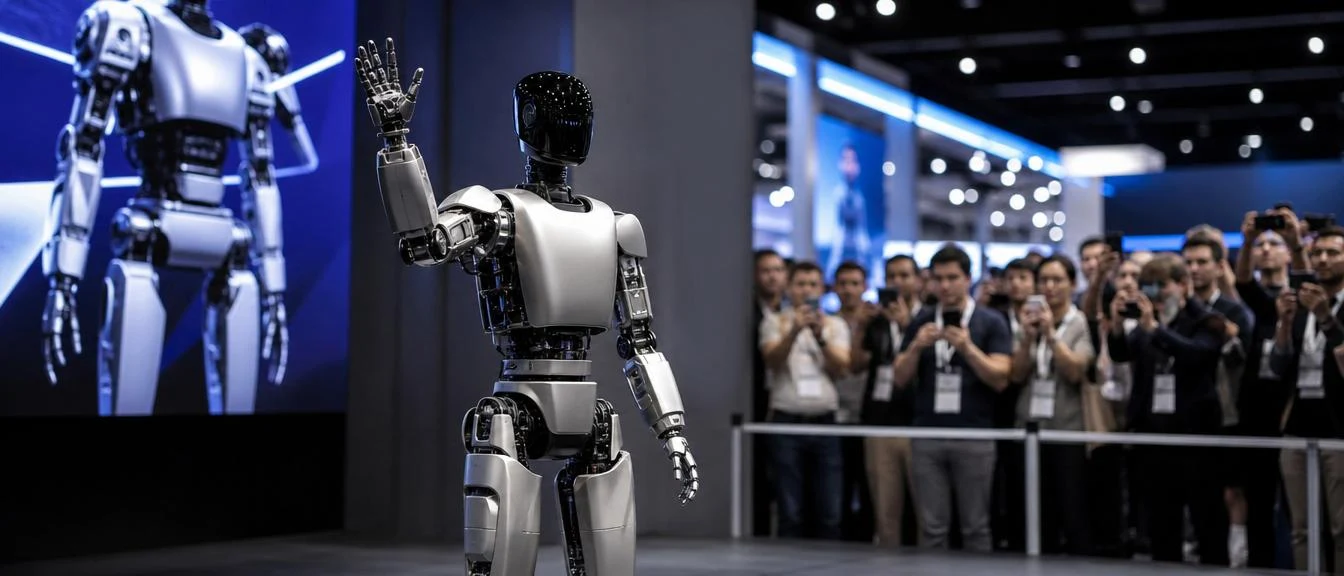
Humanoid robots have moved from screens to real-life demonstrations and shows, but the industry has accepted that demonstrations work while the path to large-scale, profitable production remains unclear.
Market and forecasts
The humanoid robots segment today is valued at approximately $2–3 billion, which is a small amount by industrial automation standards.
Analysts predict significant growth: the market could reach tens of billions by 2035, and up to $5 trillion by 2050 when services and supply chains are included. The forecast graph is shown on a logarithmic scale, where each division corresponds to a tenfold increase.
Investments and startups
Capital is flowing in faster than revenue is being generated: annual investment has grown from $700 million in 2018 to more than $4 billion last year—an almost sixfold increase in seven years.
Startups like FigureAI received enough venture funding to reach billion-dollar valuations even before unit economics were confirmed. The bet is on the expected future value of the technology rather than on current sales.
Application and rupture
The first real use of humanoids is obvious - production. However, the gap between the current fleet of worker robots and well-functioning factory automation remains large.
Technical challenges
The problem is not in the body
Google and DeepMind cite humanoid robotics as a key area. The company is collaborating with Boston Dynamics on the recently commercialized Atlas and bringing the Gemini Robotics architecture into the physical world.
DeepMind's Caroline articulates the key difference: the advantage is the ability to understand the nuances and complexity of the human world. Many impressive demonstrations are still based on predefined sequences rather than real-time intelligence.
The goal is robots with fine dexterity: folding origami, packing a lunch box, tying shoelaces, combining precise manipulation, full-body control and high levels of reasoning. As hardware and AI progress, hard-coded behaviors will give way to situational thinking in machines.
Breakthroughs and shifts
Four key shifts have underpinned the industry's development:
Robots have learned to understand natural language.
A new type of basic model has emerged, moving robotics into a data-driven era.
Robots began to imitate people and operate in unstructured spaces.
Subtle manipulation was combined with whole-body control and situational intelligence.
Common sense and safety
By placing machines in a space designed for people, the issue of safety becomes multi-layered.
The robot must cope with changes in its own physics, such as systems failure.
It is necessary to ensure stability and predictability of movement.
You need common sense - the ability to avoid puddles and not place objects close to the edge, which is only possible with intelligence.
From locomotion to manipulation
Honda, one of the early adopters, shifted its focus from locomotion to more complex forms of movement around 2013 and is now focusing on manipulation and multi-fingered hands.
Locomotion studies were once performed on low-power GPUs, but today significant computing resources have expanded our understanding of the possibilities of movement. According to the chief engineer, it is manipulation that brings real value to the customer, and the transition is not yet complete.
His assessment of the industry is free of hype: Chinese companies are strong in precision hardware, and the way forward is combining that hardware with better AI.
Scale and cyber risks
China and adoption
China already produces most humanoids at prices below Western competitors. The appetite for adoption is also high: a Mitsubishi survey found that 60% of Chinese consumers are willing to allow a humanoid to assist with everyday tasks.
Japan and the United States are noticeably inferior in terms of readiness - the cultural gap may determine where the technology takes root first.
A new dimension of safety has emerged: unlike industrial robots contained in “cages,” humanoids can be controlled remotely. Hacking a single device can become a critical problem, and there are no formal standards for security and cyber protection yet.
Business and profit
Some companies are already making a profit, but most are still losing money. Bloomberg Intelligence views humanoids as potentially the next big technology platform, but the industry is just beginning to figure out what will pay off and when.
You can expect easy entry into the market and the appearance of machines of different functionality: some for industrial work, others for household tasks, with different price levels.
The winner will be the one who can match the right business strategy with the right type of humanoid; According to analysts, the platform's defining breakthrough has not yet arrived.
For now, the gap between hype and reality remains wide. But even partial implementation of the forecasts will transform humanoids from niche devices into a significant force in the economy - the demonstrations are completed, the decade of implementation has begun.