Georgia Tech robot conquers rough terrain with accelerated learning
English translation from Unibot. Source published 2026-07-19.
Researchers at Georgia Tech tested a machine learning controller that enabled a full-size humanoid robot to walk on sand, gravel, wet grass, slopes, stairs and slippery surfaces indoors. The secret is in the accelerated recipe for reinforcement learning, writes Interesting Engineering.
The work was presented at the IEEE International Conference on Robotics and Automation. It is based on a framework called Learn to Teach.
How Learn to Teach works
Usually, the teacher model is trained first, and then the student model is trained with her help. The Georgia Tech project does both at the same time.
In the classic reinforcement learning design that the authors describe, the teacher has access to detailed simulation data. He trains first and then transfers his policy to the student who controls the real robot.
Lead researcher Feiyang Wu says the sequence takes too long and the teacher's useful data remains underutilized.
“You don't have to wait for a teacher to become an expert before he can teach a student,” Feiyang Wu, lead researcher.
In Learn to Teach, the teacher begins to impart knowledge as he or she learns. The team also allowed the teacher to learn from the student's experiences. This is done to close the imitation gap - it occurs when the student is exposed to conditions outside the teacher's idealized simulation.
Efficiency issues
The source does not provide training time, number of GPUs, or quantification of cost savings. So the computational efficiency claim remains more of a direction than a proven metric.
But the point is clear: Researchers are trying to reduce the sequential overhead of transferring walking skills from simulation to reality while maintaining stability in unfamiliar terrain.
Tests on a real robot
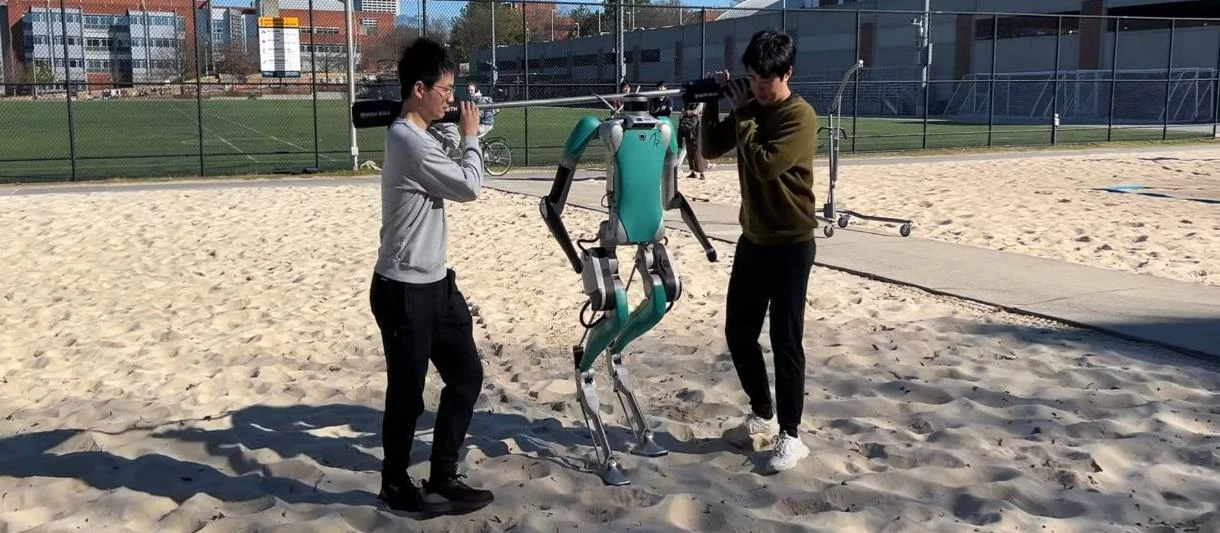
The controller was tested in the laboratory of Associate Professor Ye Zhao on a full-size humanoid robot. The article doesn't name the model or manufacturer, but says the platform is bulky and very tall.
During tests, the same controller handled uneven outdoor terrain and slippery indoor floors - without separate settings for each environment. The team also pushed and pulled the robot, and it changed its gait to maintain its balance.
Zhao said the controller outperformed the software supplied by the robot's manufacturer. The comparison is useful if replicated under controlled conditions. True, the source does not describe either the factory controller, or the test report, or the metrics used for the comparison.
Prospects of the method
The researchers believe that Learn to Teach could be adapted not only for walking humanoids, but also for other robots and tasks that require reliable movement in unpredictable environments.