GigaAI SeeLight S1 begins home pilot testing in Wuhan (China)
English translation from Unibot. Source published 2026-05-29.
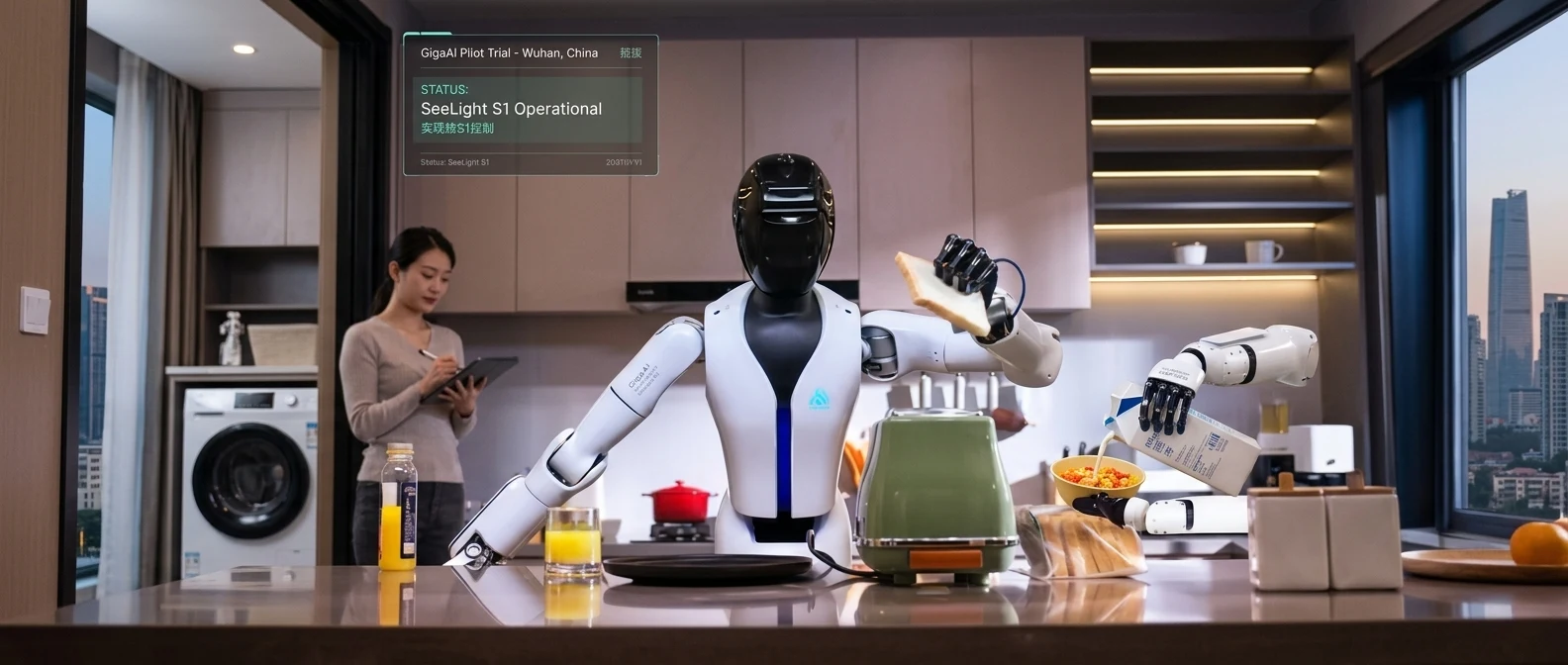
GigaAI is launching a home pilot program with the SeeLight S1 robot in China, with the first 100 units deployed in employee homes later this month, followed by a free rollout in Wuhan planned for the first half of 2027.
Pilot and deployment
The rollout will begin with internal testing, with the first 100 pilot units going into employees' homes, creating a controlled but real-life environment for the machine.
This phased strategy gives the company the ability to move smoothly from pilot to public launch and collect navigation, manipulation and safety data in a less standardized home environment.
Role in everyday life and price
The company is positioning SeeLight S1 as a commercial maid robot for doing household chores.
Fast Company notes that if the pilot and urban rollout go well, the robot could hit stores in June 2027 for about $15,000.
Technical features
Fast Company describes the SeeLight S1 as a two-arm, wheeled machine aimed at general household work.
In demos, the company shows the robot performing various household tasks:
chopping vegetables;
frying eggs;
loading the washing machine;
hanging laundry;
making the bed;
opening curtains.
Navigation and manipulation
These tasks are important because they combine navigation and fine manipulation, two areas that remain challenging even for advanced humanoids.
The home robot needs to navigate narrow spaces, find a variety of objects, and adjust its actions as the situation in the room changes.
Security and AI
GigaAI claims that the robot uses embodied artificial intelligence: perception and decision-making are directly related to the physical body operating in the environment.
The company also says the built-in sensors are designed to immediately stop movement if it comes into contact with a child or pet—a basic safety measure for a system designed to operate in inhabited homes.
Problems and expert assessments
The article highlights the gap between staged demonstrations and reliable use in the home: the home environment is not standardized, and the robot will have to cope with clutter, moving people and changing locations of objects.
Fast Company cites outside experts who remain cautious: Skepticism has less to do with the ability to perform a single task and more to do with whether the robot can repeat the actions consistently, safely and with sufficient autonomy outside of controlled testing.
Context and meaning
GigaAI was founded in 2025 and is funded by Huawei's investment arm, according to Fast Company. The project was developed jointly with the Hubei Humanoid Robot Innovation Center and the Hubei Humanoid Robotics Industry Alliance, placing it within broader government initiatives on embodied intelligence in China.
This context is important for operators and investors who are keeping an eye on where humanoids might find the first commercial niches. The home-centric pilot sets a different benchmark—one that evaluates adaptability, safety, and the ability to replace human labor in a variety of everyday scenarios.
Trials in employees' homes will be an early test of whether demonstrations of everyday tasks can translate into repeatable work in real living spaces. If the Wuhan rollout goes as planned, it could be a clear indicator of the proximity of domesticated humanoids to supervised use in the home and the amount of engineering refinement that is still required before large-scale deployment.