Hotel automation: what to consider before introducing service robots
English translation from Unibot. Source published 2026-07-27.
The hotel industry is going through a big shift. According to Les Roches Spark Research, 2025 marks an inflection point as the industry moves from post-pandemic recovery to long-term technological transformation. The global hospitality market has already exceeded $5 trillion and will continue to grow by 5.5–6.5% annually. And one of the main drivers of this growth is robotization.
The global hospitality robot market is showing explosive growth of $0.7 billion in 2025 to a projected $0.9 billion in 2026—a CAGR of 28.4%. And by 2030, according to Mordor Intelligence estimates, it will reach $1.84 billion.
The main global driver is personnel shortage. 67% of hotels worldwide report staff shortages. In Russia, the situation is no better - the shortage of hands has become a systemic problem in the industry. Robots come to places where people do not have enough time and energy for routine operations: delivery, cleaning, meeting guests, navigation.
But there is one nuance that 90% of developers miss - robotization begins not with the purchase, but with the project
At first glance, robotization seems to be a matter of choosing a model: look at the characteristics, compare the cost, order delivery, set up scenarios. But in a hotel facility, the robot becomes part of the hotel's operating system. And if this system is not designed for it, the robot turns into an expensive toy that just gathers dust in the corner.
According to a study of 451 hotels around the world conducted by the Hong Kong Polytechnic University, service robots have evolved from a “technological add-on” to a revenue driver. The study showed that for every 1,000 tasks performed by robots, hotel occupancy increases by 3.2%, and average monthly revenue increases by approximately 167,900 yuan ($23,785). At the same time, the 31.5% increase in room prices is due precisely to the increased satisfaction of guests from robotic services.
Another study of 357 hotels found even more impressive numbers: every 1,000 robot tasks increased RevPAR by 9.63%—that's an additional 31 yuan per room per night. Researchers call this a “double driver effect”: robots both increase demand (guests choose a technologically advanced hotel) and allow prices to rise.
But this effect is achieved only with proper integration. A robot that can't call the elevator, gets stuck on a doorstep, or loses Wi-Fi isn't generating revenue—it's creating problems.
SIX LAYERS OF HOTEL READINESS FOR ROBOTICS
A professional approach to hotel robotization requires the development of six interconnected layers. Skipping any of them risks the robot not being worth the investment.
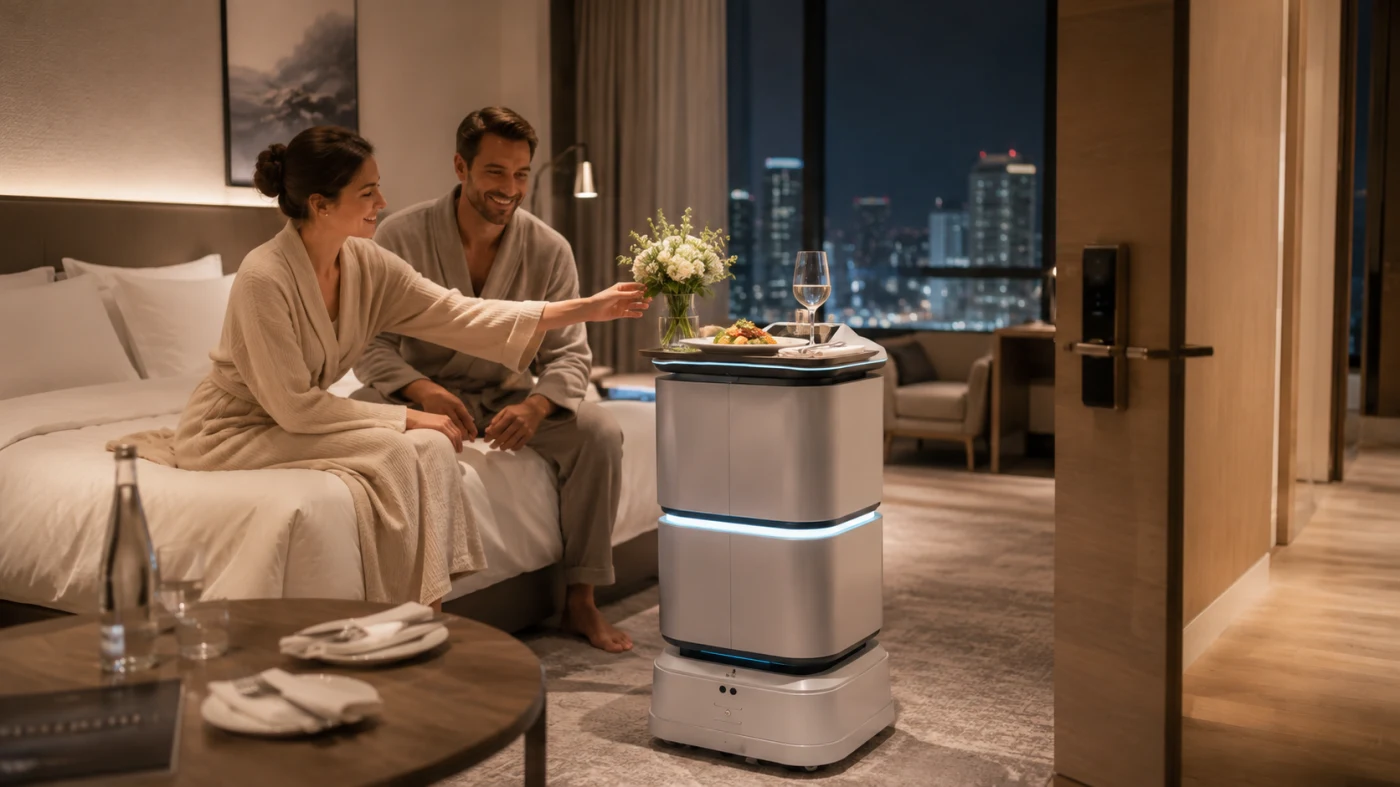
1. Guest script. The guest must understand why the robot is in the space, how to contact it, and what problem it solves. A robot concierge in the lobby helps with FAQs and navigation; a delivery robot brings the order to your room; The cleaning robot works at night without disturbing guests.
2. Operational scenario. The robot should be integrated into the work of the staff, and not compete with them. For each scenario, it is necessary to determine which part of the process the robot takes over, and where the employee must remain. A robotic cleaner can keep floors clean, but does not replace general cleaning or working with vertical surfaces.
3. Architecture. The layout must allow the robot to safely move, turn around, wait, charge, and not conflict with guest threads. Key parameters: width of passages, turning radii, absence of critical thresholds, floor coverings, furniture arrangement, elevator halls.
4. Engineering. Robots need power supply, low-current systems, stable communication, redundancy, BMS, sometimes water supply and sewerage, integration with elevators, access control systems and other building systems. The engineering requirements of robots must be taken into account not after procurement, but before the release of design and working documentation.
5. IT integration. Robots become effective only when connected to the hotel’s digital systems: PMS, CRM, BMS, access control systems, elevators, payment systems, knowledge base, analytics. Without this, they are isolated devices and not part of the ecosystem.
6. Economics. It is necessary to consider not only the cost of the equipment, but also the full CAPEX of robotization: software, integrations, charging stations, additional modules, service, personnel training, consumables, electricity and equipment service life.
Conclusions
Robotization of hotels is not a matter of purchasing equipment, but of strategic design. A robot becomes effective only in the environment that is created for it: architecture, engineering, IT integration and use cases must be worked out before choosing a model, not after.
Key principles of successful robotization:
start with scenarios (guest and operational), not with model selection;
include requirements in architecture and engineering at the project stage;
integrate robots with PMS, CRM, elevators and access control systems;
Consider the total cost of ownership, not just the price of the device.
Robotization is a competitive advantage, but only if it is designed as part of a business system, and not as an isolated gadget.
Material Creation Partner Development Systems