How AI Navigation Improves the Efficiency of Robotic Pool Vacuum Cleaners
English translation from Unibot. Source published 2026-07-01.
Pool cleaning robots used to be judged primarily on suction, brushes, and the amount of debris they collected. This is still important, but no longer defines the whole picture.
The main shift is in navigation.
Why Chaotic Movement Doesn't Work Anymore
A robot that moves erratically may clean some areas perfectly and skip others completely. It is capable of repeating the same route endlessly, getting stuck on steps or leaving a dirty waterline. This is why AI navigation is becoming a key element of productivity. It helps the machine perceive the pool as a space, and not just a container of water.
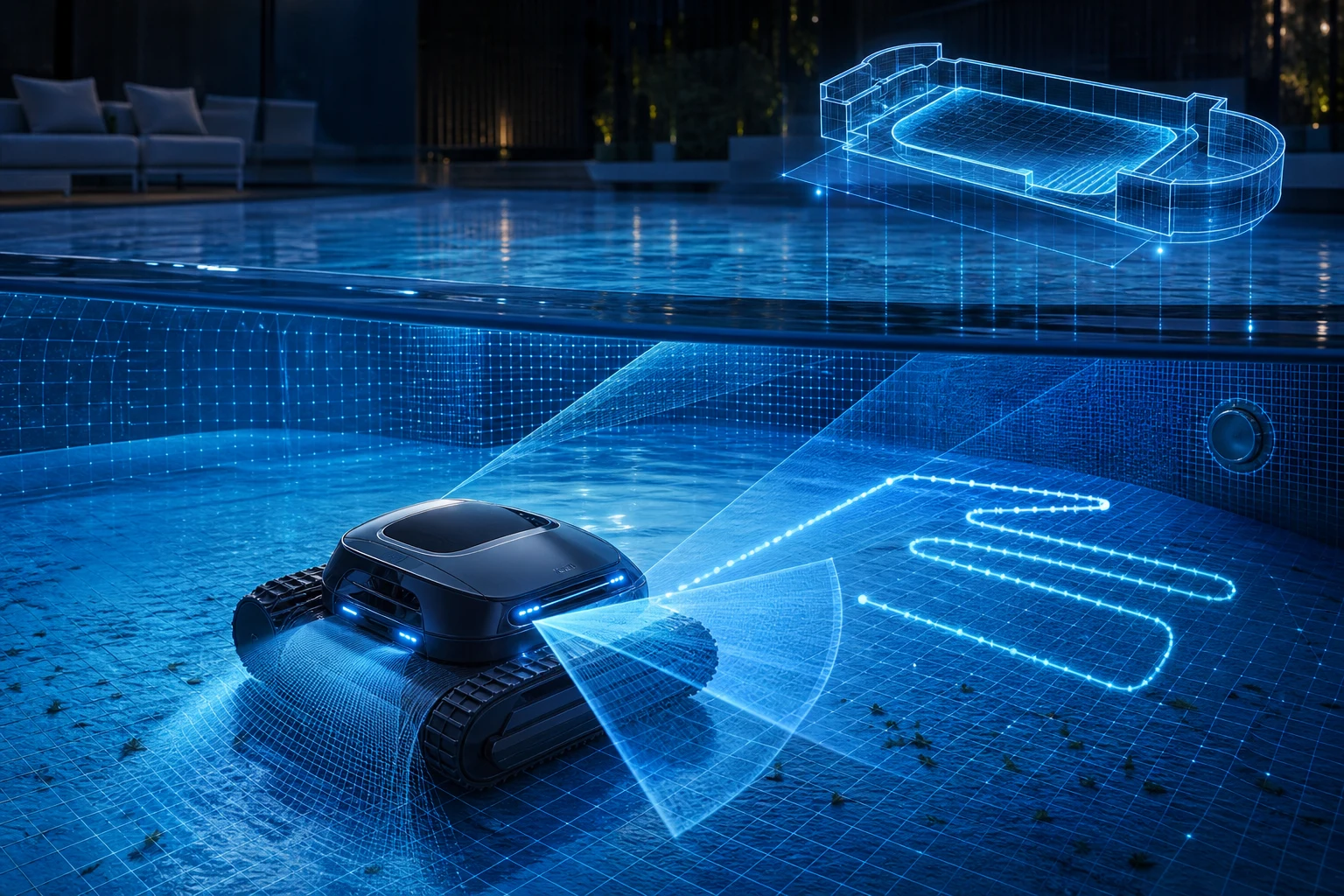
For those who follow robotics and automation, this is where the fun begins. The pool cleaner becomes a small, autonomous system that uses sensors, maps, route planning and real-time adjustments to improve coverage.
Random movement may work in a simple pool, but it is not suitable for consistent results. Swimming pools are more complex than flat indoor floors. There are slopes, and plums, and corners, and protrusions, and bends, and stairs, and waterlines, and different types of surface.
A cleaner who simply moves until he hits an obstacle risks spending too much time in one area and neglecting another. And this leads to the very problem that the owners wanted to get rid of: they have to clean it manually after the cycle.
AI navigation improves the experience by making movement meaningful. Instead of relying on luck, the robot follows a more organized cleaning logic. The result is more than just clean water. This is an efficient use of time, energy and machine resource.
Cartography: the robot learns to understand the geometry of the pool
Mapping is one of the most important breakthroughs in this category. When the robot can build or use a map of the pool's geometry, it cleans in a much more structured way.
The shape of the pool affects the cleaning logic. A rectangle requires a different approach than a kidney-shaped, free-form, or multi-level pool. Stairs, ledges, sunbathing areas and depth changes are transitions that the robot must negotiate without wasting movement.
And this is where AI navigation changes the role of a pool vacuum cleaner. The device no longer just pulls debris from surfaces. It decides how to move in a changing 3D environment.
Cartography also reduces the number of repetitions. If the robot understands where it has already cleaned, it is more likely to avoid unnecessary overlap. This improves runtime utilization and makes coverage more predictable.
Sensors turn movement into decisions on the go
Navigation depends on sensors. A pool robot needs to know more than just the starting point. It must respond to changes as the cycle progresses.
Orientation sensors help you understand direction and movement. Obstacle recognition is useful near walls, drains, steps and objects. Cameras or advanced sensors can support recognition of pool features and help the robot respond to different zones.
This is important because the pool is changing. After a thunderstorm, leaves may bunch up in one corner. Active bathing pushes fine dirt towards steps or corners. Work on the site fills the shallow water with sand. A predefined route is useful, but real-time adaptation makes the system much more flexible.
Good navigation is not just about building a map once. This is cleaning with constant analysis of the environment.
AI route planning: less idle movements
AI route planning improves productivity by reducing idle movements. A robot with smarter motion logic spends more of its cycle time doing useful cleaning rather than aimlessly moving around.
One of the main advantages is fewer missed zones. Corners, slopes, steps, ledges, walls and waterlines are places where simple cleaners are unstable. Smart Route helps the robot approach these areas in a targeted manner.
The second advantage is better use of operating time. Battery capacity is important, but how the robot uses that energy is equally important. A cleaner who repeats the same path too often is wasting time, even with a powerful battery. And a more organized robot turns the same work time into better coverage.
Stability is the real goal. Owners need more than one successful cycle. They want reliable results every time they start the car.
Case Study: Beatbot AquaSense 2 Ultra
Beatbot AquaSense 2 Ultra is a good example. Its value directly depends on the quality of navigation, and not on loud claims about suction power.
The manufacturer describes AquaSense 2 Ultra as follows: HybridSense AI Pool Mapping, CleverNav Smart Navigation, AI camera support and advanced sensors. The robot cleans the water surface, bottom, walls and waterline. For a complex pool, these capabilities are critical. The machine must not only move until it hits an obstacle, it must interpret the shape of the bowl.
The most striking scenario is a swimming pool with several levels or visual zones. Imagine a design with a sun shelf, a curved wall, a sloped bottom, steps and a long waterline.
A simple cleaner may pick up debris, but it's unlikely to move smoothly through fluctuations. AquaSense 2 Ultra is designed for pools where mapping, sensors and routing logic reduce missed spots and unnecessary passes.
For those choosing a robotic pool cleaner, the main engineering question is how navigation affects the result. Is the area covered better? Is movement more efficient? Are wall transitions smoother? Are there fewer manual adjustments after a cycle?
However, the robot does not replace regular pool care. Owners still need to test and balance the water, maintain filtration, clean baskets, manually remove large debris, follow safety procedures and call a professional for leaks, equipment malfunctions, algae, stains or persistent turbidity.
AI navigation changes user trust
Performance isn't just measured by garbage collection. There is also trust.
Users don't want to monitor every move. If the robot repeatedly misses a visible area, owners begin to doubt the system. If cycles complete predictably, the device is started more often.
Smart parking and return functions reduce friction at the end of the cycle. App status, cleaning modes, and progress visibility turn the gadget into a connected maintenance system rather than a standalone machine.
This is important for implementation. It's easier for a trusted robot to become part of your weekly routine.
Practical limits of AI navigation
Artificial intelligence improves pool cleaning, but does not solve all problems. It does not disinfect water. Does not replace chlorine, pH, alkalinity and stabilizer tests. Does not repair pumps, filters, heaters, leaks, drains or damaged surfaces.
Large branches, stones, towels, toys and sharp objects still need to be removed by hand. Actual satisfaction is affected by battery life, robot search, filter and basket cleaning, and storage.
Very cloudy water, algae, stains, scale, poor circulation, or equipment malfunctions may require professional diagnosis. Even the most advanced navigation requires a basin that matches its design, size, surface type and volume of debris.
Better navigation makes robots more autonomous
AI navigation improves cleaning robots because it turns movement into decisions. Mapping helps the machine understand the geometry of the pool. Sensors - respond to changing conditions. Route planning - use your time and energy more efficiently.
Premium systems like the Beatbot AquaSense 2 Ultra show where the category is heading. Navigation is no longer an afterthought. It becomes a key performance indicator.
The future is not completely autonomous pool ownership. Water care, filtration, safety and equipment maintenance are still important. But AI navigation makes pool robots more autonomous, stable and trustworthy as smart care devices.