How autonomous robots are changing Arctic and Antarctic science
English translation from Unibot. Source published 2026-08-05.
The British Antarctic Survey says autonomous robots are "transforming polar science." One robot moves beneath Antarctic ice, another is screwed into the face of a melting Greenland glacier, and a third silently counts penguins on a deserted beach. No human is nearby.
In the Arctic and Antarctic, autonomous machines are reshaping how scientists study the planet's most inaccessible and hostile regions. They work underwater, on the ocean surface and in the air, gathering data for weeks or months, often where human access is too dangerous, costly or simply impossible.
Technology working without people
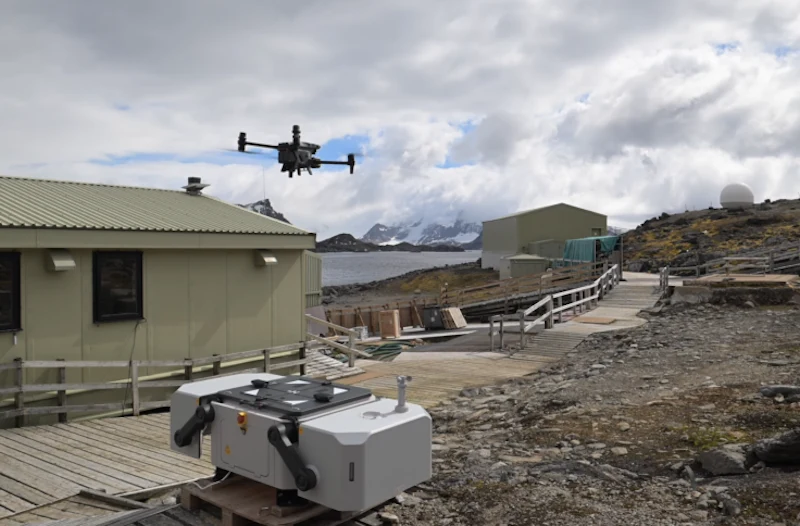
Here is Autosub Long Range, also known as Boaty McBoatface, on the deck of RRS Sir David Attenborough. Here is Professor Erin Pettit with the Meltstake platform aboard the same ship. And here is a drone-in-a-box system deployed on Signy Island.
Widespread autonomous vehicle use enables glacier, ocean, wildlife and climate monitoring on scales unimaginable a decade ago.
Dr Alex Brearley, an oceanographer at the British Antarctic Survey (BAS), works directly with this technology. "It's amazing: I can sit in Cambridge, take out my phone and send commands to a glider working thousands of kilometers away in Antarctica."
Underwater gliders and internal tsunamis
Brearley operates several underwater gliders in Ryder Bay, near Rothera Research Station on the Antarctic Peninsula. They have no engines or propellers. The torpedo-shaped vehicles change buoyancy and glide slowly through the water, periodically surfacing to obtain GPS coordinates, transmit data and receive commands. Careful energy management lets them remain at sea for months.
The gliders monitor how icebergs calving from glaciers generate powerful waves. These waves mix heat and nutrients throughout the water column and carry carbon into the depths. The phenomenon, called "internal tsunamis," was first observed from a research vessel. Autonomous vehicles now provide much longer and more detailed observations.
"The gliders come in afterwards to observe the same processes at much higher resolution," Brearley says. "The point is often to provide mission durations that a ship cannot achieve without enormous expense."
Robots reach places people cannot
Why have autonomous systems spread so widely? One reason is their ability to operate where human risk is too high. BAS's GIANT project, Greenland Ice sheet to AtlaNtic Tipping points, is a good example. It studies how warm ocean water melts Greenland's glaciers. Nine autonomous systems participate, including the yellow underwater vehicle Boaty McBoatface.
The most unusual is Meltstake, an automated scientific platform that screws directly into a glacier face. An autonomous boat delivers it and a remotely operated underwater vehicle positions it, allowing Meltstake to screw into the ice wall 100-200 meters below the waterline. As the ice melts, the platform gradually advances.
It carries cameras, hydrophones and acoustic instruments, continuously measuring ocean-ice interactions from a position no scientist can occupy. The system helps explain why existing climate models appear to underestimate glacier melt rates.
Professor Erin Pettit of Oregon State University believes the glacier itself plays a more active role than previously thought. "It is packed with tiny pressurized bubbles. They hiss and burst when they enter the water. As bubbles escape, they disturb the fluid boundary layer," Pettit explains. "Chaotic mixing generates additional energy, which in turn accelerates melting."
Watching birds from thousands of kilometers away
Autonomous aircraft are also changing wildlife monitoring. On Signy Island in the South Orkney Islands, BAS biologist Dr Norman Ratcliffe deployed a drone-in-a-box. The aircraft stays permanently in Antarctica, living in a protective docking station where it recharges between preprogrammed flights over penguin colonies.
Scientists in Cambridge can schedule flights remotely throughout the year, monitoring breeding even when no researchers remain on the island. "If we can operate safely from Cambridge, we can survey at almost any time of year, regardless of how many people remain at the station," Ratcliffe says. "For repetitive tasks this is incredibly efficient, especially when staff or trained pilots are scarce."
The system may eventually cover more remote penguin colonies that have not been surveyed in detail for decades. Autonomous surface vessels conduct similar long-term observations at sea. BAS biological oceanographer Dr Sophie Fielding uses a two-meter Sailbuoy to monitor krill near South Georgia. Powered by wind and sunlight, the small vessel carries an echosounder capable of detecting krill hundreds of meters below and transmits data by satellite. Unlike research ships, Sailbuoy can remain at sea for months with almost no carbon dioxide emissions. "For simple platforms such as Sailbuoy, it makes sense to deploy whole swarms: a swarm of buoys following a swarm of krill," Fielding observes.
Small drones, major discoveries
Fixed-wing drones have also become important polar research tools. The lightweight eBee X fits in a backpack, launches by hand and flies fully autonomously for up to 90 minutes. Near South Georgia, BAS researchers received permission for beyond-visual-line-of-sight operation, enabling surveys of animal colonies on remote coastlines.
Nathan Fenney, BAS head of geomatics, says this dramatically expands survey coverage. "Previously, small drones flew within visual line of sight, VLOS, meaning no farther than approximately 500 meters from the pilot," Fenney explains. "With beyond-visual-line-of-sight, BVLOS, operation on platforms such as eBee X, we cover far larger areas, measured in kilometers, and reach places inaccessible by land. This gives us access to South Georgia's largest and most remote colonies."
The imagery enabled new animal-counting methods using three-dimensional terrain models rather than individual photographs. Surveys confirmed that one of South Georgia's largest king penguin colonies had grown to 132,000 breeding pairs. They also revealed a severe decline in southern elephant seals following avian influenza outbreaks.
Large drones replace aircraft
Larger autonomous vehicles are changing Antarctic geology too. The Windracers ULTRA drone has a 10-meter wingspan, carries up to 60 kilograms and flies almost 1,000 kilometers without a pilot. For BAS geologist Dr Tom Jordan, this means geological surveys previously requiring crewed aircraft can increasingly be performed autonomously.
The drone carries radar, magnetometers and gravimeters to study rocks hidden beneath the Antarctic ice sheet. "For years, instruments were too heavy and drones too small. Now the lines have crossed: sensors have become lighter and drones powerful enough for serious Antarctic science," Jordan explains. "Moving surveys to drones gives us the same science with much lower fuel and logistics requirements. A large aircraft previously needed 200 drums of fuel; Windracers uses twenty. The drone also frees our Twin Otters for other work, supporting field teams or surveys with larger sensors, so all resources deliver maximum benefit."
Robots assist rather than replace scientists
Despite rapid autonomous-system growth, BAS researchers do not expect robots to displace people. They instead fill the gap between satellites observing Earth from space and scientists working directly in the field.
Professor Petra Heil, BAS director of science, believes AI will play an increasingly important role in coordinating these varied data sources. "AI can show us where our science has blind spots. It can bring satellite imagery, models and past measurements together to highlight the most uncertain areas. AI is essential: it manages data, suggests where to send platforms and continually adjusts missions as the environment and technologies change."
Some tasks, however, remain beyond robots. As Ratcliffe notes: "I don't know a drone that can catch a penguin, weigh it and attach a tag. Or collect its droppings to find out what it eats."