How Sony's AI table tennis robot advances physical AI
English translation from Unibot. Source published 2026-06-15.
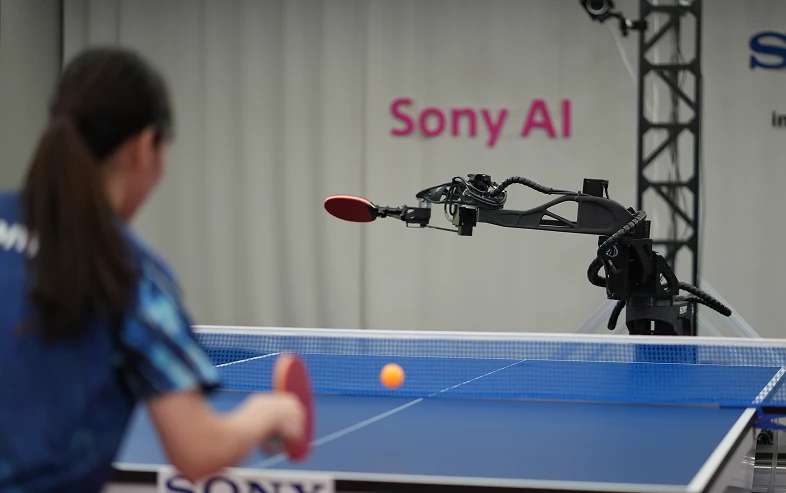
Sony AI's table tennis robot Ace has defeated seven professional players, including the former world number five. This is the first time an autonomous system has beaten professionals in a competitive sport under official rules.
Why table tennis is a difficult test for AI
A robot that plays table tennis may seem like a fun toy. After all, industrial robots have long been assembling cars, sorting packages and welding metal with pinpoint precision.
But for researchers at the intersection of robotics and artificial intelligence, table tennis is one of the most difficult real-world tests imaginable. To play successfully, you need to see the fast-moving ball, predict its trajectory, instantly decide how to respond, take the correct position and execute the exact movement. And all this in a split second.
The task integrates vision, motor planning, control, prediction and decision making in a constantly changing environment. That's why Sony AI spent several years developing Ace, an autonomous table tennis robot that has become a testing ground for breakthroughs in the field of physics AI.
Ace results: victories over professionals
The company recently announced that Ace has surpassed the results described in a paper published in Nature earlier this year. From February to April 2026, the system defeated seven professional table tennis players using the official competition rules.
Among the defeated opponents are former world number five Miu Hirano and Miyu Kihara, who is currently ranked 26th in the world. Sony doesn't claim that the robot beat the best human players. But these results are the first demonstration of an autonomous robotic system beating professional opponents in a competitive sport under official rules.
How Ace achieved success: key improvements
Perhaps more important than the victories themselves is how exactly Ace achieved them. According to Sony AI, most of the improvements came not from redesigning the machine, but from retraining and scaling its AI models.
The researchers took several steps:
Increased the size of the neural networks that control the robot
Improved reinforcement learning algorithms
Improved simulation environment
Introduced new learning objectives that encourage anticipation rather than just reaction
The project also highlights a growing trend in robotics: the combination of physical simulation and machine learning. Ace learned from countless simulated games and then transferred those skills into the real world, where additional experience against strong opponents helped hone his skills even further.
Hardware improvements
Hardware improvements also played a role. Engineers reduced weight through topology optimization, updated the engines to increase acceleration, and reduced perception latency from about 10 milliseconds to 8.5 milliseconds. This gave the robot extra time to react to quick impacts.
Significance of the project for physical AI
But the significance of this work goes far beyond sports. Many of the same abilities needed to hit a curveball will be needed by future robots in factories, warehouses and other dynamic environments.
Robots must interpret complex sensory information, predict outcomes, and adapt their behavior in real time as conditions change. In this sense, table tennis serves as a benchmark for a larger goal: creating robotic systems that can intelligently respond to the unpredictability of the physical world.
Whether Ace can ever reach the level of the world's top professionals is perhaps not as important as the technology developed along the way. The project shows how advances in simulation, reinforcement learning, perception and control can combine to create increasingly capable physical AI systems. For the robotics industry, this is perhaps the most valuable lesson of all.