Humanizing robots improves factory worker productivity
English translation from Unibot. Source published 2026-06-18.
Treating robots as colleagues
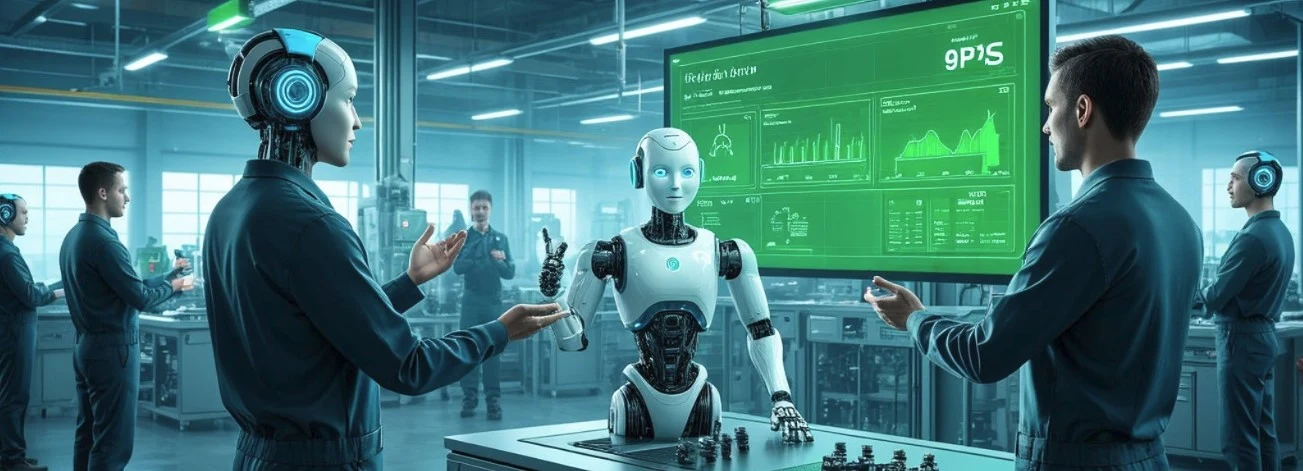
Factory workers who treat industrial robots as co-workers—and even attribute human qualities to them—are more productive and feel better. This is according to a new study conducted at the Alberta Business School.
“The more workers sought ways to connect with these machines, even on an emotional level, and understood their idiosyncrasies, the better they were able to keep the line running—and the happier they were in their jobs,” said Dr. Trish Ray, who led the study with European colleagues.
It's a bit like bonding with a new employee, explains Ray, an expert in organizational and institutional change.
Four years of observations
The study, titled “Matilda Is Lazy Today: How Mind Perception Triggers Relational Redesign of Working with Industrial Robots,” lasted four years. Scientists observed workers in European factories, interviewed robot operators, their managers and experts in the implementation of robotics. The work was published in the journal Group & Organization Management.
The results showed that workers' anthropomorphic perceptions of robots—including giving them the ability to act with awareness, have human feelings, and experience—generally helped improve production line performance.
The massive introduction of industrial robots into workshops around the world is not only radically changing the organization of work, “but also forcing workers to rethink their relationship to work and adapt to interaction with technology.”
Inhuman appearance, human perception
The robots observed in this study were not controlled by artificial intelligence - although such a feature would be more likely to lead people to attribute human characteristics to them, Ray notes. On the contrary, these machines performed highly specialized tasks - such as lifting heavy objects or leveling materials in a furniture factory - and did not resemble humans in any way.
“Industrial robots—despite their lack of anthropomorphic design—are perceived as more than just tools; workers imbue them with the qualities of teammates,” the authors write. “This highlights an important and little-understood phenomenon: relationships with technology can occur even without specific intent.”
Names and characters of cars
Productive relationships with robots don't happen overnight, Ray says. At first, workers give the machines names - "Bobby" or "Matilda" - to distinguish them and remember which one requires special care.
“In the early days after the introduction of robots, there was more anger towards them, but over time it subsided,” says Ray.
“People realized that this was not the most efficient way to keep the entire line running. They advised each other: “If the machine doesn’t listen to you, maybe you’re just giving it the wrong command.”
Everyone is happier when equipment works properly and efficiently - because productivity increases and workers get more money."
Diagnosis through humanization
According to Rhee, an efficient production line requires workers to be able to troubleshoot problems and be sensitive to machine behavior. “When they say, ‘Matilda is lazy or sick today,’ that helps diagnose the problem. Sometimes it’s the early signs that tell you it’s time for unscheduled maintenance.”
One of the workers admitted: “With the robot, I’m just an operator - we work together. He depends on us, and we depend on him.”
This feeling of oneness with technology is contagious, says Rea, and is gradually becoming the new norm. “People either advise each other on how to get along with a particular robot, or they scold their colleagues if they don’t encourage their robot to do what it needs to do.”
Relational construction of work
This phenomenon is one example of what Rea calls "relational construction of work." The point is that groups of people, over time, find the best way to interact with machines.
Her team found that workers “actively engaged in relational construction of work with industrial robots, rather than relying on given instructions and specifications.”
The study's authors advise companies to encourage this behavior during technological transitions. “Employees can then rethink how they perceive and approach new technologies... This can help them cope with uncertainty, relieve stress, take care of their well-being and achieve performance goals.”
“Everyone does it in their own way - you can’t just order it. We need people to believe that the robot has its own will.”