Humanoid AI puts HMND 01 on wheels for industry
English translation from Unibot. Source published 2026-07-19.
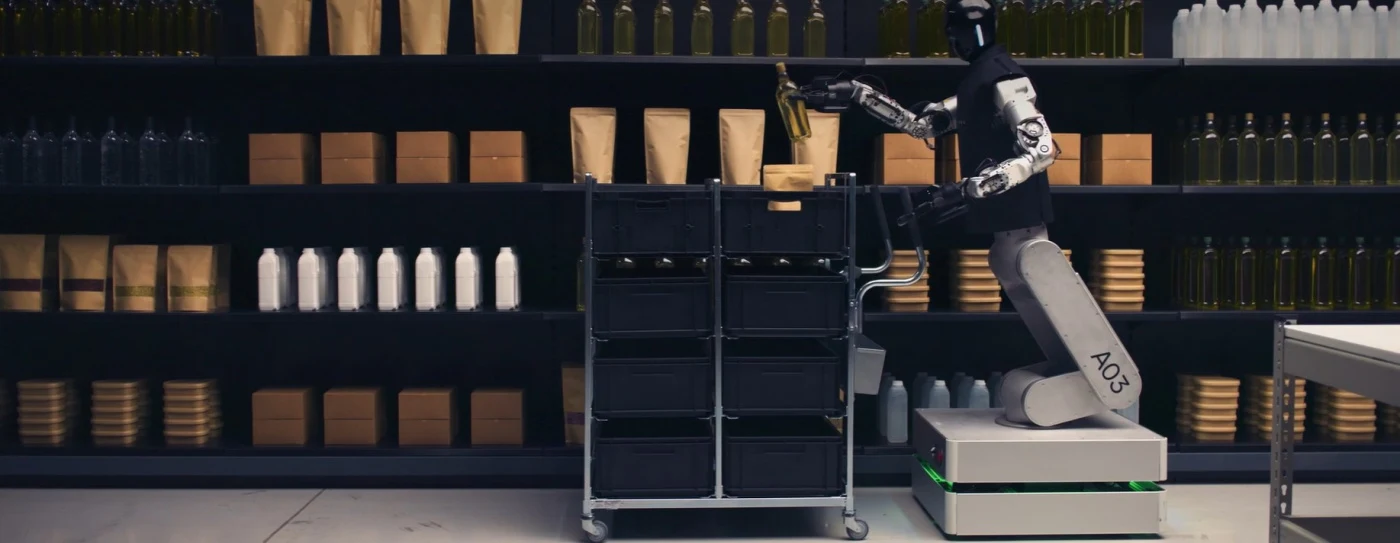
Humanoid AI has focused almost 90% of its engineering efforts on the wheeled humanoid HMND 01, although the British company also has a bipedal prototype. Forbes visited the London office and spoke with Chief Product Officer Sotirios Stasinopoulos.
A pragmatic choice for industry
The choice of wheeled platform is pragmatic. Humanoid AI is targeting industry. There, energy consumption, stability, reach, load capacity and certification decide whether the robot will go into production or remain in the laboratory.
Stasinopoulos told Forbes: “The wheeled platform covers more than 85-90% of use cases.”
The current alpha version of HMND 01 lifts 15 kilograms. The next one will take 20. The robot's arms work from zero to one and a half meters in height and the same distance from the body, Stasinopoulos added.
Key facts
Company: Humanoid AI, founded in 2024
Team: 130 people
Main Platform: Wheeled Humanoid HMND 01
Engineering Focus: Approximately 90% on wheeled platform
Current load capacity: 15 kilograms
Target load capacity: 20 kilograms
Certification: Fully certified product by the end of 2027
Certification dictates form
For industrial buyers in Europe, CE certification is more than just a formality. The logic of Humanoid AI is simple: it is much easier to fit a wheeled humanoid into existing approval schemes than a bipedal machine.
Stasinopoulos explained that there is no ISO standard for bipedal technology in industry yet - a robot with legs can fall. In a conversation with Forbes, he called the certification of such systems “immature” and suggested that the corresponding standards will appear “closer to the end of next year or early 28th.”
The wheeled HMND 01, on the other hand, can build on standards for autonomous mobile robots and collaborative industrial platforms. Humanoid AI expects to have a fully certified product by the end of 2027.
The two-legged version was not abandoned - it now has a different task. Stasinopoulos said the company is refocusing on service and residential scenarios as part of its mid- to long-term strategy. According to him, biped technologies are not yet reliable enough for the 20-hour industrial cycle for which the company designs its solutions.
Four layers of software - from fleet tasks to movements
The Humanoid AI robot intelligence stack is broken down into four layers, numbered System 3 through System 0. At the top is System 3, the agent fleet coordinator. It receives tasks from the customer's WMS or ERP and distributes them among robots based on their location, battery charge, and available work tools.
System 2 is a reasoning layer based on visual language models like Google Gemini. Its task is to decompose the incoming work into a deterministic algorithm that can be verified before execution. System 1 is Humanoid AI’s own visual-linguistic action engine for specific operations: for example, taking a product from a shelf. System 0 is a full body controller that turns these commands into physical movements.
The architecture reflects a "fleet first" approach. Stasinopoulos told Forbes that the company is not trying to assign one robot to each task - for single operations, conventional automation is often more profitable. The goal is a flexible set of machines that can replenish racks, load machines, and re-sort inventory throughout the day.
Humanoid AI says its robots already perform a number of key tasks at about 80% of human speed and success rates, up from about 60% previously. According to Forbes, the company expects to catch up and eventually surpass humans in some operations. But this result promises to yield not just imitation of people, but reinforcement learning.
Partnerships offset modest budgets
Humanoid AI has raised $74 million, according to a source. Forbes draws a parallel with German competitor Neura Robotics, which, according to the same data, has raised more than a billion. American Figure and Apptronik have a much more significant capital base.
The British company has signed implementation contracts with Schaeffler, Bosch and Siemens. The actuator strategy is closely tied to Schaeffler - the nodes are developed jointly, and the computing part runs on Nvidia. Forbes also writes that Schaeffler has ordered at least a thousand Humanoid AI robots. Through European partnerships, the company has access to capacity sufficient to produce 100 thousand humanoids by 2031.
Stasinopoulos called supply chain a strategic issue: Humanoid AI plans to manufacture in Europe for European customers and take a "China plus one" approach for sustainability. Forbes also reports that a new round of funding looks likely, although Stasinopoulos would not comment on the details.