Humanoid Musashi from the University of Tokyo demonstrates car control
English translation from Unibot. Source published 2026-09-14.
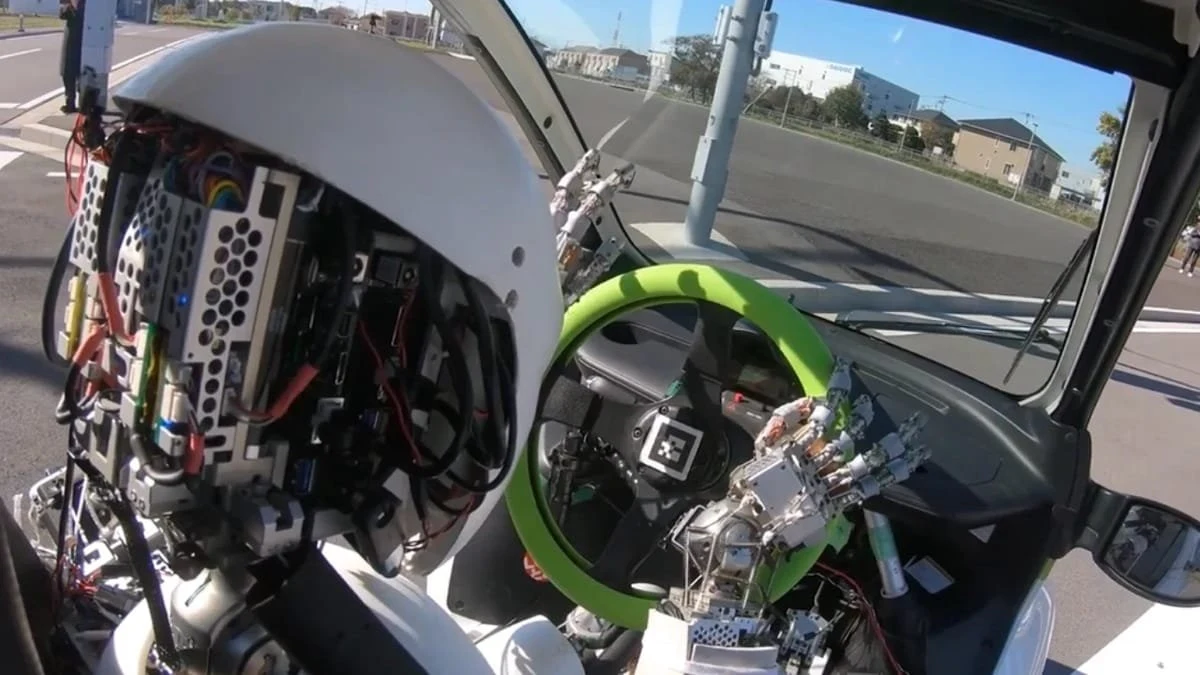
The humanoid Musashi from the University of Tokyo has shown that it can drive a regular car. It turns the steering wheel, presses the pedals, clicks the turn signals - everything physically, with its arms and legs.
An article for Advanced Intelligent Systems says that the robot also recognized traffic lights and passed intersections.
Why is this necessary?
As Supercar Blondie writes, Musashi was designed based on the proportions and functions of the human body. The logic here is simple: do not build autopilot hardware directly into the car, but check whether a universal humanoid can operate controls designed for humans.
How a robot controls a car
The robot worked with pedals through the dynamic circuit of the body - the speed of the machine was both an input and an output signal for it. This is described by Kento Kawaharazuka, Kei Okada and Masayuki Inaba.
However, when Musashi was first reported in 2024, its top speed was only 3 miles per hour.
This is a laboratory demonstration for now.
What does this mean in practice? So far we are talking about a controlled laboratory demonstration, and not about a robot driver ready to hit the road.
There is no success rate, no operator intervention data, no confirmation of operation at normal road speeds in the source.
Daimler Truck Patent
By the way, Daimler Truck also filed a patent for a humanoid that can drive a truck. But a patent is not proof that the system is about to be launched.