Humanoid robots: how machines that look like us will change our lives
English translation from Unibot. Source published 2026-06-19.
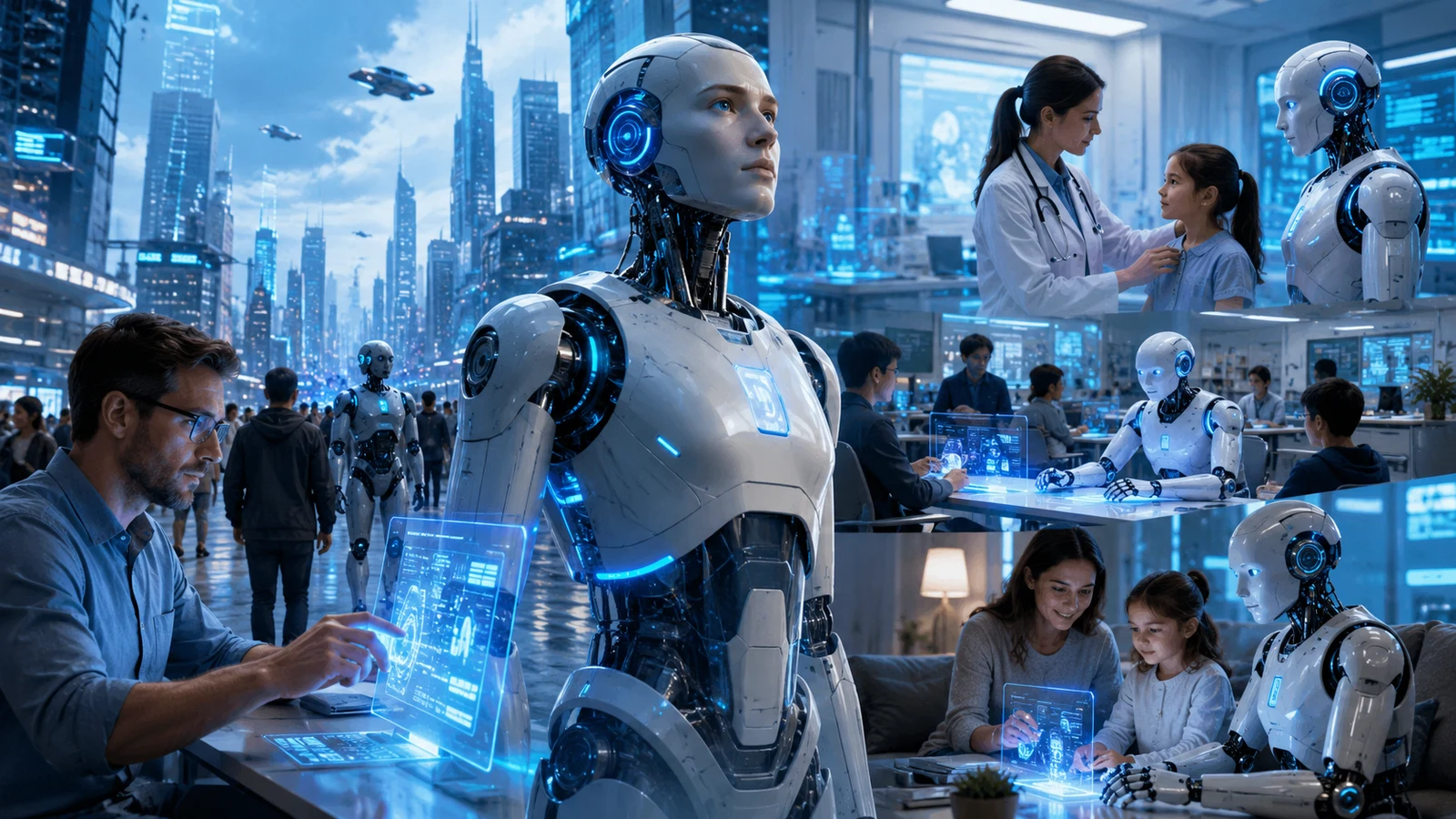
Humanoid robots are no longer science fiction. They are able to take on tasks that are beyond the capabilities of humans, and in the future they can occupy an important place in industry, the service sector or in private homes.
At the University of Erlangen-Nuremberg (FAU), scientists are working on hardware and software for machines that look like people. Dr. Sebastian Reitelshöfer from the Department of Factory Automation and Production Systems at FAU explains in an interview how such robots will be able to help us in the future and why this technology on two legs is a chance for industry in northern Bavaria.
What is a humanoid robot
These robots are designed to resemble a human in appearance. Many of them walk on two legs. But this is not a prerequisite - there are also humanoid robots on a mobile platform.
The important difference is not so much technical as psychological: they almost always evoke strong emotions, associations and expectations in people. Visitors to our laboratory, for example, often try to talk to them directly - simply because they intuitively assume: since it looks like a person, it means it can speak.
This helps to engage inexperienced users who do not need to read the instructions. But the developers also face a challenge: not to disappoint these intuitive expectations, otherwise the robots simply will not be accepted.
What tasks will they take on?
Humanoid robots are expected to do many different things. Their body sizes are approximately the same as those of humans - which means they can, say, replenish shelves in a warehouse, like ordinary workers. Although moving on legs is technically more difficult than on wheels, legs allow robots to navigate our complex world, where the floor is not everywhere level.
Therefore, in the near future they can be used, for example, in everyday life, to help artisans or in patronage care for the elderly.
Technological barriers along the way
With current approaches in AI, robotics has taken a huge step towards real-world applications. If humanoid robots can learn to understand complex queries in natural language and "read" a scene from images, then their use in the real world - such as in homes - will be possible for the first time.
A service robot in a nursing home can already clear dishes from a table in a real room - even if there is a travel bag on the floor, clothes hanging on a chair, or a vase of flowers on the table. Previously, it was useless to program such scenarios manually - classical methods could not cope. And now AI allows you to safely avoid obstacles and remove only the plates.
So AI is a key factor. But research is still needed: modern models are successful, say, in 80% of cases. In some scenarios this already helps, but for industrial production, for example, this is absolutely not enough. If a robot assembles twenty percent of the parts incorrectly, this is unacceptable.
In addition to software, there are more serious problems with hardware. For example, the wear resistance of drives is a big headache. At the last Beijing Marathon, a breakthrough was that many robots were able to run a half marathon - although this was at the limit of their capabilities.
But in in-plant logistics, it would be unacceptable if the robot’s legs broke after a few tens of kilometers and had to be replaced. And outside industry, robots must be more sensitive, with soft surfaces and limbs - otherwise direct contact with humans is excluded.
Economic and social opportunities
In northern Bavaria we have many large companies that have until now worked as suppliers to the automotive industry. These enterprises have enormous experience - they are able to produce high-quality, reliable and complex mechatronic systems on a large scale.
Ideal conditions to create permanent jobs in the region for the production of humanoid robots. Moreover, existing robotic systems still require serious improvement in terms of hardware.
Centers and hubs need to be created as quickly as possible in order to develop exemplary platforms for robots. Because there are simply no large robot manufacturers for suppliers to work for yet.
Let's hope that social development will quickly lead to many useful applications. For example, to relieve medical staff from non-core tasks not related to patient care. In addition, humanoid robots will help save jobs and, through automation, will allow us to continue producing products in Germany and Europe.
What will life be like in 10 years?
It is hardly possible to accurately estimate how much technology will advance in ten years. But in general, it seems to me that the current situation is roughly comparable to the early 1980s, if we draw parallels with the personal computer. Computers were already widely known back then. However, they have not yet entered people’s everyday lives - they could only be found in large companies such as insurance firms and banks.
In the 1980s, people had a hard time imagining that today there would be many more computers than people in one room. In the same way, we now have a hard time imagining how thoroughly and on a large scale robotics will enter our future.