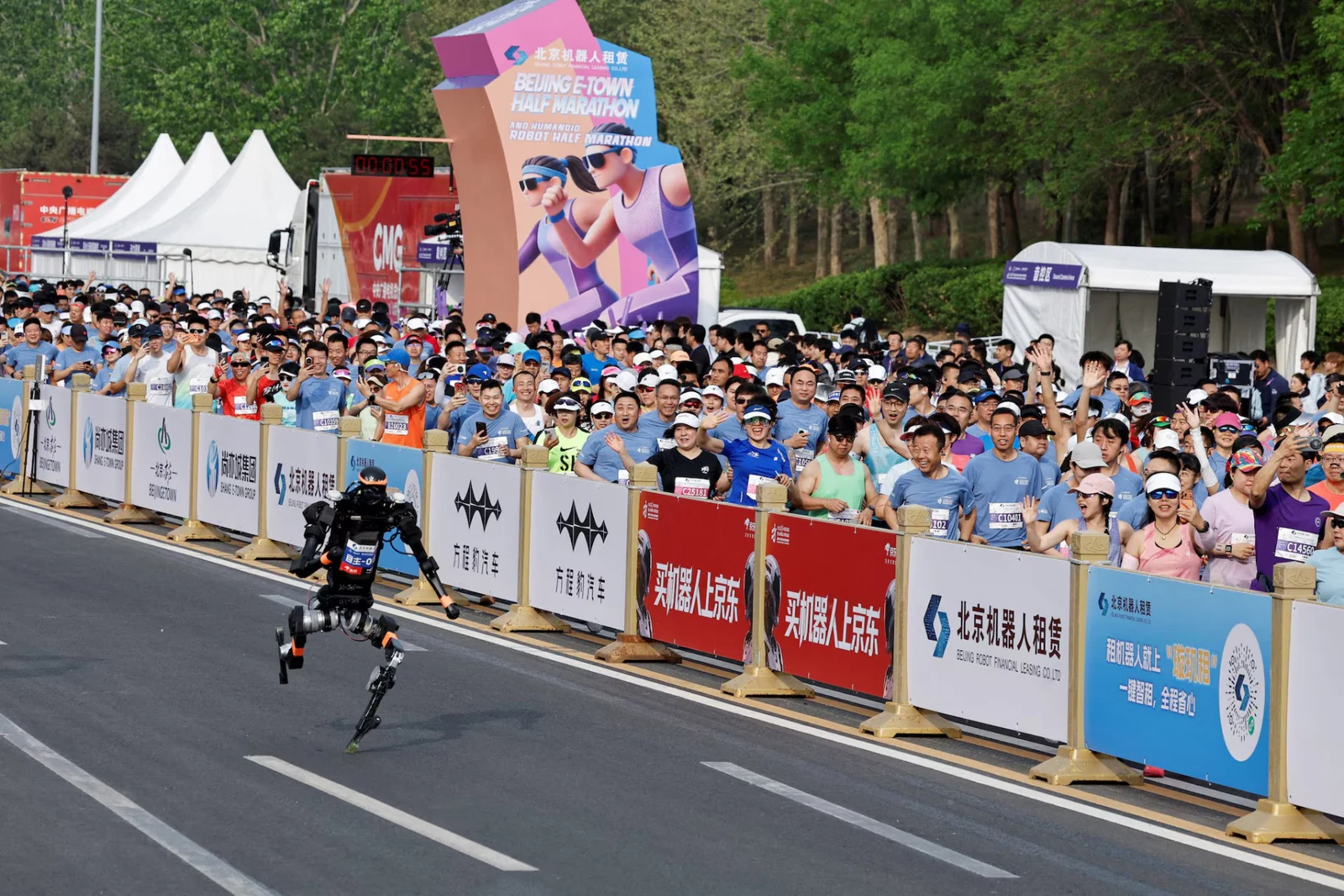
Humanoid robots showed significant progress at the half marathon in Beijing and ran the distance next to people
English translation from Unibot. Source published 2026-04-20.
At the Beijing Half Marathon, humanoid robots showed remarkable improvements in agility and endurance, with more than 100 machines competing alongside humans. The race, held in the E-Town area, reflects the rapid pace of development in China's humanoid robotics sector.
The fastest robot created by the Chinese smartphone manufacturer Honor covered the distance in 50 minutes 26 seconds. His result was reportedly significantly faster than both the human participants' time and previous robotic achievements.
The progress made contrasts with the first edition of the competition, held a year earlier. In 2025, most of the participating humanoids had difficulty completing the distance, and the winning robot took 2 hours and 40 minutes. His lag was noticeably greater than that of people running along a parallel track.
This year, the organizers note both an increase in the number of participants and an increase in reliability. The number of humanoids increased from about 20 to over 100, and many successfully completed the race. The results indicate significant improvements in motion control, stability, and energy management for long-distance walking systems.
Although detailed technical characteristics of the machines were not disclosed, the achieved indicators indicate improvements in the efficiency of drives, gait optimization and real-time control systems. Long-term running at the half-marathon level places stringent demands on thermal conditions, joint durability, and on-board power supplies—factors that have historically limited the use of humanoids outside of strictly controlled conditions.
The event also reflects China's broader industrial policy to accelerate the development of humanoid robots. Such public demonstrations are increasingly being used to show progress and attract investment, while also serving as informal benchmarks of system capacity.
Despite the impressive results, many economically feasible application scenarios for humanoid robots still remain in the testing phase. The Beijing Half Marathon serves as a clear indicator of progress, but translating athletic ability into sustainable industrial or service deployment remains a challenge.
Such rapid improvement in one year hints at accelerating iteration cycles in humanoid robotics. For practitioners and operators, these results highlight the transition from proof-of-concept demonstrations to more sustainable and repeatable performance in dynamic, real-world environments.