Hyundai workers go on strike over introduction of Atlas humanoid robot
English translation from Unibot. Source published 2026-07-21.
Thirty-five thousand workers at the Hyundai complex in Ulsan began a four-hour partial strike on July 20. TechTimes writes about this. The reason is a labor dispute, at the center of which is the humanoid robot Atlas from Boston Dynamics. Although this robot has not yet set foot on the territory of any Hyundai plant in Korea.
Union demands veto on robots
The strike is tied to a wider dispute over wages. But the big issue in robotics is consent. The Korean Metalworkers' Union (KMWU) demands that a clause be included in the contract: not a single humanoid robot should be launched at Hyundai factories in Korea without the union's approval.
TechTimes, citing several sources who in turn cited the Wall Street Journal, calls this shutdown the first in the auto industry directly caused by humanoid robots.
Boston Dynamics deal coincides with protest
The timing was unusually poignant. On the same day, Hyundai Motor Group completed a deal to gain full control of Boston Dynamics. SoftBank exercised the put option and sold the remaining approximately 10 percent of the shares. The transaction amount is about $325 million. This values Boston Dynamics at approximately 3.3 billion. Atlas is currently outside of Korea.
According to the source, Hyundai has not assigned the Atlas to any tasks at Korean factories. Confirmed deployment is at Hyundai Motor Group's Metaplant America plant near Savannah, Georgia. Will start in 2028. Atlas will first begin sorting parts, and by 2030 will move on to assembling components. This absence of a robot in local factories is the lever of the trade union.
Proactive Negotiation Strategy
Once humanoids begin working on the shop floor, negotiations typically revolve around mitigation, retraining, and severance packages. The KMWU is trying to agree on the terms of admission for the robot before its appearance sets a precedent in practice.
Hyundai says workers will be able to move into more skilled roles - teaching, monitoring and maintaining robots. The union does not consider this sufficient protection.
Their requirements include:
conversion of hourly production rates to fixed salaries
raising the retirement age from 60 to 65 years
the official right of workers to approve or reject the introduction of humanoids
What the fifth generation Atlas can do
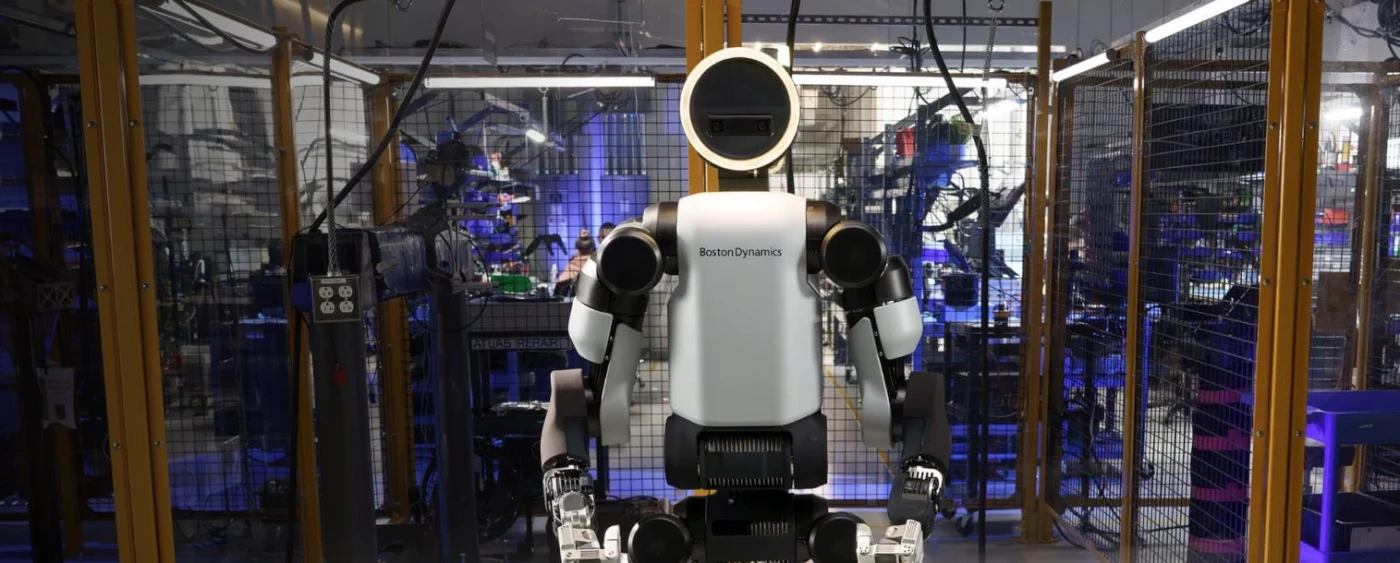
We are talking about the fifth generation Atlas - an electric humanoid from Boston Dynamics. This is not the same old hydraulic platform that was shown in public demonstrations. TechTimes writes: The production Atlas is 6.2 feet tall, weighs 198 pounds, and has 56 degrees of freedom. It has 360 degree joint rotation - in the hips, waist, neck and limbs.
The source indicates the lifting capacity: 50 kilograms per lift, 30 kilograms during continuous operation. Arm reach is 2.3 meters. This allows the robot to work on existing assembly lines without major changes to the shop floor.
Two hot-swappable, replaceable batteries provide approximately four hours of runtime each. Autonomous battery replacement takes three minutes - so the robot can work the entire shift without stopping.
The article also emphasizes the teaching method. Atlas uses reinforcement learning. Human motion capture data is adapted to the robot's joint geometry and trained in a large-scale simulation. TechTimes reports: New industrial tasks can be trained in about 24 hours. Internal test: the robot was trained to a load of 50 kilograms, and it adapted to heavier loads without retraining.
Robot availability is limited
These claims should be separated from broader commercial evidence for now. The source says: all copies of the 2026 Atlas have already been distributed between Hyundai and Google DeepMind factories. There will be no available commercial clients until 2027.
For plant operators, this labor dispute may be as useful a signal as the demo videos: workers are treating the platform as a real threat even before it arrives on their line.
Damage from strikes and wage demands
The union represents more than 39 thousand employees. More than 34 thousand of them authorized the strike. Early partial strikes - from July 13 to 15, when workers left two hours early each day - disrupted the production of about 5,000 cars. According to the source, this is about 200 billion won (approximately $145 million) in potential revenue.
Salary conditions are specific. The workers are demanding a performance bonus of 30 percent of Hyundai's consolidated net profits. Management suggested:
increase in basic monthly salary by 89 thousand won (about 64 dollars)
performance bonus of 350 percent of base salary
plus 10 million won (approximately $7,200) and 15 company shares per worker
Hyundai said it would not compensate wages lost during the strikes. Management warned the shutdowns would cause “irreversible production losses.” The union has hinted it could expand the action or go on a full strike if demands for automation go unanswered.
Gap in security standards
The security base is thin. As TechTimes reports, there is no single safety standard for humanoid robots in mixed production facilities where both people and machines work. OSHA does not have regulations for such scenarios. And the ISO 25785-1 standard, which describes the requirements for dynamically stable walking robots, is still in development - its publication should not be expected until 2026 or 2027.
Implementation scale and precedent
Hyundai, according to the source, plans to deploy more than 25,000 Atlas robots at Hyundai and Kia factories around the world. That will absorb most of the 30,000-unit annual production slated for 2028.
If the KMWU wins pre-approval rights for the introduction of Atlas in Korea, other industrial unions will have a concrete model for negotiations. If not, Hyundai will have a freer path to introduce humanoid robots on its own schedule, as soon as the equipment is ready for Korean factories.