Kawasaki Robotics Shows 8-Axis Physical AI Robot at Automate 2026
English translation from Unibot. Source published 2026-06-30.
Kawasaki Robotics showcased its latest automation technology at Automate 2026 in Chicago. At the company's stand, they demonstrated how robotics, artificial intelligence, machine learning, vision systems and real-time control are changing industrial automation.
The main new products at the stand
Among the key premieres is the debut of the RL030N robotic platform with eight degrees of freedom (DoF), created for Physical AI applications. They also showed Kawasaki Robotics' patented Pulseboard technology, which was used in a weld control system developed jointly with Fives DyAG.
In addition, new industrial robots MXP360L and BA013L were presented. The Kawasaki Robotics booth showcased intelligent automation systems with advanced motion control, precise quality control and flexible manufacturing.
Seiji Amazawa, President of Kawasaki Robotics, said: “At Kawasaki Robotics, we believe that the future of automation lies in robotic systems that seamlessly integrate perception, motion and decision-making. Automate 2026 is an important milestone: we are introducing technologies for new Physical AI applications, without forgetting the industrial reliability that manufacturers expect."
RL030N is built for Physical AI
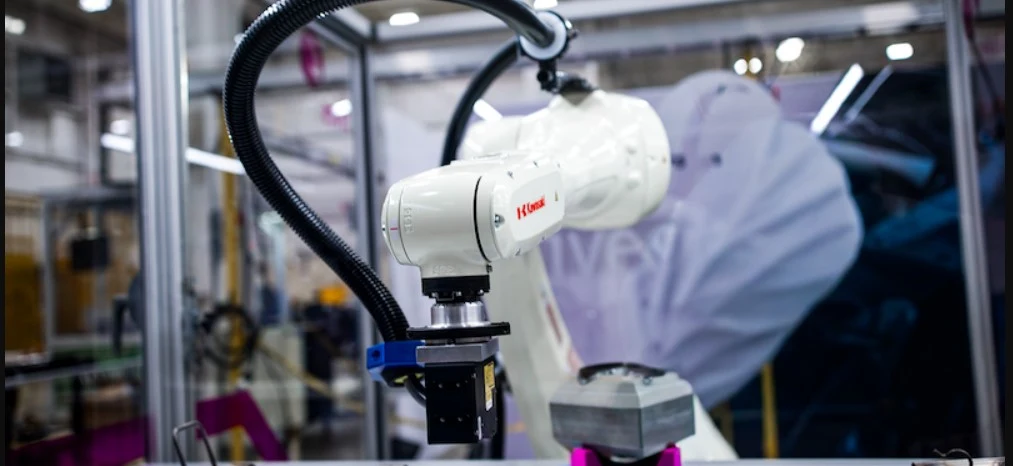
The RL030N debuted at Automate 2026 as the industry's first eight-axis robot designed specifically for Physical AI. It combines high-speed movement, increased maneuverability, lightweight design and real-time external control capabilities - for work in dynamic and tight environments.
Unlike conventional industrial robots that are designed for repetitive tasks, the RL030N supports AI-based applications such as adaptive motion, obstacle avoidance, confined space manipulation, and complex path planning. The unique eight-degree-of-freedom architecture provides an additional axis of rotation, providing greater flexibility than traditional six-axis models.
The RL030N runs on Kawasaki Robotics' open real-time KRNX API. This allows external AI software, ROS frameworks, machine learning systems, vision platforms and third-party orchestration systems to control the robot in real time.
Pulseboard technology speeds up weld inspection
Kawasaki Robotics also demonstrated its patented Tool Tip Displacement Output Function technology, known as Pulseboard. It was integrated into an advanced weld inspection solution developed with partner Fives DyAG. The system combines a Kawasaki RS013N robot, a 3D laser camera and Kawasaki's high-speed motion synchronization technology to improve control of complex welding geometries and curved surfaces.
Unlike conventional systems, where the robot stops for each shot, Pulseboard continuously synchronizes image capture with the movement of the tool. According to the company, this allows for high-resolution images during acceleration and deceleration. The result is weld inspection up to 10 times faster, improved defect localization and reduced setup requirements.
Wade Rickard, CEO of Fives DyAG Corp., said, “The Pulseboard-based solution developed in partnership with Kawasaki brings real value to our customers. It speeds up inspection, identifies defects and maintains the highest level of quality without slowing down production. Together with Kawasaki, we have created an innovative high-speed solution that redefines efficiency, improves reliability and makes operations smarter.”
Closed loop dosing with Coherix
Kawasaki Robotics also showed off the BU015X seven-axis robot in an adhesive application and control demonstration developed with Coherix. The system simulated the work in the automotive industry: it applied sealant to the door panel of a Ford F-150, continuously measuring and automatically adjusting the position of the glue bead in real time - at a speed of up to 400 times per second.
The system combined Kawasaki Robotics hollow manipulators with 3D laser-based adaptive process control technology from Coherix. Machine learning and real-time optimization were used. The goal is to help manufacturers reduce scrap, material waste, labor costs and rework without reducing assembly line speed.
Scott Childs, senior director of Kawasaki Robotics' automotive business, explains, “This closed-loop application process is the next step in the evolution of smart manufacturing. Robots, AI process control and real-time inspection work together to create systems that constantly adapt and optimize.”
New industrial robots
The BA013L 13 kg arc welding robot also made its debut - in a compact cell for high-performance tasks. The demo stand included: the BA013L itself, a Kawasaki PST500-L2 two-axis positioner, a Rollon Glider RTU linear module, a Strong Hand welding table and a Miller power source.
The robot was designed for harsh production conditions. It features a new 50mm hollow wrist architecture for internal cable routing, support for high-power welding torches, less cable wear and better access. The axial speed is up to 730° per second, and the reach is 2093 mm. This should speed up cycles without losing seam quality.
The MXP360L robot was shown in action - it was carrying a Kawasaki Z125S motorcycle on a Rollon RTU linear module. The 360 kg load capacity, long reach and advanced vibration damping system for heavy materials were clearly demonstrated.
Kawasaki Robotics also showed collaborative solutions: welding trolleys of the CL series and grinding with FerRobotics tools.