Kingston University to lead UK's first robotics hub for recycling
English translation from Unibot. Source published 2026-10-11.
Kingston University will lead the UK's first robotics center for recycling and waste management. The project is being implemented as part of a government program worth 40 million pounds sterling (about $53 million).
What is NORAH
The National Center for Robotics in Waste and Recycling (NORAH) is funded by Innovate UK and based in the south east of England. It became one of eight robotics centers that will be deployed throughout the country.
The task is to advise businesses and government agencies that want to use the latest technologies and switch to automation.
Who led the project
The NORAH project, worth £3.6 million (1.5 million of which will go to Kingston University), is led by Professor Vasilis Argyriou, a specialist in computer vision and AI.
The center will help UK recycling businesses test and deploy robots to recover more materials, send less to landfill and create skilled jobs. Essentially, it will accelerate automation in one of the most technically complex industries.
Why is the industry lagging behind?
Less than five percent of UK waste management businesses have switched to automation. The reason is simple: robots have difficulty working where materials are dirty, heterogeneous and easily deformed.
This leaves operators unable to predict performance, estimate return on investment, or implement systems with confidence.
The center will close this gap - robotics will be tested, verified and implemented directly on real waste streams.
Where to start
The focus will be on complex materials first: textiles, mixed recyclables and soft waste. This is where current systems perform worst, but where the potential for increased efficiency and productivity is greatest.
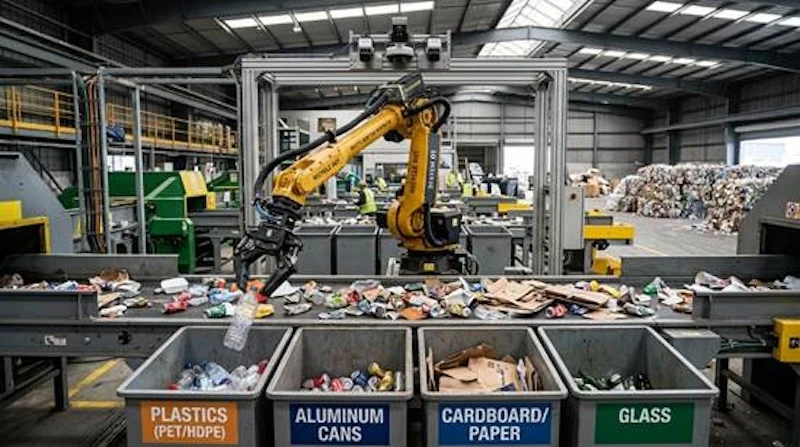
Using advanced sensors, multi-armed robotic sorting cells and digital modeling, the technologies will be tested on live contaminated streams. This will provide measurable data on classification accuracy, throughput, contaminant handling and material recovery.
To this will be added economic modeling for specific sites - to calculate payback periods and investment cases. Less uncertainty, faster implementation.
Center services
Real test beds on contaminated, heterogeneous waste streams including textiles, mixed recyclables and deformable materials
Independent benchmarking on operator-specific waste samples - measurable performance data instead of marketing numbers from suppliers
Support integration in sorting plants and legacy infrastructure, including cramped layouts and variable raw materials
Training and retraining programs for personnel with an emphasis on safe work in contaminated environments
Innovative programs for industry tasks: sorting of mixed fibers, removal of contaminants, automated disassembly
Access to waste operators, local authorities and commercial sites - direct routes to implementation and field testing
Composition of the consortium
The NORAH consortium, led by Kingston University, will include the University of Kent, West London Waste Authority, robot developers, waste operators, local authorities and national organisations.
The center will combine implementation with research and policy alignment. Solutions will meet industry needs, meet regulatory requirements and be scalable to ensure robotics becomes more widespread across the waste sector.
Plans until 2030
Professor Argyriou spoke about plans: to support more than 150 organizations and reach operational implementation by 2030.
“The National Robotics Implementation Center for Waste and Recycling will help UK recyclers take proven robotics out of the lab and into the real world. This will keep valuable materials out of landfills, reduce carbon emissions, create skilled jobs and accelerate the transition to a circular economy.”