Lab-grown muscles allow robots to jump, swim and grab
English translation from Unibot. Source published 2026-10-23.
Laboratory-grown skeletal muscle tissue contracts too weakly to propel biohybrid robots. Researchers from ETH Zurich have shown that it is not the amount of tissue that matters, but how the muscle interacts with the artificial frame.
Muscle and frame are designed together
Their bioactuators connect living skeletal muscle grown from mouse cells to a soft hydrogel scaffold. This material, saturated with water, bends and stretches like living tissue. What's new here is that both parts are designed together as a single system.
First, using computer simulation, scientists determined where and how much muscle tissue to place and what properties the hydrogel scaffold should have.
Aiste Balciunaite and Mike J. Mikelis, co-authors of a recent paper in Nature Communications, have collaborated to develop a new approach to do this. The muscle and frame are designed together from the very beginning.
Balciunaite, a doctoral student in the Soft Robotics Laboratory led by ETH Professor Robert Katzschmann, explains: “Instead of specifying a fixed shape for the muscle geometry, we wanted to design everything from scratch on the computer.”
Muscle movement is visible to the naked eye
To do this, the researchers designed the muscle tissue configuration and frame simultaneously on a computer, rather than one after the other. The algorithm looked for options in which muscle contraction would produce maximum movement of the entire component.
Then the computer-designed muscle actuators were assembled in the laboratory and tested. The frames were printed on a 3D printer using xolography technology - about a minute for each frame.
“Of course, the process was iterative,” recalls Balciunaite. The experiments provided data on material properties and manufacturing conditions, and this data was fed back into the computer simulation.
The resulting bioactuators were about 1.5 centimeters long each. They consist of living muscle tissue and an artificial hydrogel frame. They bend so much that the movement is visible to the naked eye.
Researchers report a range of motion up to 11 times greater than previous systems with comparable amounts of muscle tissue. “With previous systems, sometimes you had to look into a microscope to see the bending,” says Balciunaite.
Jump, swim, grab
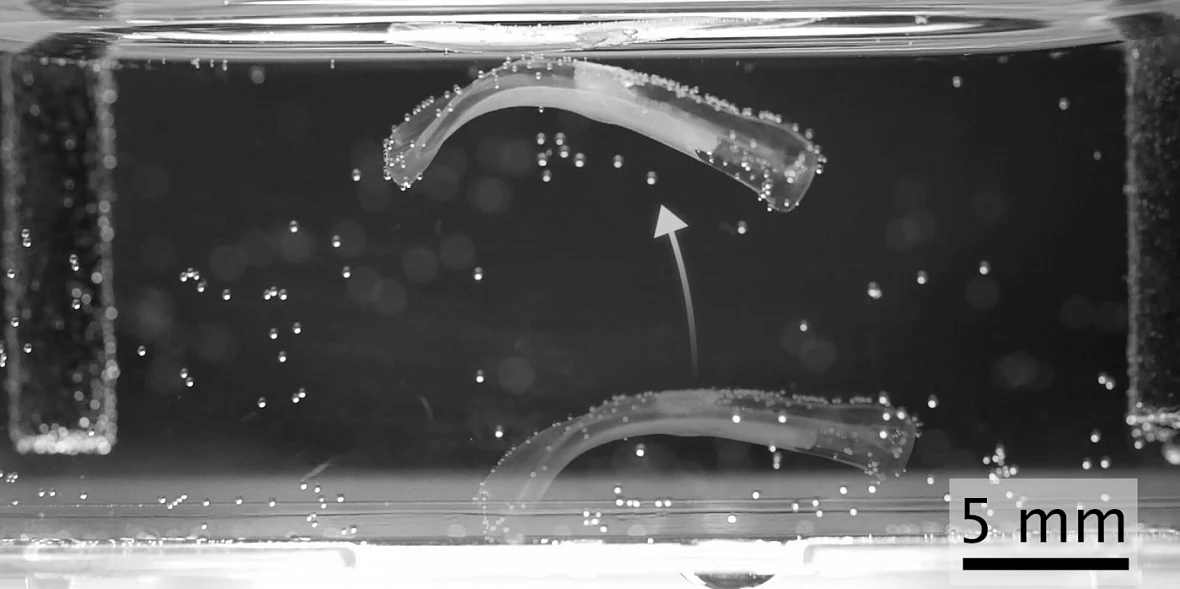
New bioactuators can jump, swim, move on surfaces and grab objects. What impressed Balciunaite the most was the jumping. According to her, this is an unusual movement that requires a particularly strong deformation. For her, this experiment shows how important the interaction between living muscle and a soft artificial frame is.
In one contraction, the actuator rises approximately 5 millimeters (0.2 in) above the bottom of the cup - a third of its own body length. The "walking" version travels 6.2 millimeters per second (0.24 inches per second). Relative to body length, this is faster than any walking biohybrid robot reported so far.
It's not just muscle tissue that makes these little robots move so powerfully. The key is that the muscle and frame form a seamless, strong connection. Thin grooves on the frame help the tissue to securely attach and build muscle fibers. So when transferred to the frame, a minimum of muscle strength is lost.
There's still a long way to go before leaving the laboratory.
However, for now, biohybrid robots depend on a nutrient solution to keep their muscle tissue alive. Researchers are still a long way from a robot suitable for long-term work.
Katzschmann explains: Large systems need artificial blood - a vascular system that delivers oxygen and nutrients to tissues and removes waste products. This is one of the main problems for future developments.
Another difficulty is the natural variability of living tissue. Unlike industrial parts, grown muscle actuators do not behave in the same way. So researchers want to better understand and control how muscle tissue develops in the laboratory as it matures.
Why living muscles at all?
For Katzschmann, the research primarily shows the potential for interaction between living tissue and soft artificial structures. Muscles can do more than just create force. They change shape and thus affect how the body moves and bends. The shape of the muscle itself becomes something that engineers can design, rather than a hard constraint that has to be worked around.
At the same time, the work shows how closely different fields of science should cooperate. Only through the interaction of cell biology, materials science, robotics and computer design was it possible to grow muscle tissue and an artificial frame as a single system.
For Katzschmann, there is also long-term potential: in the future, robotic systems could make greater use of the properties of living organisms, rather than relying only on conventional motors and rigid parts. "We're just starting to build robots in a more natural way," he says.
Lab-grown mouse muscles allow tiny robots to jump, swim, walk and grasp objects.