Mimic Robotics unveils 'advanced video-action models' at Audi plant
English translation from Unibot. Source published 2026-07-30.
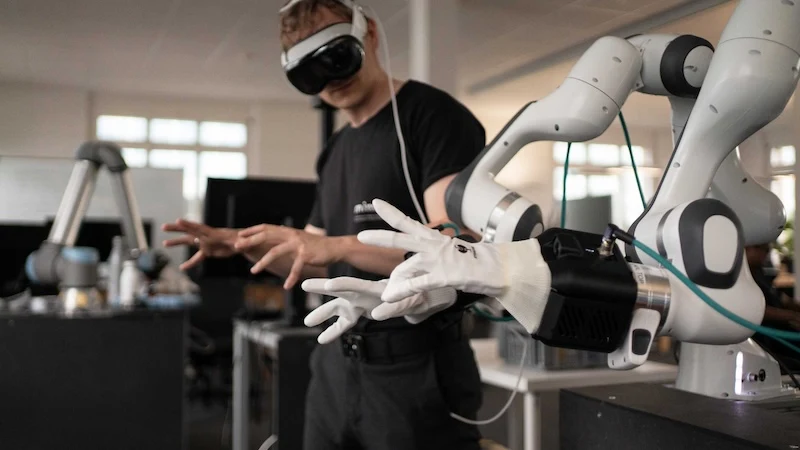
Mimic Robotics has introduced FLUX-mimic, a new Video-Action model created in collaboration with Black Forest Labs. It allows robots to learn and perform complex manipulation tasks in real industrial environments.
What is FLUX-mimic
Mimic Robotics is engaged in physical AI and develops Video-Action models for industrial automation. FLUX-mimic combines Mimic's expertise in robot training, dexterous manipulation and production implementation with Black Forest Labs' advanced visual intelligence architecture - their new FLUX 3 model.
Mimic's early work, "mimic-video", marked the beginning of Video-Action Models: they took a pre-trained video generation model and added the ability to predict the robot's actions. FLUX-mimic develops this foundation, but with an architecture tailored for physical AI.
Fundamental difference from other models
Most modern robot learning pipelines are built on Vision-Language-Action models. Their basis is pre-trained on static image-text pairs. Therefore, they have to learn physical dynamics almost from scratch - using scarce and expensive data from real robots.
FLUX-mimic works differently. It is built on a generative video model that already understands dynamics and behavior thanks to training on huge amounts of video. And then an action decoder is added to it, which predicts the robot’s movements directly from the visual forecast.
Drastic reduction in training time
Result: depending on the complexity of the task, the model can be adjusted for a specific manipulation in just 30 minutes of data from the robot. Previously, this took 30 hours or more. A huge leap - implementation cycles have been reduced from months to weeks.
Robin Rombach, co-founder and CEO of Black Forest Labs, says: “Robotics is one of the most compelling evidence of visual intelligence. To generate compelling video, the model must understand how the physical world works. This same understanding allows us to act within it.
By combining FLUX 3's learned world model with Mimic's expertise in robot training and deployment, FLUX-mimic makes it easier for robots to adapt to new tasks and production environments. Instead of programming them for one single operation.”
Partnership with Audi
Mimic is already implementing FLUX-mimic with production leaders such as Audi. Companies are exploring how advanced Video-Action models can reduce deployment time, engineering costs and robot training for real-world industrial automation.
Audi operates one of the most automated production networks in the auto industry. Therefore, they see exactly where traditional automation is still failing.
Despite decades of investment in industrial robots, tasks involving flexible parts and delicate manipulation remain manual. The variety of options in premium auto manufacturing makes reprogramming robots prohibitively expensive.
Learning-based systems change this logic. And they pave the way for Audi's long-term vision: to transform plants into smart factories, where AI and robots become assistants for employees. They take on the repetitive and physically demanding work while offering targeted support.
Partners' opinion
Christoph Schneider from the Audi production laboratory says: “In partnership with Mimic, we are testing and implementing FLUX-mimic. We've seen these robots solve complex soft-body problems - things that were simply not possible with conventional robotics.
This new technology can greatly help our employees, increase efficiency and expand flexible automation in production and logistics. For us, partnering with pioneers like Mimic and Black Forest Labs is key to advancing physical AI and testing these innovations in real-world production settings.”
Stefan-Daniel Grawert, co-founder and chief product officer of Mimic Robotics, adds: “Audi is exactly the production partner for whom we created FLUX-mimic.
Their production environment requires automation that is flexible enough for unstructured tasks, reliable enough for continuous operation, and one that can be implemented without months of engineering overhead. Through this partnership with Audi, we want to prove that FLUX-mimic is able to meet these requirements on real production lines.”