Morgan Stanley predicts tens of billions of robots in twenty years
English translation from Unibot. Source published 2026-09-24.
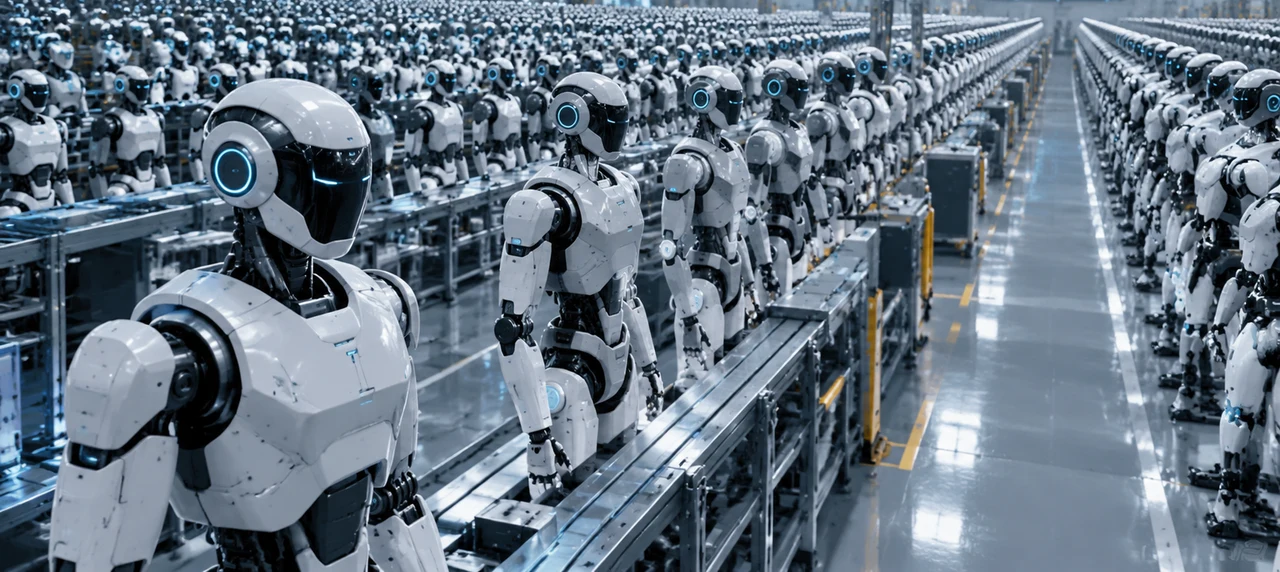
Adam Jonas, a strategist at Morgan Stanley, expects tens of billions of robots in everyday life within ten to twenty years. Moreover, humanoid machines are only part of a much larger economy of physical AI.
In an interview with Bloomberg Tech, Jonas tied the growth of robotics to manufacturing capacity, supply chain policies, edge computing and increased regulation.
World GDP Forecast
His boldest estimate: the combination of AI and robotics can increase global GDP by eight to ten times. True, the interview did not name the assumptions on which this calculation was based.
So it should be perceived as a long-term scenario, and not as a reasonable forecast for the near future. Jonas also described physical AI as potentially socially destabilizing and crucial to military rivalry.
Humanoid robots are just one of thousands of forms
According to Jonas, the humanoid form receives a disproportionate amount of attention and today functions in part as a recruiting and capital-raising tool. Morgan Stanley's scenarios still allow for billions of humanoid robots by 2050.
But the firm expects physical AI to spread across thousands of categories - mobile robots, industrial systems, self-driving cars, low-altitude vehicles.
The key technical argument is this: More and more model inference should happen inside connected machines. Jonas believes that any machine that can be automated and equipped with an edge computer for inference will eventually have it. And technology without such an opportunity, according to his argument, will become obsolete faster.
In this model, connected robots collectively perform a significant share of the world's inference, rather than sending every task to centralized data centers. Jonas compared using a GPU in a data center for a simple inference query to driving a Ferrari to get milk.
The analogy reflects a real system problem, although no figures were given in the interview for energy consumption, latency or computing requirements of the proposed robotic network.
Tesla and SpaceX - the pillar of the investment idea
Morgan Stanley views Tesla and SpaceX as complementary companies in the physical AI space. Jonas described Tesla as a manufacturing and data acquisition layer capable of producing robots and collecting information from the physical world. SpaceX would provide communications and an AI infrastructure layer, including orbital computing associated with Elon Musk.
Jonas declined to assess the likelihood of a merger. But he said that investors should expect continued cooperation - around the idea of producing more intelligence for every unit of energy, cost and time. This is still a strategic thesis, not a disclosed product architecture.
Tesla's humanoid Optimus was mentioned in the conversation, but Jonas didn't provide any deployment data, mission completion numbers, or other evidence that Optimus today is dependent on Starlink or orbital computing. His argument concerned the future connection between connected robots, local inference and wider infrastructure.
China remains embedded in the supply chain
China's leadership in manufacturing ecosystems, critical minerals, rare earths and component supplies Jonas called a fact that the United States will not be able to quickly reverse. Morgan Stanley's scenario analysis did not find a convincing path to decoupling the US and Chinese technology ecosystems without significant inflationary consequences.
Instead, he expects investments in physical AI to boost U.S. manufacturing while maintaining extensive - if politically sensitive - supply chain ties to China. Large-scale production of robots, according to Jonas, will also require professional, technical and highly skilled labor in the United States and partner countries.
Regulation is included in the basic scenario
Jonas expects AI robots to face widespread oversight as autonomous machines have both civilian and military applications. He argues that regulation can change the sequence and speed of implementation, but not prevent deployment on a large scale.
The interview is a broad outlook on physical AI, not a deployment report. His strongest immediate thesis is much more modest than the GDP forecast: robot production, edge computing and supply chain capacity are becoming increasingly difficult to assess separately.