New sensor lets robots "see" touch
English translation from Unibot. Source published 2026-07-04.
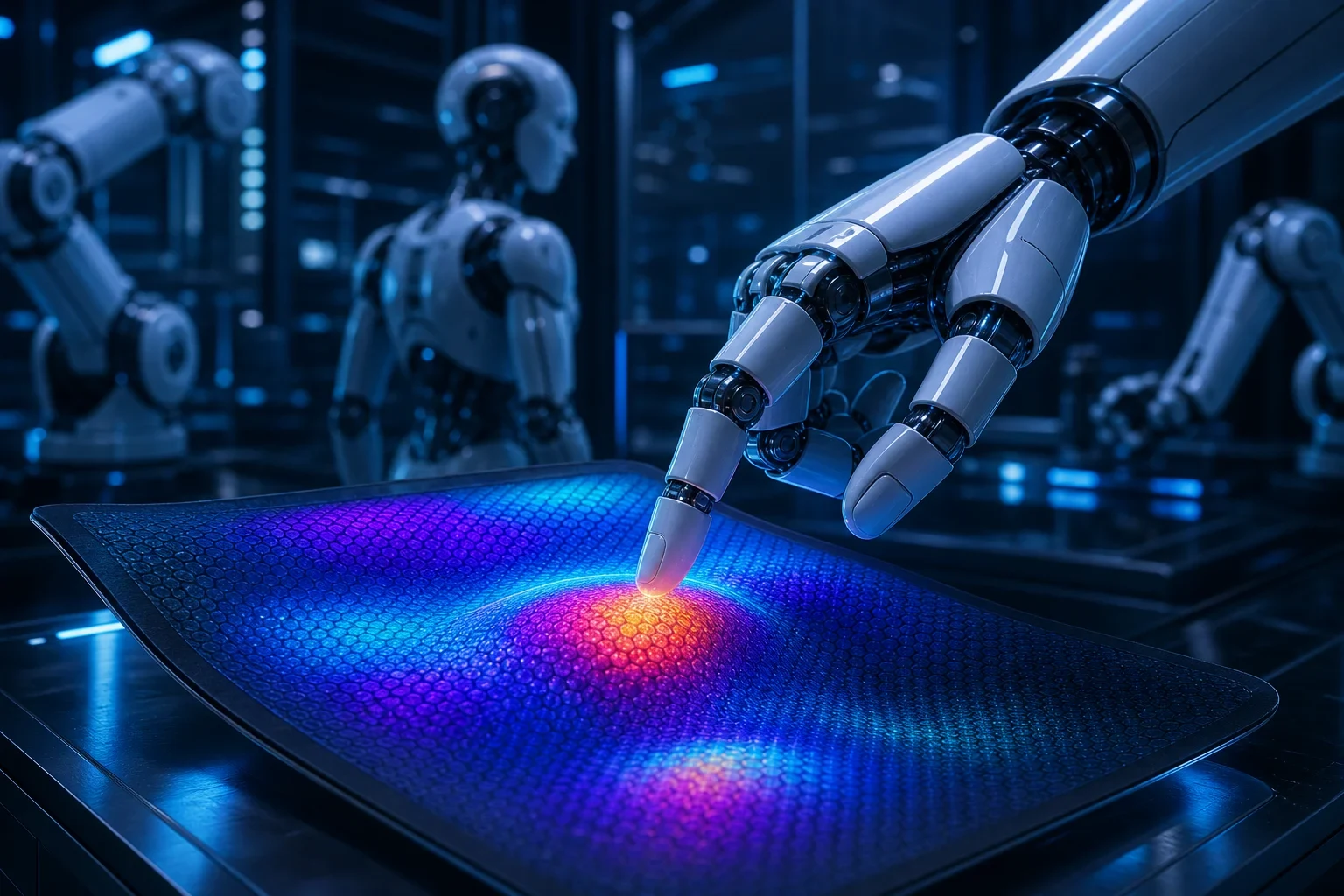
Engineers from Queen Mary University of London have created a color-changing tactile sensor. It allows robots to simultaneously “see” and touch in real time.
The idea came from Giacomo Sasso, a postdoctoral fellow at the School of Engineering and Materials Science at the same university. The principle of operation is simple: invisible forces are transformed into dynamic color patterns. This instantly produces high-resolution maps of contact, deformation and pressure.
The study was published in the journal Science Advances.
How the new sensor works
When pressure is applied to the soft touch surface, the material creates spatially varying structural colors. A regular camera captures them immediately - no complex reconstruction algorithms are needed.
The robot touches the coin, feeling the smallest details of its relief. Source: Queen Mary University of London
From factory floors to operating rooms
The technology makes it possible to create a robotic gripper for assembling microscopic parts with the delicacy required in precision manufacturing. Any slightest change in force becomes visible in real time.
This could also be useful in medicine: an external prosthesis (artificial limb) will gain a more refined sense of touch for everyday or clinical tasks. In addition, surgical systems will be able to distinguish healthy tissue from abnormal tissue by reading subtle pressure signals directly through the color response of the material.
Sensitivity built into the material
Unlike traditional tactile sensors, the new system embeds sensors directly into the material itself. Mechanical interactions turn into color fields that a cheap USB camera reads in real time. The work has already yielded results - this is the first solution of its kind that works without delays.
“You have no idea how much information is generated when your finger presses a switch. There are more than ten thousand mechanoreceptors in the human hand that cope with this task. And yet the sense of touch remains one of the main problems in robotics,” says Sasso.
“We were excited to capture fingerprints—no existing technology can replicate this kind of sensor density with comparable simplicity. The key idea of the project is to think outside the box: instead of embedding dense and congested arrays of sensors, we transferred the sensing into the material itself. Mechanical signals are directly converted into color fields, which are captured by a simple, cheap USB camera.” This produces rich pressure maps and simplifies the system architecture.
Co-authors of the project from the University of Florence, the University of Trieste and the University of Trent (Italy) agree: “What is especially powerful is that the information is already embedded in the light signal. You are no longer reconstructing the sense of touch - you are observing it directly,” says Professor James Busfield.
Resolution of a long-standing compromise
The idea was born out of the need to overcome the constant compromise in visual and tactile perception. High resolution systems typically require heavy computational pipelines to reconstruct contact geometry - this introduces latency. And faster systems often sacrifice spatial detail.
The collaboration between Professor Federico Carpi from the University of Florence and Busfield brought together the worlds of soft robotics and materials science. Building on years of work on stretchable sensors and polymer characterization, the team has made gradual progress in linking mechanical compliance to functional sensing.
In this paradigm, mechanochromic materials open a new direction. Rather than relying on sophisticated microelectronics to interpret strain (taxiles), the material itself becomes a sensor medium, directly encoding mechanical interactions into visible optical signals.