New soft sensor turns touch into robotic movement without electronics
English translation from Unibot. Source published 2026-07-13.
Soft robots are made from flexible, pliable materials. They are increasingly used in a variety of applications - from minimally invasive surgery to deep-sea exploration. But there is one fundamental problem that is hindering development.
To sense their surroundings and respond, most soft robots require separate electronic sensors, signal processing circuitry, and actuators—all of which are controlled by a computer. This chain of components adds weight, complicates the design and creates vulnerabilities. Especially in damp, hot or pressure environments where electronics are easily damaged.
Researchers at the National University of Singapore College of Design and Engineering (NUS CDE) have developed a mechanical soft force sensor that does away with this electronic chain entirely. The sensor converts the applied force directly into a fluid flow, which drives the actuators. It turns out a closed cycle “sensation - action” without any calculations and external power. This approach could simplify the creation of soft robots and allow them to work where conventional electronics are powerless.
Breakthrough in soft robotics
The work was led by Professor Benjamin Tee from the Department of Materials Science and Engineering and Professor Cecilia Laski from the Department of Mechanical Engineering (both NUS CDE). The study was published in Science Advances on July 8, 2026. Their sensor, called ME-SOFS (mechanical soft force sensor), uses a purely mechanical design to sense and separate multidirectional forces and directly convert them into hydraulic movement.
Design and operating principle of ME-SOFS for drive coordination in multi-axis force measurement. Photo: Science Advances (2026). DOI: 10.1126/sciadv.aeb8052
How the sensor works
ME-SOFS is a 3D printed soft porous structure. It is based on a central pillar connected to five adjacent chambers filled with liquid. Four cameras are located horizontally, one - vertically. When force is applied, the strut tilts in the same direction, compresses the corresponding chambers and forces the liquid through soft tubes to the actuators at the other end. Each camera operates independently, so the sensor can sense and separate forces in three directions: horizontal, lateral and vertical.
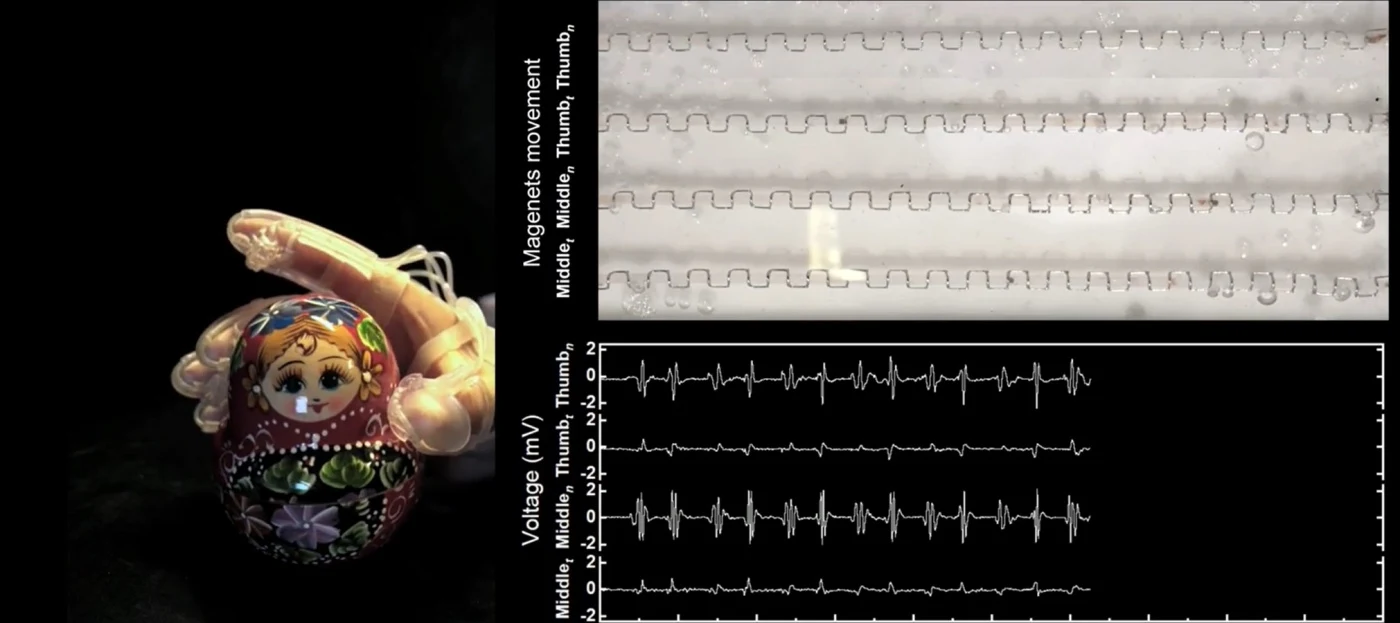
Physical pressing on the sensor turns into fluid movement, which turns into triggering of the mechanism. No electronic conversion. To get a readable electrical signal in addition to the mechanical output, the team added a passive circuit: the displaced fluid moves small magnets past 3D-printed metal arcs, and the change in magnetic flux induces voltage pulses. The same principle causes a bicycle dynamo to generate current from the rotation of the wheel. The number of impulses directly corresponds to the magnitude of the applied force - this is how a measurable indicator is obtained without any active power.
The design of the sensor is determined by adjustable geometric parameters: primarily the diameter of the holes, the thickness and angle of inclination of the slopes of the central porous element. Sensitivity can be adjusted for different tasks - just change the 3D model.
“We took an unconventional path because we were inspired by nature. She can scale tactile sensors in a variety of environments using just cells, which are essentially liquid. We wondered: could a fluid-filled channel not only sense touch, but also directly transmit tactile feedback to another person? It turned out that this architecture is extremely reliable and can be used to train robots in physical AI tasks,” says Ti.
High versatility
To show how flexible this technology can be, the team integrated the sensor into several robotic platforms. A soft glove with five miniature ME-SOFS modules - each about the size of a pea - was 3D printed in one continuous cycle, from a single material and without manual assembly. When worn on the hand, the glove sensed the grip force on each finger and predicted the weight of objects being held - paving the way for applications in prosthetics and human-machine interaction.
In addition, the researchers connected the sensor to a soft haptic pad on a person's fingers, creating a feedback system. The blindfolded operator controlled the robotic arm's grip only through touch: the force recorded on the gripper was transmitted in the form of fluid pressure on the pad, giving the operator a direct sense of how tightly the robot was gripping objects ranging from an egg to wooden blocks to a half-filled water bottle. The signals recorded during a successful grasp were then played back to train the robot to repeat the movement autonomously. This way, the sensor simultaneously transmits touch in real time and collects data for subsequent training.
The same sense-action loop controlled individual droplets of liquid through a miniature controller without any software (useful for portable medical diagnostics) and drove a set of flexible hair-like structures that flexed depending on the direction and strength of the detected impact.
Working in extreme conditions
ME-SOFS maintained stable performance in hot water (90°C) and high pressure, equivalent to a depth of about 11 meters. Its open fluid channels equalize pressure with the surrounding water, so the sensor only registers the applied force, not external conditions. There are no electronic components in it, so it is not afraid of electromagnetic interference that can disrupt the operation of conventional sensors.
“This work is a striking example of how the physical body itself can generate sensorimotor behavior without a control system, which can be seen as analogous to the nervous system in biology. This form of embodied intelligence, that is, mechanical intelligence built into the body itself, is widely observed in nature across species and kingdoms,” says Lasky.
Prospects and future applications
In the future, it is planned to explore various applications of the system due to its force scalability and miniaturization. A direct sense-action loop could be seamlessly built into a soft robot's body, allowing the intelligent agent to exhibit near-instinctive behavior in dynamically changing interactions. The dynamic signals generated by ME-SOFS carry more information about applied forces than simple pulse counting, which can be used for more nuanced sensing in complex robotic interactions.
Joint first author Dr Jan Kelu, Research Fellow in the Department of Materials Science and Engineering, says: “By converting force into action directly, without electronics or a processor, ME-SOFS opens up a wide range of possible applications. In medical training, this will allow trainees to feel the same force of feedback as an experienced practitioner when performing a complex movement. In robotic care for the elderly, this will help the robotic arm respond almost like a reflex - sensing a sudden increase in load when falling and immediately providing stronger support. It’s this direct sense-to-action response that makes the system especially promising for soft robots that need to safely interact with people.”