New training method ensures stability of wheeled, flying and six-legged robots
English translation from Unibot. Source published 2026-10-22.
It is not enough for a robot to simply learn to perform a task optimally - it must do so within reasonable expectations. Until now, roboticists could get one or the other. Aerospace engineering researchers from the Grainger College of Engineering at the University of Illinois at Urbana-Champaign combined reinforcement learning and control theory to ensure robot stability and improve tracking accuracy by up to 15% compared to existing methods.
The paper “Contraction-Aware Reinforcement Learning for Nonlinear Control with Statistical Robustness” by Minjae Cho, Hiroyasu Tsukamoto, and Hugh T. Tran is published in IEEE Transactions on Robotics.
“Reinforcement learning offers a promising way to teach a robot effective behavior, but it often lacks robustness guarantees,” says graduate student Minjae Cho, whose supervisors include Hugh Tran and Hiro Tsukamoto. - Without confidence that the robot will remain stable, it is difficult to deploy it in practice. In the worst case scenario, it may break down and require expensive repairs. Therefore, guaranteeing the stability of the robot along with ensuring effective training is the key idea of this project."
Keep the robot learning on track
Reinforcement learning is similar to the hot and cold game you may have played as a child. One person knows where the object is in the room. When the second, blindfolded, moves in a direction, the first says “hot” if he approaches the object and “cold” if he moves away, giving real-time feedback until the person succeeds.
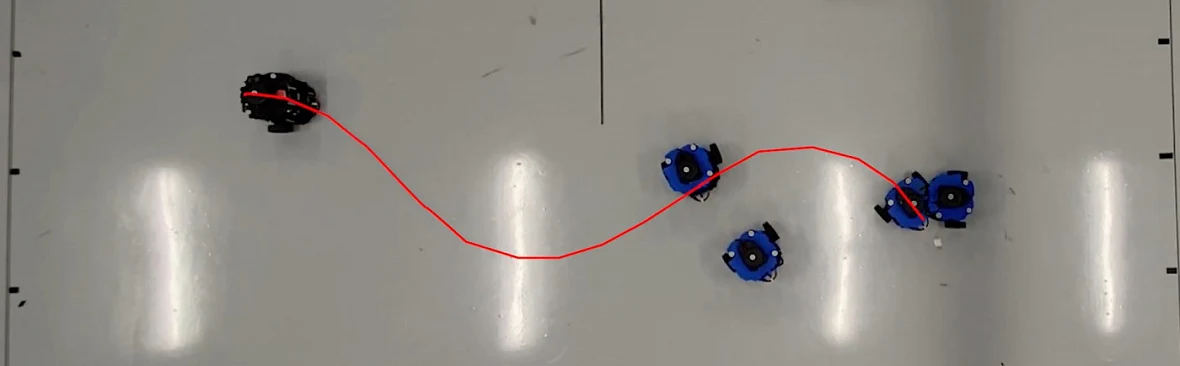
With Cho's new method called CARL (Contraction-Aware Reinforcement Learning), the robot stays consistently on its trajectory and reaches its target faster.
“CARL combines reinforcement learning with contraction theory to ensure its robustness. Small tracking errors may occur, but the method sets mathematical limits on how large they can become. This allows reinforcement learning to serve as the main controller of the robot with stability guarantees.”
Close the gap between simulation and reality
Cho started with the CARL simulation and then moved to the Aerospace Engineering Flight Laboratory to test the method on several real robots.
“There is a difference between the model we train in the computer world and the physical robot in the real world. For example, the model in the simulator weighs 1 kilogram (2.2 lb). In reality it could be 1.2 kilograms (2.6 pounds). This is called the simulation-reality gap, but our algorithm has been tested to cope better with such uncertainties.”
Cho experimented with three types of robots: the wheeled TurboBot 3 Burger, the flapping aerial drone, and the six-legged robot Jethexa. He created a video where the progress of the robots is superimposed on the work of previous algorithms and CARL.
“There was no guarantee that our method would work better than existing ones, especially given the increasing complexity of the robots we were testing. But we found that combining these two methods is not only new, but the performance achieved in the computing world is consistently better in real-world tests - up to 15%."
Where is the method useful?
One example of the method, according to Cho, is fighting forest fires. Rescuers could send robots to identify fires or even deliver supplies.
CARL is open source and the code is also posted on GitHub.
Publication details
Minjae Cho et al., Contraction-Aware Reinforcement Learning for Nonlinear Control with Statistical Robustness, IEEE Transactions on Robotics (2026). DOI: 10.1109/tro.2026.3727138
Citation: Wheeled, flying and six-legged robots stay on track with new learning method (2026, October 21) retrieved 22 October 2026 from https://techxplore.com/news/2026-10-wheeled-flying-legged-robots-stay.html