Nvidia and LG's Humanoid Robot Partnership Covers Motors and Data Centers
English translation from Unibot. Source published 2026-06-09.
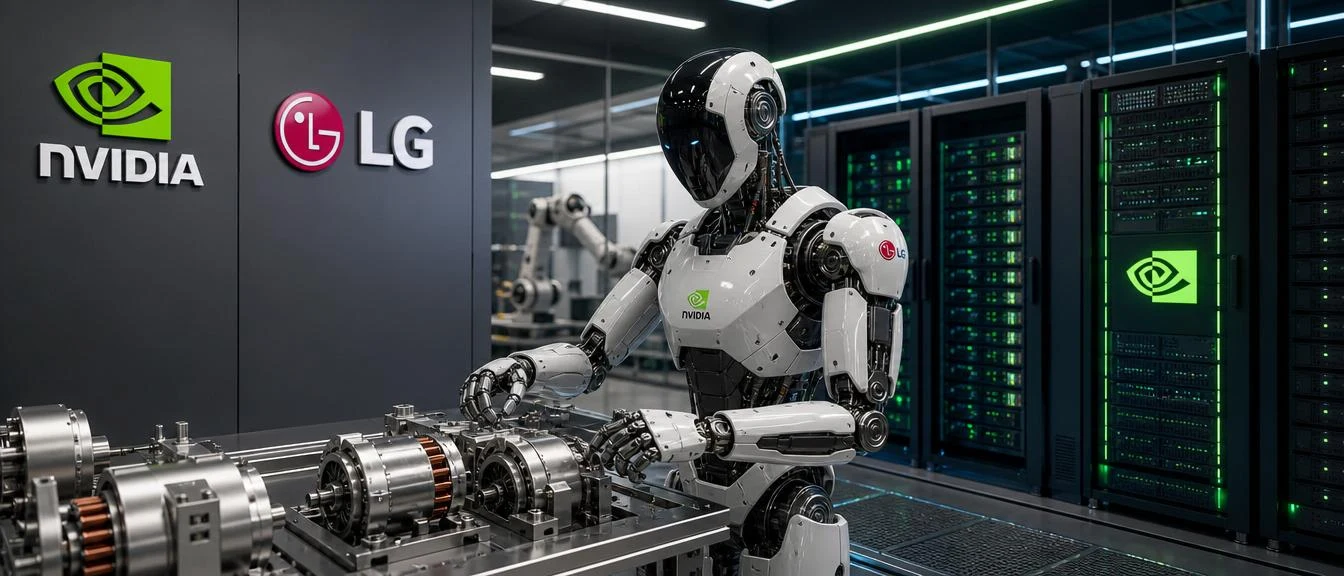
Nvidia CEO Jensen Huang said June 8 in Seoul that the companies are working together on humanoid robots, motor technology, mechanical systems and future data centers. The announcement is significant for robotics because it points to a program that integrates software and computing platforms with actuator, system and manufacturing development within a large industrial group.
Collaboration goes beyond supplies
Huang spoke after a meeting with LG Group Chairman Koo Kwang-mo, according to letsdatascience.com, which summarizes material from Reuters and Korean industry sources. He described work that went beyond the typical supplier relationship.
Reuters quoted Huang as saying that Nvidia is "working with them on motor technology as well as mechanical systems" so that companies can integrate humanoid robotics with what he called the future of robotics. This language is notable because it places collaboration at the hardware level, rather than just at the AI software level, where Nvidia is already a familiar supplier.
Chosun, as stated in the original text, reported that Huang described the relationship as a "huge team" spanning Nvidia's business lines. This involves the involvement of multiple engineering teams rather than narrow collaboration on individual components.
Public information is still limited. The original text makes it clear that neither Reuters nor the Korean publications have published the full scope of work or the terms of the multi-year binding agreements. Therefore, the partnership should be viewed as an open collaboration rather than a fully defined plan to create a humanoid robot product.
Technical aspects of cooperation
The most specific technical signals in reports are mentions of engine technology and mechanical systems. For humanoid robot developers, these are the basic building blocks that directly affect the robot's performance, reliability, and manufacturability.
If the collaboration moves into manufacturing programs, it will mean working together on the parts of the humanoid robot stack that determine motion quality and physical integration, not just the perception interfaces or language interfaces.
Existing connections between companies
The source also points to existing ties between the two companies in the areas of robotics and factory software. Industry reports and company statements cited by letsdatascience.com suggest that LG has already integrated Nvidia chipsets into its CLOi home robot. The company also uses Nvidia platforms such as Isaac and Omniverse to simulate robots and digital twins of smart factories.
In practice, this means that companies already have a working relationship in the areas of simulation, training environments, and virtual plant simulation—tools relevant for the development and validation of more complex humanoid systems.
LG Manufacturing Efforts
Additional industry reports cited by the source suggest that LG is stepping up efforts to internalize drive manufacturing. The company is also working on server and infrastructure cooling components relevant to large data centers.
This combination provides important context. Humanoid robot programs require a depth of electromechanical knowledge, while modern robot development also depends on significant computing infrastructure for simulation, training, and deployment support.
Implications for humanoid robotics
For robotics practitioners, the significance of Nvidia and LG's partnership lies less in the announcement of a finished robot and more in the alignment of capabilities. Nvidia provides widely used robot development tools and computing platforms, while LG Group provides manufacturing scale and mechanical and electronic systems expertise.
These types of partnerships can shorten prototyping cycles if simulation, control systems development, and hardware design are conducted in parallel.
The reports also suggest that LG's current work in robotics may serve as a bridge to the development of humanoid robots, rather than a starting point from scratch. The source cites Thelec and LG disclosures indicating that Nvidia's Isaac and Omniverse platforms are already part of LG's robotics and smart factory workflows.
This does not confirm the existence of a commercial product in the form of a humanoid robot, but it does mean that some of the supporting software and digital infrastructure has already been created.
At the same time, the article does not indicate the name of the robot, launch date, technical characteristics or deployment goals. These omissions matter. Without a published roadmap, it remains unclear whether the immediate target is a research platform, a prototype, an internal industrial tool, or a larger commercial humanoid program.
What to track next
The next useful signals will be tangible engineering milestones. According to the source, Thelec said it had discussed testing prototypes of CLOi humanoid robots and the goal of starting mass production of the actuators in the first half of the year, which is attributed to LG's CFO. If these timelines are reflected in subsequent reports, demos or product announcements, it will give the partnership more concrete weight.
Technical demonstrations will also help clarify the division of labor. The source highlights the possibility of using simulation training for closed-loop motor control, as well as reference architectures for cooling and powering data centers in which both companies are involved.
For the humanoid sector, this will show whether this remains a broad strategic alliance or evolves into a more tightly integrated robot development platform.
What is known today is that Nvidia and LG have publicly linked humanoid robotics to the motors, mechanical systems and computing infrastructure that underpin the development. What remains unknown is the timing, the robot's specific architecture, and whether the collaboration will lead to the creation of a signature humanoid system or primarily strengthen LG's internal robotics capabilities.