Paris-based UMA presents Northstar humanoid that learns by observing people
English translation from Unibot. Source published 2026-08-05.
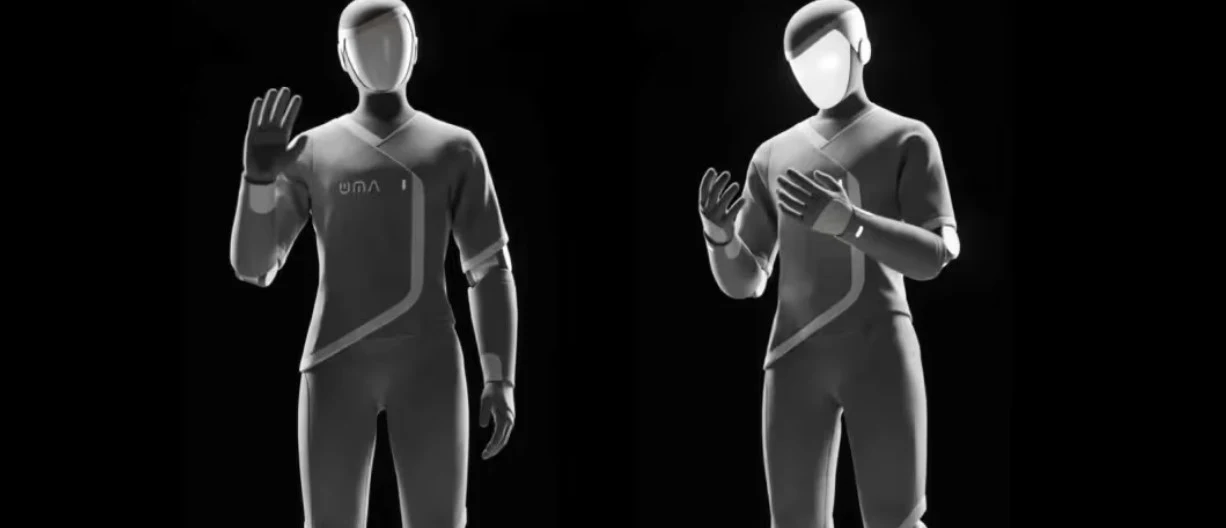
Paris-based robotics company UMA presented Northstar, a lightweight humanoid that learns practical work by observing people. Instead of relying on predefined movements, the robot repeats and refines actions through practice.
Learning through observation
Northstar is designed to acquire skills from humans. This approach gives the robot a human-oriented identity, combining physical robotics with modern AI.
The design reinforces this goal. A restrained visor replaces expressive facial features, and a soft outer body makes the machine approachable in shared spaces. Low weight supports safer human interaction.
Specifications
Northstar stands 165 cm tall, weighs 40 kg and has a rated payload of 15 kg. Each arm ends in a five-fingered hand. There are 24 degrees of freedom in total, including 12 in the hands.
Humanoid Guide gives it an overall score of 3, corresponding to the developing category:
navigation: 1 out of 5;
manipulation: 2 out of 5.
Key applications
Northstar targets environments where careful, repeatable handling matters more than impressive athletic performance. Its current strengths fall into two main scenarios: sorting goods and folding clothes.
In warehouses or fulfillment centers, sorting involves basic pick, place and organize operations that benefit from a humanoid form factor able to work in human spaces with standard equipment.
In domestic or care settings, folding clothes demonstrates controlled arm movement, hand work and the ability to handle soft, deformable objects common in everyday life.
Prototype status
These tasks match the current skill profile. Manipulation is developing but remains at an early stage, so the robot is better viewed as a platform for learning and practicing structured tasks than as a general workforce replacement.
Northstar is currently a prototype, making it more significant as an indication of direction than as a finished mass-market product.
Team experience and positioning
UMA positions the project at the intersection of embodied AI and practical robotics, drawing on experience associated with Tesla Autopilot and Optimus, Google DeepMind, Hugging Face and humanoid design. This combination matters as the industry increasingly depends on teams able to unite perception, learning and physical execution in one product.
With a stated price of $70,000 and target markets ranging from homes to healthcare, logistics and manufacturing, Northstar enters the discussion as an ambitious French contender. Its wider significance lies in how new European startups are trying to make humanoids safer, more trainable and more acceptable in everyday human environments.