Purdue scientists have created an underwater robot for reliable ocean missions
English translation from Unibot. Source published 2026-08-27.
Purdue University engineers have developed an underwater robot that can change its mode of movement during a mission. A patent application has already been filed for the technology. The device could improve ocean exploration, inspection of underwater infrastructure and search and rescue operations. The secret is that it adapts to tasks in real time: it works as a drifting platform, a glider or a vehicle with propulsion.
The robot chooses its own mode of movement
Yu She, an assistant professor in the Edwardson School of Industrial Engineering, created technology that allows a robot to change the way it moves mid-task. “It changes the way it moves depending on what the mission needs: to conserve energy, go further, follow the current, actively maneuver or get out of a confined space,” he explained. According to Associate Professor She, the main challenge in underwater robotics is that different mission phases require different modes of propulsion: passive drift, gliding due to buoyancy, or propulsion. Each option has its pros and cons. “Our technology combines all three modes into one compact subsea platform,” he says. “The robot itself chooses the appropriate mode for the task or environmental conditions, rather than being stuck in one forever.” This technology is especially useful for missions where the vehicle must operate for long periods of time, navigate tight or unpredictable conditions, and change its movement strategy within the same dive. Examples of such tasks: - monitoring of oceans and lakes; - mapping of currents and flows; - inspection of underwater structures; - exploration under shelf ice; - environmental monitoring; - distributed data collection underwater. She referred the development to Purdue Innovates' technology commercialization office, which filed a patent application to protect the intellectual property.
Weaknesses of traditional devices
If the craft can't change its mode of propulsion, the mission could become less efficient, unreliable, or fail altogether, She says. “A purely drifting platform floats with the current but cannot actively maneuver toward a target or get out of an unwanted route,” he explains. - A pure gliding platform has good endurance, but fails in tight and difficult conditions. The device maneuvers well only with a propulsion device, but it quickly consumes energy, which reduces the mission time.” These restrictions hit end users: operating costs increase, operating time decreases, the completeness of data collection decreases, and the risk of losing or getting stuck with the device increases. In addition, instead of one platform, you have to run several specialized machines. “In scientific applications like polar or oceanographic monitoring, these limitations also reduce the quality and quantity of data needed to understand important natural processes,” he added.
How the new robot works
The robot's integrated architecture coordinates buoyancy adjustment, internal mass displacement, folding wings, and propulsion. Thanks to this, the device switches between several modes of movement during one dive. “It can drift with the flow when energy efficiency or environmental tracking is important, glide when low-power long-distance travel is needed, and engage propulsion when active maneuvering, position holding, or escaping tight conditions are required,” he said. The robot combines three types of movement: drifting, gliding and powered propulsion. Switching between modes is currently done manually, but in the future this task is planned to be automated. “In drift mode, it regulates buoyancy and moves with the flow of water,” the scientist explained. - In glide mode, it changes buoyancy, shifts the internal weight to change the angle of inclination and deploys hydrodynamic wings, turning vertical movement into horizontal. When an active maneuver is needed, the engine and steering gear are turned on.”
Tests and future plans
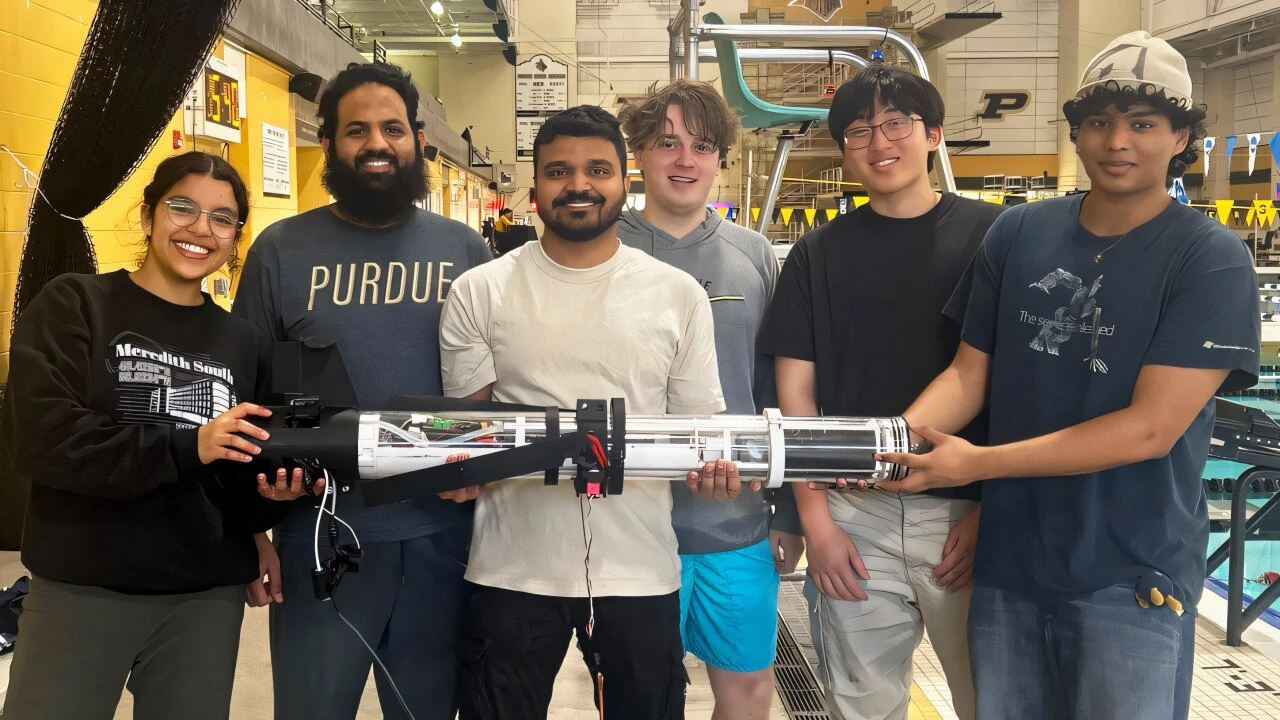
Testing of the prototype in an underwater pool confirmed the performance of key components: a folding wing, a buoyancy control system for diving and ascent, propulsion by engine and gliding due to the coordinated operation of ballast, pitch control and wings. “Tests have shown that the main subsystems work together in water and the robot demonstrates all three declared modes of movement,” said Associate Professor She. “Future work will focus on quantitative indicators: energy efficiency, autonomy, maneuverability, mode switching time, control accuracy and stability in the field.” The next stage is a detailed assessment of the characteristics and preparation for actual operation. “We want to measure power consumption, autonomy, maneuverability, gliding efficiency, speed of mode changes and reliability in real-world conditions,” he said. “We will also develop more advanced algorithms for closed-loop control and autonomous mode selection, so that the robot itself decides when to drift, glide or use propulsion, based on mission objectives and environmental data.”