RayNex G3 industrial humanoid targets heavy manufacturing work
English translation from Unibot. Source published 2026-08-22.
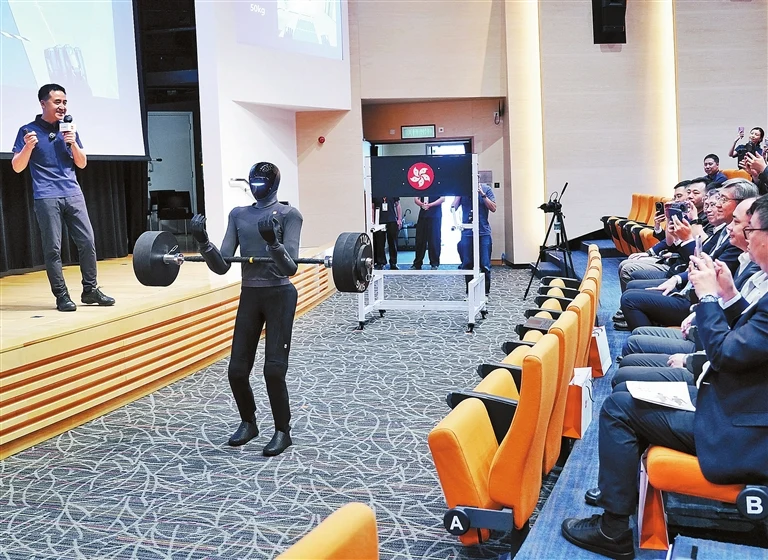
The industrial humanoid RayNex G3 is designed for heavy manufacturing work. It stands 173 centimeters tall, weighs 60 kilograms and has a stated deadlift capacity of 100 kilograms. Its compact humanoid body combines hybrid actuators: linear and harmonic elastic joints work alongside frameless torque motors and gearboxes.
This arrangement provides precise force delivery and stable whole-body movement.
Design and specifications
The platform has 32 degrees of freedom, including 12 in its hands, with five fingers on each. Proprietary RayBrain AI and RayBrain OS systems connect perception, planning and control. A whole-body force-control network uses 44 precision sensors to adapt movement dynamics to the load.
The robot's maximum speed is 6 kilometers per hour, with a working gait of 4 kilometers per hour. Ethernet and WiFi are supported, and one charge provides eight hours of operation. It is intended for industry and manufacturing.
Skill level and demonstration tasks
RayNex G3 scores 5 out of 10 on the overall skill scale, placing it in the developing category. Navigation scores 2 out of 5, indicating an early level of mobile autonomy. Manipulation scores 3 out of 5, reflecting developing whole-body skills and task performance.
Demonstration tasks include:
climbing stairs;
sorting goods;
assembling products;
loading a dishwasher.
These tasks suit structured workspaces where the robot combines movement with two-arm manipulation. Its stated load capabilities, including carrying 80 kilograms while moving and holding 60 kilograms with both arms, emphasize the platform's focus on intensive material handling.
Manufacturer and price
RayNex G3 is produced by Chinese company NineRay and costs $6,500. For specific applications, the manufacturer invites discussion of individual requirements. Safe operation near people is claimed, an important consideration for shared industrial environments.
Market positioning
The combination of high payload, long runtime and proprietary control technology is a step toward humanoids that work in manufacturing rather than only in laboratories. By combining in-house component development with a unified AI stack, NineRay positions G3 as a foundation for industrial automation.
The availability of such a machine itself points to growing commercial interest in humanoid systems for heavy factory tasks.