Robot bird dives underwater and takes off without a run-up
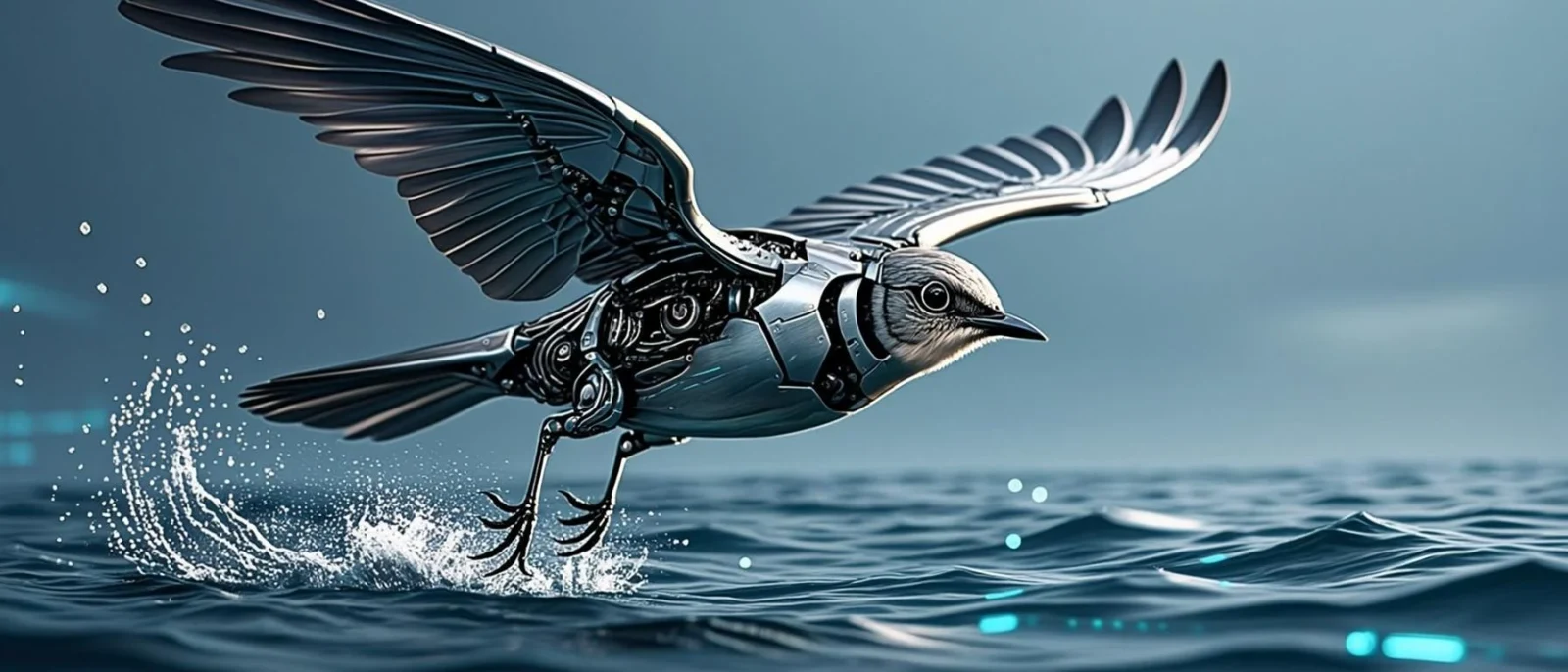
English translation from Unibot. Source published 2026-07-10.
Inspiration from nature: birds that fly and dive
Loons, gulls, puffins and petrels are just a few of the hundreds of bird species that can both fly and swim. These diving birds are capable of falling like stones into the water for prey, and then soaring into the sky again.
Inspired by such waterfowl, engineers from the Massachusetts Institute of Technology and the Swiss EPFL created a robot. He can swim underwater, and then, flapping his wings, break to the surface and continue flying - just like a real diving bird.
How does a robot bird work?
The flapping wing vehicle, or FAAV, weighs less than 300 grams (10.6 ounces). His goal is to help scientists understand the mechanics that allow diving birds to move in both air and water.
The robot has a central body (fuselage), two flexible flapping wings and a controlled tail. The wings and tail can be replaced - choose different sizes.
In experiments conducted in a laboratory pool and on a local lake, engineers selected combinations of wing size, flapping frequency and tail angle so that the robot smoothly transitioned from the water column to the surface and took off.
Practical value of the discovery
The results were published in the journal Science. They can help scientists understand how diving birds adapt their flight mechanics to their environments - air or water, which have completely different physical properties.
By the way, the design can give rise to a new class of drones - air-water vehicles. Researchers imagine how such winged robots will be used in oceanography: they will fly to the desired area, take samples where it is dangerous for ordinary ships to go.
“Our dream is for oceanographers, marine biologists and coastal residents to launch such a robot from a boat or from the shore. It will fly to an object of interest - an iceberg, a port facility or a school of whales - dive, take a sample, return and transmit the data. And all this is several times cheaper than traditional methods. And then he’ll go again for a new portion,” says Rafael Zufferi, assistant professor of mechanical engineering at MIT.
Zufferi is the lead author of the study. Colleagues from EPFL and Northwest Indian College in Bellingham, Washington also participated in the work.
Flight mechanics: lessons from nature
At MIT, Zufferi runs the AURA laboratory, where he and his students design aircraft and underwater vehicles inspired by the biomechanics of nature. Their robots are small - to quietly explore the oceans and bodies of water and monitor their condition.
In the new work, the team set a goal: to create a device that can fly through the air and swim underwater. Any such machine must adapt to and switch between two completely different environments. Water is a thousand times denser than air - it would seem that completely different mechanics are needed. But nature thinks differently.
“We have to adapt some things to make the transition work. But the solution already exists in nature, says Zufferi. - Puffins, for example, fly in the air very quickly, and dive and swim at a speed of three meters per second. They do amazing things. We knew it was possible. It’s just that no one has tried to implement this in a mobile robot before.”
To understand how diving birds fly, the team reviewed the scientific literature and collected available data on puffins, petrels, kingfishers and other feathered divers.
It turned out that small birds flap their wings about ten times per second in the air and about four times per second under water. Large birds have a slightly lower flapping frequency, both in the air and in the water, due to their wider wingspan.
Based on the biomechanics of birds, the team developed a winged robot that flaps its wings at a frequency similar to real diving birds.
Decisive leap: how a robot flies out of the water
The new robot vaguely resembles a bird: it has a body, two wings and a tail. Hidden inside the case is a battery and a waterproof electric motor that rotates the crankshaft. This, in turn, causes the wings to flap up and down at a given frequency.
The wings themselves are made of thin membranes coated with hydrophobic nanoparticles - they help repel water. And the robot’s tail is also motorized: by changing the angle of inclination, it allows the machine to soar up or dive down.
A robot flapping its wings moves from water to air on a natural lake. Source: Raphael Zufferey
The wings can be replaced to suit different sizes. The researchers made and tested three sets: small (60 centimeters in span), medium (80 centimeters) and large (one meter). The experiments were first carried out in a small tank of water, and then on Lake Geneva in Switzerland.
During the tests, the robot was placed underwater, about half a meter below the surface. The wings were given a certain flapping frequency, and the tail was given a certain angle of inclination throughout the flight. Scientists have observed: under what conditions the machine successfully floats to the surface, breaks out of the water and takes off into the air.
The robot made several flights - with different wings, different flapping frequencies and different tail angles. As a result, it turned out that it swims, flies and moves from one environment to another most reliably with medium wings.
The key is flexibility. The wings must be flexible enough to reduce the amplitude of flapping in the water, but at the same time rigid enough to keep the robot in the air.
Researchers also discovered that the robot is capable of swimming underwater at a speed of almost a meter per second if it flaps its wings at a frequency of about five hertz (five beats per second). In the air it flies about six meters per second at the same frequency. The speeds and frequency of flaps turned out to be close to those of real diving birds.
To make a jump from water to air, the robot must be tilted 70 degrees - a fairly steep angle that prevents the tips of the wings from touching the water surface as the car flaps and takes off. If the angle is made even steeper, the robot will tip back into the water.
Unexpected conclusion: paws are not needed
And here's what's interesting: it was this combination of wing size, flapping frequency and tail angle that allowed the robot to swim underwater, lift off the surface and fly - without which most diving birds cannot do without. Without paws.
When birds like puffins and ducks take off from the water, they not only flap their wings and change the angle of their tail, but also push off with their feet. But Zufferey and his colleagues were surprised to discover that, at least in robotics, you don't have to row to fly out of the water.
“If you look at birds, most of them need to paddle their feet on the surface to fly. And we asked ourselves: do robots need the same thing? It turned out not,” says Zufferey.
Future plans
Now the team is finalizing the design of the wings: they want them to not only flap up and down, but also turn. In addition, the robot will be tested in turbulent conditions, such as taking off from rough water and flying against the wind. And then they plan to use the machine to collect data in oceanology.
“One of the main challenges in ocean science is collecting data frequently and at many locations simultaneously. This robot could solve this problem in the future, explains Zufferey. - It can be launched not once a week, but every hour. It can quickly take off, dive, return, transmit data and set off again - and so on many times.”
Publication data
Raphael Zufferey, Leaping out of the water: Aerial-aquatic locomotion with flapping wings, Science (2026). DOI: 10.1126/science.aeb6744. www.science.org/doi/10.1126/science.aeb6744
Who is behind this story? Sadie Harley
Bachelor of Science in Life and Environmental Sciences. Experience working in a microbiology laboratory and covering pharmaceutical news in the oil, gas and renewable energy industries. Full profile →
Andrew Zinin
Master's degree in physics with research experience. Longtime science news enthusiast. Plays a key role in the editorial success of Science X. Full profile →
This story is reprinted with permission from MIT News (web.mit.edu/newsoffice/), a popular site covering research, innovation and teaching at MIT. Quote:
Birdlike Robot Swims Underwater, Then Flies into the Air Without Paddle (2026, July 9) Retrieved July 10, 2026, from https://techxplore.com/news/2026-07-birdlike-robot-underwater-flight.html
This document is protected by copyright. Except for fair use for private study or research, no part of it may be reproduced without written permission. The content is provided for informational purposes only.