Robot.com launches humanoid robot 'for jobs that make people burn out'
English translation from Unibot. Source published 2026-07-14.
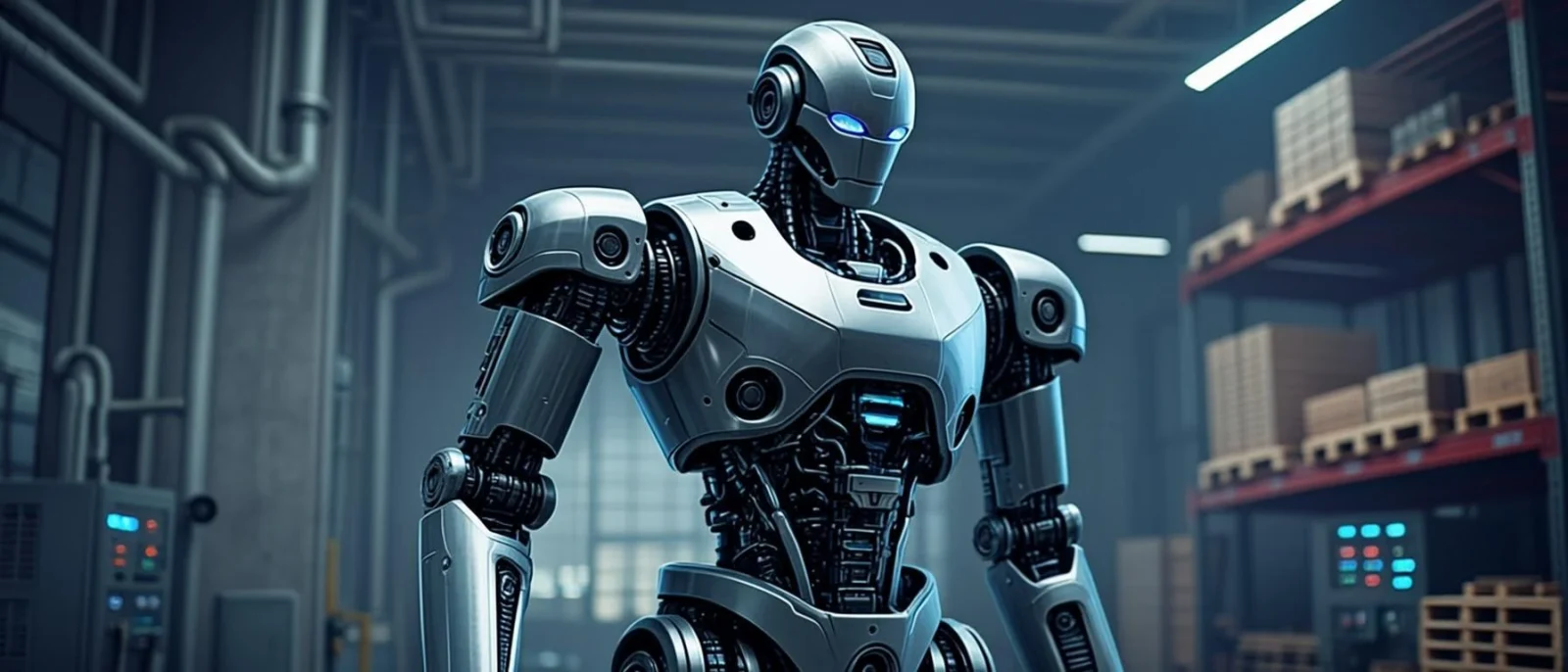
Robot.com brings robots into the real world. The company announced its entry into the humanoid work solutions market with the commercial launch of R-noid, a robot "designed specifically for repetitive, multi-shift, and hard-to-staff work."
RaaS model and first tasks
Under the Robot-as-a-Service (RaaS) model, Robot.com can go from the first customer visit to running an autonomous R-noid on site in just eight to twelve weeks.
The R-noid launch begins with five initial solution categories: Restaurant Assistant, Packer, Picker, Folder and Hostess. They are deployed across six industry verticals: industrial, logistics, healthcare, food service, hospitality and entertainment. These solutions target roles that operators chronically fail to fill.
At the recent Automate Show in Chicago, Robot.com showed R-noid in the Humanoid Robots Pavilion along with proven solutions R-kiwi, R-kiwi+ and R-cargo.
The problem of staff turnover
The problem that R-noid solves is structural and pervasive. At fast food establishments, staff turnover exceeds 130 percent. The average period of work for a warehouse picker is only 1.2 years. More than 67 percent of hoteliers report critical staffing shortages in housekeeping and laundry departments.
These staffing failures jeopardize the customer experience - vacancies simply are not filled. R-noid never quits.
“The future of work is not about fewer people. These are people freed from the parts of their jobs that stress them out and doing more of what they are good at,” said Felipe Chavez Cortez, CEO and co-founder. “We create robots that make this exchange real: taking repetitive physical work away from your team so they can focus on craftsmanship, care and the customer.”
Partners and ecosystem
The launch is supported by Nvidia Robotics, Astribot, FieldAI, Formic, Physical Intelligence, Robots for America and Yukai Engineering. R-noid adds humanoid work solutions to Robot.com's wider fleet - R-kiwi for delivery, R-cargo for transportation and R-kiwi+ for advertising. They all work on the same software stack and according to a five-phase interaction model.
Robot.com is partnering with FieldAI to bring generic field fundamental models (FFMs) to R-noid as the brain of autonomy. FFMs serve as an operational AI layer that generalizes the operation of different robots and environments.
They serve three roles: provide safe and reliable operation in dynamic real-world environments without prior information or supporting infrastructure; prevent models from hallucinating through physically based AI models; coordinate the work of several robots together.
Construction and design
The body that powers the system is designed for reach and stability, with two arms with seven degrees of freedom (DoF), a four-degree-of-freedom articulated torso with a vertical reach of 0 to 1.9 meters, and a holonomic mobile base that allows the R-noid to rearrange itself in tight and congested spaces.
For the robot's design and character, Robot.com turned to Yukai Engineering, a Japanese studio known for emotionally expressive consumer robots. Yukai advised on materials, production and interaction design.
The result of the collaboration was R-soul - a system of expression and behavior designed to gain people's trust in seconds. This is the goal Robot.com has been striving for since 2017: creating robots that open people's hearts and minds to the future of technology. R-soul allows the robot to communicate intent, status, and personality.
Manual dexterity and tasks
Physical Intelligence provides sleight of hand. R-noid runs on π0.7, a vision-language-action model from Physical Intelligence designed for universal manipulation. It reads instructions in natural language, looks at the scene in front of it, and generates arm and hand movements to complete the task, adapting to changes in objects, location, and order.
One model covers packaging, picking and folding, so adding a new task means expanding the same system rather than developing a new robot for each job.
At launch, R-noid can perform 19 deployable tasks in five categories. Pilot implementations are already underway, demonstrating the speed of influence of new humanoid robots on business indicators.
R-noid Packer works at an award-winning golf course, packing orders on site. The Packer category is also moving towards production in a large food manufacturing facility - early results confirm R-noid's end-line capabilities at scale. Picker is designed for direct integration into existing picking ports in logistics operations without refurbishment of the facility. Formic acts as a deployment partner.
Implementation speed
Robot.com is a humanoid solution partner that helps clients test, deploy, and scale automation in real-world production environments.
"Our answer to the question 'how long will it take?' “weeks, not years,” says David Rodriguez, co-founder of Robot.com. - Thanks to thoughtful hardware design, best-in-class software and a proven platform, we can launch a robot that will do real work on your site within a few weeks of the first conversation. No other humanoid robot platform can boast of this.”
Robot.com Park is built on the full robotics stack from Nvidia. The robots are powered by Nvidia Jetson modules: they handle perception, planning and control on board, delivering the low latency needed for real-world tasks. Throughout all stages of development, Robot.com uses Nvidia Isaac Sim, a simulator, to test, validate and stress test each robot before deployment. This ensures reliability even before the device reaches the customer site.
Future plans
In addition to debuting at Automate, R-noid will be among the key exhibitors at Robot.com's first Cannes Advertising Festival. There, the company will act as an official partner for robotic innovation within the AI & Tech Sandbox from PMG.