Robotera presents M7 upper-body humanoid
English translation from Unibot. Source published 2026-08-05.
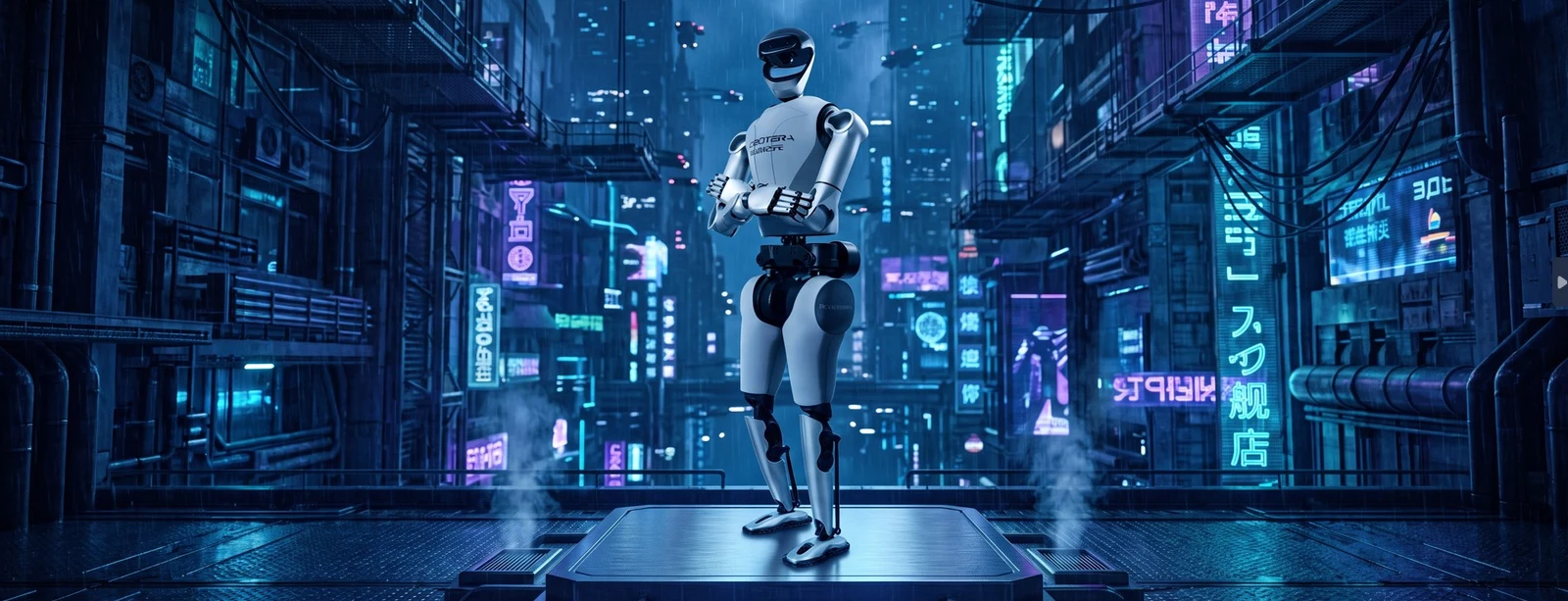
Robotera presented M7, an upper-body humanoid for embodied AI research, teleoperation and precise manipulation. The platform prioritizes arms and hands rather than mobility.
A compact developer platform
The robot stands 119 centimeters tall and weighs 43 kilograms. It has 43 degrees of freedom, including 24 in the hands: ten fingers enable two-handed work.
Its structure uses aluminum alloy and engineering composites. Actuation combines electric servos, harmonic gearboxes and precision joints. Stereoscopic RGB vision provides perception, while Ethernet, USB and WiFi provide connectivity.
The software environment uses Linux and ROS, with stated compatibility with embodied AI models and Robotera VLA models.
Capability assessment
M7 scores 2 on the Humanoid Guide scale, indicating an early capability level. Navigation is rated 0 out of 5 and manipulation 2 out of 5. The platform clearly targets upper-body experiments rather than autonomous movement.
Practical applications
M7 is best suited to manipulation tasks such as goods sorting and product assembly. Stereo vision, dexterous hands and teleoperation support let operators and researchers practice grasping, handovers and placement with precise control over movement quality.
The 24 hand degrees of freedom, human-like arm geometry and Linux/ROS stack make it a useful tool for collecting embodied AI training data for structured industrial operations.
LLM compatibility adds capabilities: the robot understands natural-language commands and connects them to physical actions. This is useful in sorting and assembly research in laboratories, pilot manufacturing cells and robotics development programs.
Status and price
Robotera states that M7 is already in production. The price is $100,000. It is a commercial research and development platform rather than a concept prototype. Built in China, it targets AI development, logistics, manufacturing and science.
A shift in humanoid robotics
M7 reflects a broader shift in humanoid robotics: useful hand work first, full mobility later. This gives universities, industrial developers and automation teams a practical route into teleoperation, perception and robot learning without the extra burden of a walking machine.
Its human-safe design and compatibility with modern embodied AI software make it relevant to organizations building the next generation of interactive robotics applications.