Scientists have created artificial skin for robots that is sensitive to pencil lead and needles
English translation from Unibot. Source published 2026-10-28.
Robots have learned to sense touch. And even pull your “hand” away from the needle.
Researchers have covered robotic fingers with new artificial skin. It lets the robot grasp fragile pencil lead and withdraw from a needle before it punctures the coating. But it's not just about sensitive sensors. The robot must also quickly receive signals and quickly decipher them - otherwise there will be no reaction.
If you add thousands of sensitivity points, the task becomes more complicated. The more detailed the touch information, the more data needs to be read, transmitted and processed.
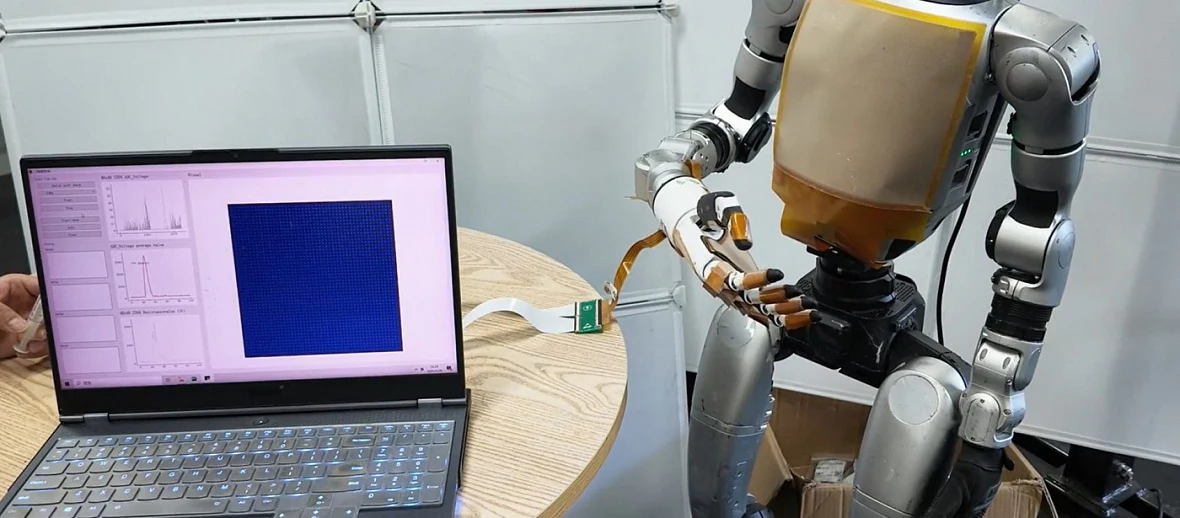
A team of scientists from the Southern University of Science and Technology in China, together with colleagues from other institutes, bypassed this bottleneck with a system taken from the human sensory nervous system. The work is described in Nature Machine Intelligence: the system reads more than 10,000 sensitive elements one hundred times per second and processes the information in stages.
How to make sense of thousands of signals
Many artificial skins poll their points one at a time. The more points, the longer the delays. In addition, neighboring sensors interfere with each other - and the picture of where exactly the touch occurred is blurred.
The new skin combines flexible electrodes with a soft gel in which charged particles float. Pressure changes the electrical response at the interface between the gel and the electrodes, which is how the system measures touch signals.
To read many points at once, the researchers separated them into different frequencies within each sensor bundle. Much like individual notes in a chord: signals can be distinguished even if they arrived at the same time. Frequency indicates a specific point, and signal strength indicates pressure. The circuitry also dampens interference between adjacent sensors.
Next, the system reduces the amount of data that needs to be transmitted. An intermediate processing stage, inspired by the spinal cord's role in processing sensory information, compresses the signals before the upper-level software gets to work.
The team tested whether useful detail would survive such compression. The data was compressed 268 times - and the system still distinguished ten household categories of objects with an accuracy of 98.2%. The entire path from touch to interpretation took about 23 milliseconds.
When is it time to loosen your grip?
Fingers covered with this skin grasped pencil lead just half a millimeter in diameter. They also handled soft solder wire 0.2 millimeters thick. When a person bent the wire, the robotic fingers changed position to prevent it from slipping out.
But protecting the skin required another judgment: At what point does contact become dangerous?
The researchers built a calculated “pain” signal from the force of pressure, the degree of concentration of contact and how sharply the pressure changed across the surface of the skin. The sharper the object, the smaller the area the pressure was compressed into. This signal served as an engineering warning of possible damage.
The robot's reaction depended on the contact parameters. The prickly chestnut caused the fingers to loosen their grip. And the tip of the needle created highly concentrated pressure - and triggered withdrawal. When the protective response was turned off, the fingers continued to move towards the needle, and some of the sensitive areas were damaged.
However, making the system compact enough for full integration into artificial skin is still not easy. “The current implementation of encoding and decoding schemes is quite cumbersome,” the authors write. They propose to embed it in specialized chips - so that the electronics that decipher touches are closer to the flexible film that detects them.