Six-legged robot learned to walk like a stick insect
English translation from Unibot. Source published 2026-08-28.
Have you ever noticed an ant scurrying around the kitchen counter and wondered how this little one managed to overcome all the obstacles in the house? Insects move with remarkable dexterity despite their tiny nervous systems. This skill can be transferred to robots, which have better things to do than look for bread crumbs in your kitchen.
An international team of researchers from Tohoku University (Japan) and Vidyasirimedhi Institute of Science and Technology (VISTEC, Thailand) trained an AI on the gait cycle of a stick insect. The goal is to find the optimal strategy for moving on different surfaces. The method was successfully tested on a six-legged robot, which learned to walk in just an hour.
Moreover, the robot was able to move over uneven terrain and adapt to the loss of a limb. In dangerous areas after disasters, where wheeled vehicles cannot reach, such adaptive six-legged robots can become real rescuers. The study was published in the journal Bioinspiration & Biomimetics.
What does an insect teach?
Stick insects, named for their striking resemblance to twigs, are a classic model for studying gait. The scientists used an open data source containing only three to four insect steps. From this data, the AI simultaneously inferred two things. The first is what the stick insect strives for when walking (the so-called “reward”). The second is how the legs should move to achieve this.
The question is not how to walk, but why
Most papers ask how to make a robot walk. This study asks what walking is all about.
"We've never told a robot how to walk," explains Dai Owaki, an assistant professor at Tohoku University. “We asked what the insect was trying to achieve and let the robot independently strive for the same goal.”
Faster and cheaper
The robot mastered walking three times faster than when using a standard reward. If you give a machine specific instructions on how to move each leg, the design process becomes lengthy and must be repeated for each new model. This approach, on the contrary, eliminates this step by offering the robot an animal teacher.
Training takes place in two categories. One part captures general patterns. The other stores machine-specific information. This separation allows the results to be transferred to other robots. Each new model does not have to start from scratch, which reduces the cost and speeds up production.
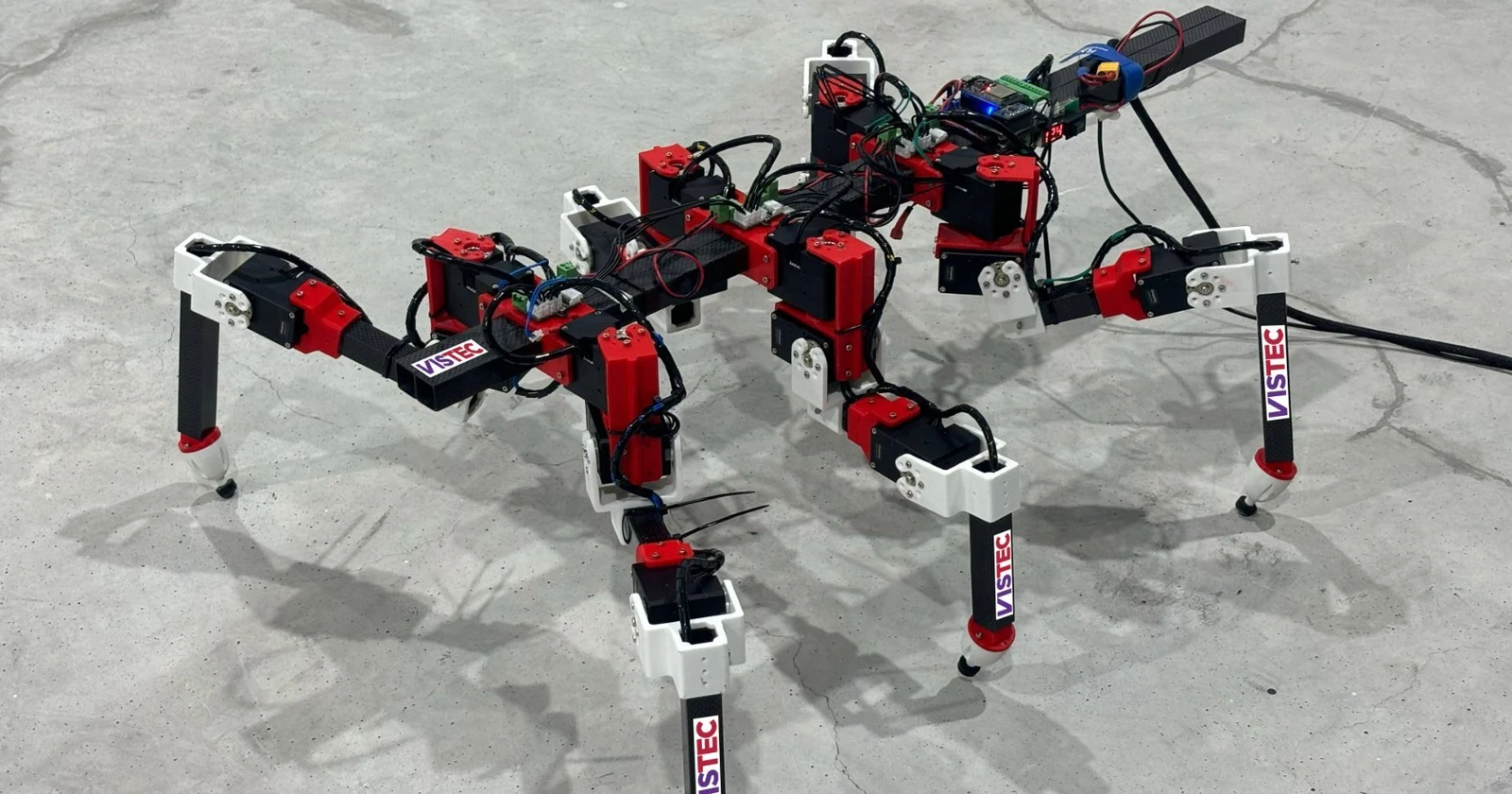
The six-legged RedMirror robot from VISTEC walks using a control law learned from just a few steps of a stick insect. Photo: Dai Owaki, 2026
How the method works. The AI reads the walking purpose from the stick insect's data. This goal is then transferred to a robot with a different body. Photo: Dai Owaki, 2026
“It’s amazing that a few steps of one stick insect were enough to find a principle that works on a machine five times larger,” says Owaki.
Method and perspective
The study used a inverse reinforcement learning method: the AI is not told how to walk - it learns by trying to understand the purpose of an ideal example. In this case, the example was the stick insect, but other animals with high dexterity can also serve as models.
The next step, the researchers add, is to introduce memory so the robot can learn and gain experience over time. This will bring closer the creation of highly mobile vehicles that will one day help eliminate the consequences of disasters.
Six-legged robot learned to walk by looking at a stick insect
Publication data
Yuchen Wang et al., “From insect behavior to robotic locomotion: inferring embodied locomotor principles from limited data via adversarial inverse reinforcement learning,” Bioinspiration & Biomimetics (2026). DOI: 10.1088/1748-3190/ae901f
Quote:
Six-legged robot learns to walk from a stick insect (2026, August 27), retrieved August 28, 2026, from https://techxplore.com/news/2026-08-legged-robot-insect.html