Soft exoskeleton makes it easier to get up from a chair
English translation from Unibot. Source published 2026-09-29.
Getting up from a chair is an action that most of us don't think about. The movement is almost automatic: legs and hips work in a clear sequence. But for older people, this task sometimes becomes difficult due to weakened muscles and poor coordination in the hips and legs.
If a robotic suit is going to help at least partially, it must react intuitively and move in time with the body.
Soft suit with artificial tendons
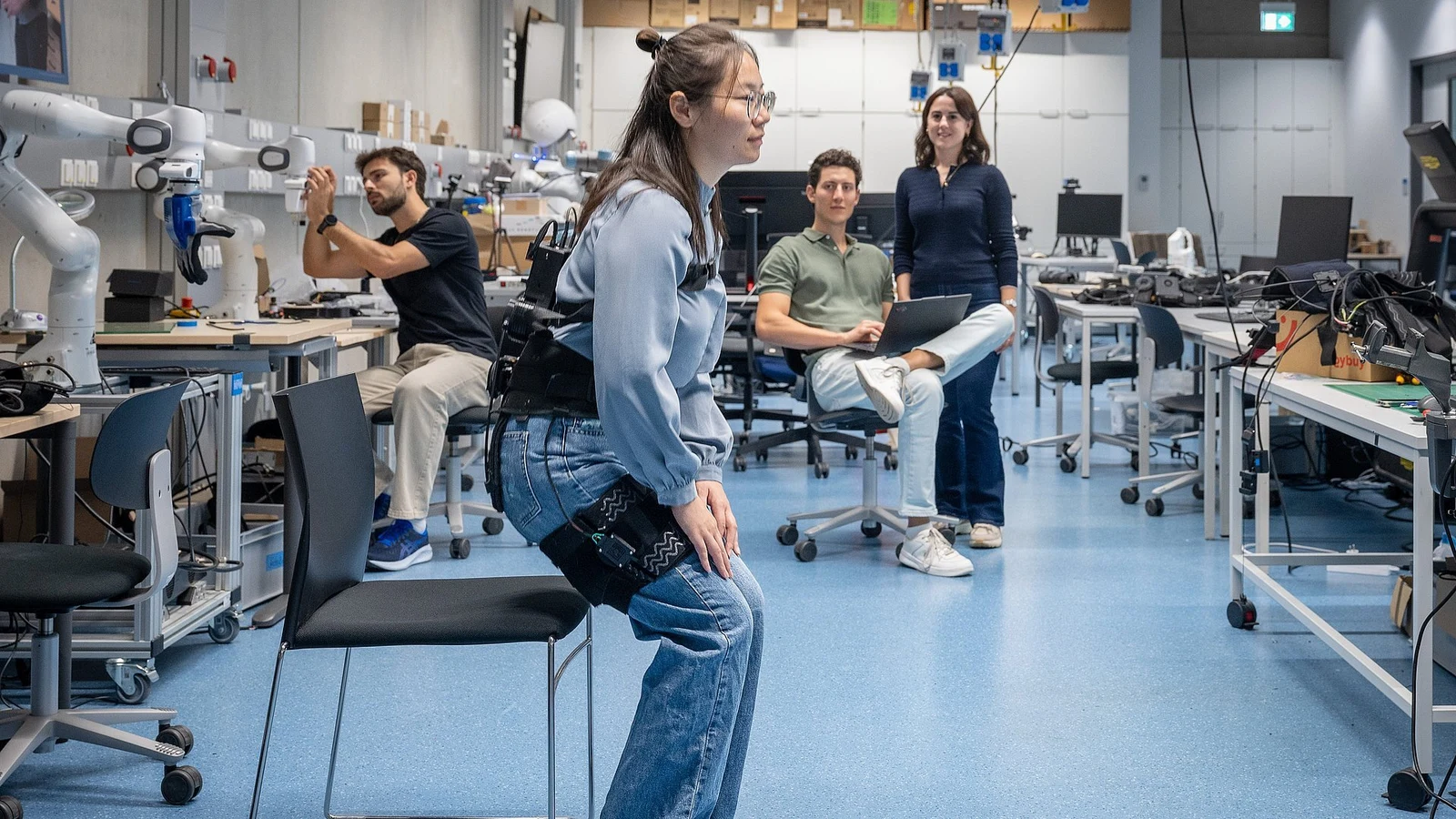
Researchers from the Technical University of Munich (TUM) have created a soft, lightweight suit that helps extend the hip using artificial tendons. It makes it easier for older people to get out of a chair and makes walking more economical. The article was published in the journal Nature Communications.
“We use machine learning to provide help at precisely the right moment,” says Dr. Xiaohui Zhang, a researcher at the Department of Intelligent Biorobotic Systems at the TUM School of Computing, Informatics and Technology.
To build the recognition system and train the algorithm, the scientists first collected data on the movements of a group of young healthy people. As data accumulates, the system will be further trained.
The robot helps naturally
The suit can be put on and taken off in a matter of minutes - just like regular clothes. It has two straps on the hips, a waist belt and artificial tendons connected to a small motor unit on the back - almost like a backpack. Two sensors on the hips track the movement of the legs.
When the system realizes that a person is standing up or walking, the motor tightens the tendons and supports the hip. “The sensors detect movement in real time and transmit information to the controller, which controls the motor to help the user,” Zhang explains.
Users got up more often and faster
Ten older adults with reduced lower limb function tested the exosuit as part of the study. Their ages range from 69 to 85 years.
Standing up became easier with the support of the suit, with some participants performing up to four additional sit-to-stand cycles in a minute, and cycle time was reduced by almost 22%. On average, participants in the experimental group performed 18 cycles per minute - two more than before. Walking also became more effective: the maximum individual reduction in metabolic cost reached 27.5%, and the average improvement was 14%.
Subjective impressions of the participants were also positive: despite the robotic suit, they felt in control of their movements.
“On a seven-point scale, they rated their sense of agency above a six, indicating a high degree of perceived autonomy,” Zhang says. “It’s great to see that our algorithms are actually helping people in their daily lives.”
Like "regular clothes"
“Those who tried on our robotic suit did not find it intrusive and noted that it was comfortable to wear over regular clothing,” notes Lorenzo Masia, executive director of the MIRMI Robotics Institute at TUM and head of the Department of Intelligent Biorobotic Systems.
The exosuit is designed to support older people who want to remain independent longer, as well as those undergoing rehabilitation.