Soft robotic cells from morph: physical AI right in the hardware
English translation from Unibot. Source published 2026-07-01.
The startup morph combines reinforcement learning and high-fidelity physics simulation. This, according to the developers, speeds up the path from idea to finished product.
Physics AI right in the material
While some developers rely exclusively on software and algorithms, the British startup morph takes a broader view of the problem. For them, embodied AI is not only about the code, but also about the hardware.
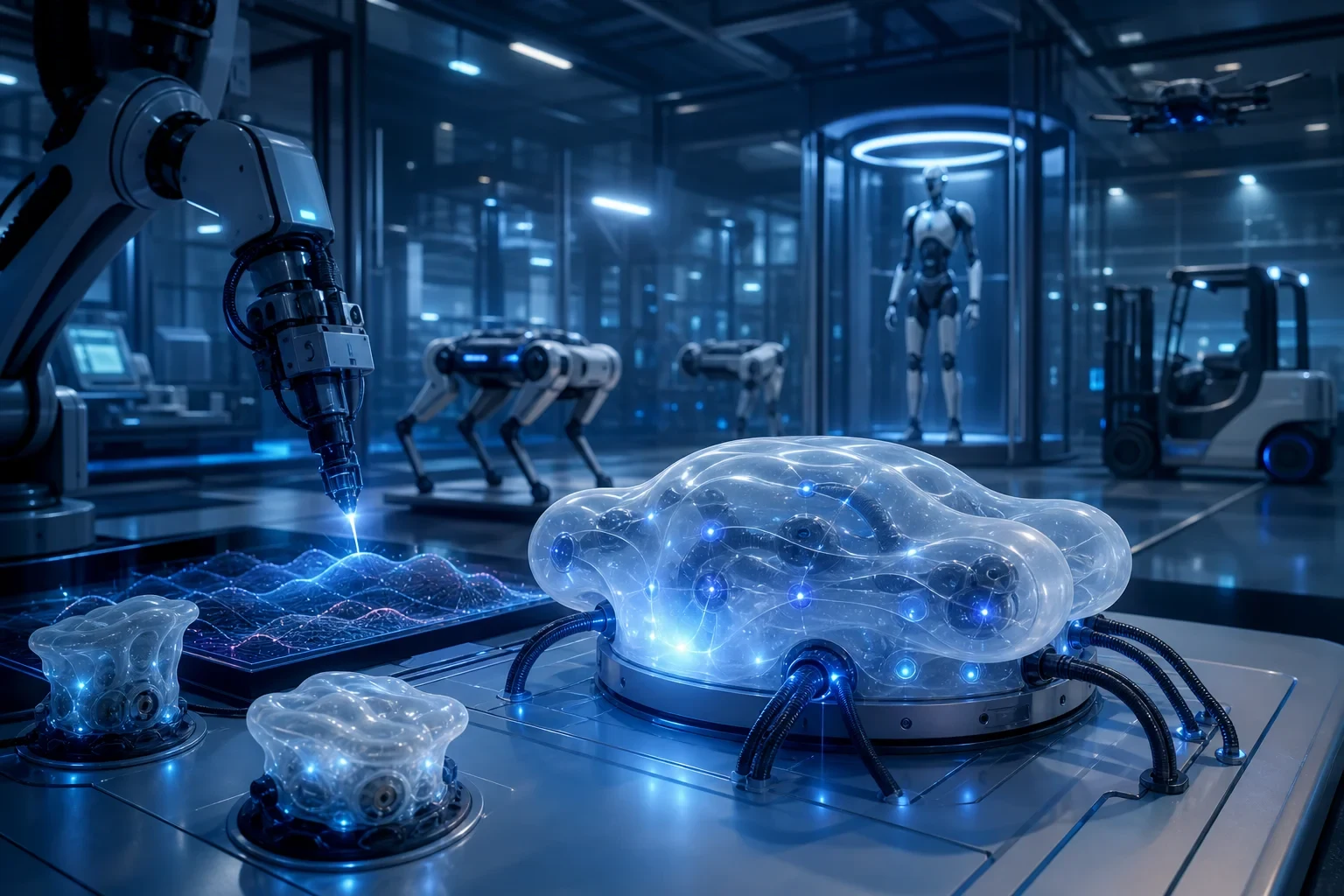
The London-based company embeds sensors and adaptive control directly into tunable deformable materials. The result is “soft cells” that change shape and stiffness in real time. They can be integrated into a wide variety of robots.
“We run physical AI models in real time. They receive data from sensors, analyze it, and then the cells change shape and adapt - for movement, support or protection, explains morph founder Dr Jean Nem. “We have soft sensory cells that can sense information, understand it, and change shape to benefit a product or create value.”
Erase the boundary between hardware and software
Inspired by the adaptability of octopuses, morph aims to accelerate the development of physical AI systems. He is confident that the key to success is to combine the development of AI and hardware. In morph robot cells, intelligence is built right into the material. This allows cells to sense, adapt and respond to the body and environment in real time.
“I don’t believe you can build a robot by separating the hardware from the AI. It doesn't work. It's damn hard to do it right, says Nem. - We are not born just with a body. We are born with an intelligence that learns."
morph's plans are to create different models and implement them in different ways. In the long term, Nem hopes to build a more universal model of the world.
“Look at a puppy or a baby - they learn and adapt. You can see how they are trying to apply the model to understand: “How can I grab this?” he says. - This integration is critical, and we do it from the very beginning. We build design models, implement them in different form factors to drive change, and build a continuous learning cycle into them. When we put something out into the world, it continues to learn.”
Why soft robotics
Dr. Jean Nem is a former reconstructive surgeon who founded and successfully sold the company Digital Surgery (surgical AI). morph relies on soft, deformable materials - they are safer when interacting with people.
“We chose this approach for two reasons,” says Nem. “One: softness is a much more interesting way to solve problems that are not limited to industrial warehouses.”
“I understand the idea of humanoids in warehouses,” he notes. “But to bring them into the big world, a lot will have to be improved. And part of that, I think, will be the integration of soft materials.”
The second reason is flexibility. “Soft systems are easy to adapt and scale. Production will be much more cost effective. We are interested in creating form factors that are optimized for a wide variety of environments,” explains Nem.
Of course, soft robots also have their downsides. Nem admits that such materials are difficult to predict, especially compared to rigid systems. But advances in computing power in recent years have opened up new possibilities for simulating and testing soft robotics.
“It used to be incredibly difficult to model fluid dynamics mathematically,” Nem recalls. - Now, with the growth of computing power - thanks to the large hyperscalers, Google, NVIDIA and others who are investing in the infrastructure - very interesting computing models can be launched. “They allow fluid-driven deformable systems to be designed, modeled, simulated, tested and implemented in ways that were not possible before such capabilities were available.”
Partnership with robot developers
Soft robotic morph cells can be incorporated into a wide variety of products to better respond to human movement and interaction. morph's B2B strategy is simple: the company wants to become a software, design and production partner, helping industries and businesses implement soft robotics technologies.
“We're looking for anyone who has a problem that requires a deformable, soft component or a soft form factor,” Nehme says. - We built a design engine. We have assembled a production stack and are able to deploy and test models for a specific task.”
morph's initial focus is on healthcare. These include athletic performance, injury prevention and mobility support. Over time, the programmable platform will scale to other categories, from medical to automotive to industrial safety, Nehme says.
“We're looking forward to working with people from different industries,” he says. - Write to us, we are open to cooperation. We will work with as many partners as possible, giving them access to our form factor design systems.”
Famous investor and fresh perspective
When morph came out of stealth mode, it was backed by investors such as 8VC, Copper, Qubit Health Capital, Valia Ventures and Blue Lion. Backers include Harvey Spevak, chairman of the Equinox Group, and musician Pharrell Williams.
“Pharrell is an avid fan of robots and has several of them,” Nehme says. - Aside from the song we all know, he truly believes in investing in things that make the world a happier and better place. I really enjoy spending time with him, we communicate a lot, he is deeply immersed in the business and is incredibly supportive of us as an investor.”
Neme argues that in order to create successful robots, it is vital to attract people from outside the industry. “At the core of my belief is that innovation is the result of many people with different perspectives looking at a problem, sharing ideas and arguing,” he says. - We need an outside view. To achieve true innovation, you must be challenged. And to be challenged, you need someone who will look at the problem from a completely different angle and give a different opinion.”