Streets of Tomorrow
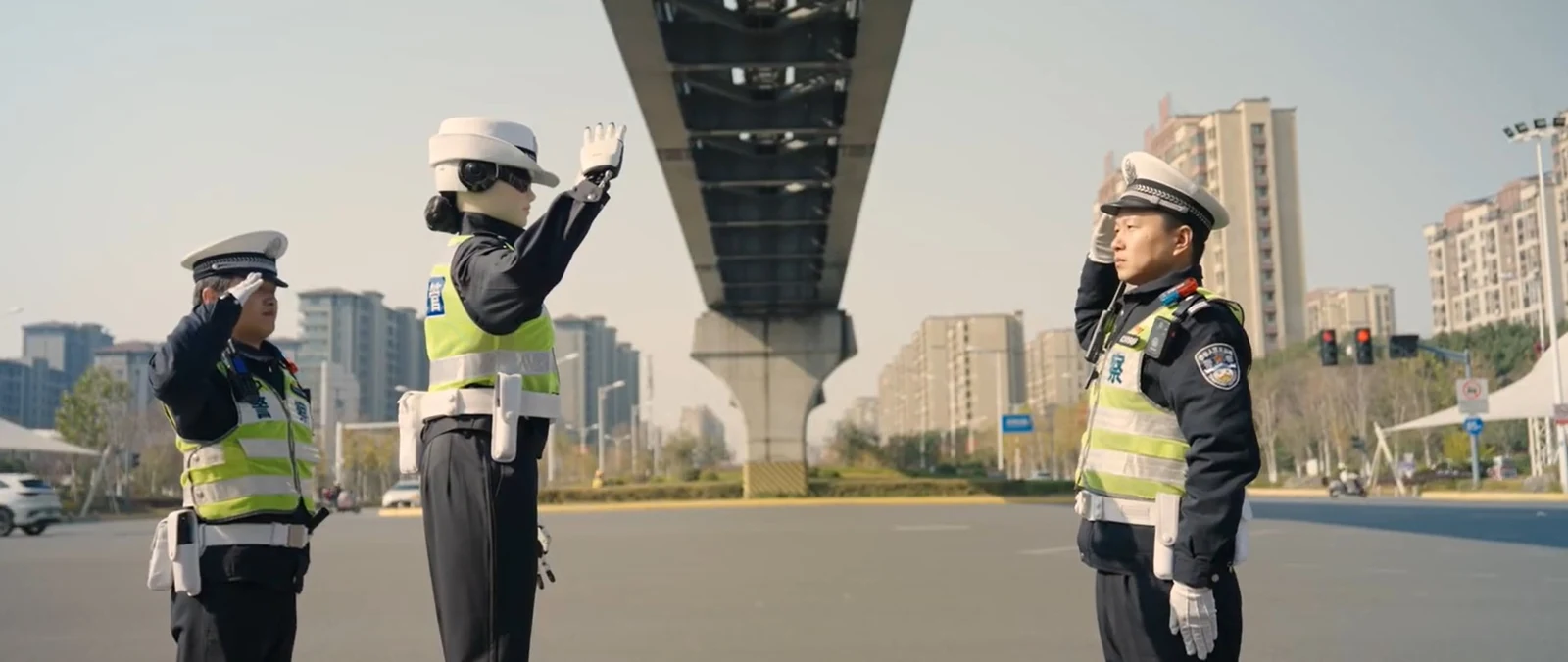
English translation from Unibot. Source published 2026-01-19.
The bustle of a modern city intersection is a chaotic symphony of engines, hurrying pedestrians and shrill whistles. But in cities like Wuhu and Hangzhou, a new conductor has taken the helm. On January 10, 2026, China's People's Police Day, AiMOGA Robotics officially launched its ZhiJing R001 (Intelligent Police Squad) to the forefront of urban traffic management.
Situated on a traffic island at the busy intersection of Zhongjiang Avenue and Chizhu Shan Road, the ZhiJing R001 is more than just a high-tech decoration. This is a functional, on-duty member of the security forces, marking a pivotal transition from laboratory experiments to real-life urban use.
Rise of "ZhiJing R001": precision in chaos
ZhiJing R001 is the pinnacle of the AiMOG series of intelligent assistants. Dressed in a formal police uniform and sporting an official badge on the chest, the R001 is designed to perform routine but visible gestures to keep traffic moving.
Its main role is “human-machine interaction”. By performing standard hand signals such as "Stop" and "Go straight" with a fluidity that mimics human movements, it remains connected to the city's digital brain. Integrated directly into local traffic light control systems, the R001 uses a sophisticated multi-layer sensor system to monitor the road. If he notices a cyclist without a helmet or a car crossing the stop line, he doesn't just observe - he makes a polite and standardized remark in a polite and standardized voice, returning road users to safe behavior.
The Human Advantage: Shifting Risk to Silicon
The strongest argument for implementing the ZhiJing R001 is not replacing human officers, but protecting them. Intersections are some of the most hostile work environments in the city. Officers face daily:
The “three extremes”: adverse weather, toxic exhaust fumes and deafening noise.
Physical stress: standing on concrete for many hours (8-12 hours a day), repetitive signals leading to chronic problems with joints and muscles.
Safety risks: constant danger of being hit by an inattentive driver.
By outsourcing these "high-risk, low-complexity" tasks to a humanoid robot, police can redirect people into "high-value" roles. R001 can control the flow of a typical Tuesday afternoon, allowing his human partner to focus on investigating accidents, resolving complex disputes, or responding to emergencies that require genuine human empathy and judgment.
Why humanoid? Psychology of gesture
One might ask: why implement a complex 70-kilogram robot if a digital sign or a camera on a pole can handle the task? The answer lies not in the hardware, but in human-robot interaction (HRI).
The power of anthropomorphism: Research from institutions such as Hallstad University (2025) and IEEE (2022) confirms that humans are evolutionarily programmed to respond to the human form. When ZhiJing R001 raises its hand in a "Stop" gesture, it triggers a cognitive response in drivers much faster than a red light on a screen.
The Audience Effect: We behave differently when we feel we are being watched by a social being. Unlike a static camera, which is perceived as an inanimate recorder, a humanoid robot creates a social presence. This creates a psychological "deterrent effect" - pedestrians and drivers are instinctively more likely to obey traffic rules when the "body" is physically present and watching them.
Trust and communication: In a mixed traffic environment, “explicit communication” is key. The humanoid robot can use gaze, head tilts and hand gestures to confirm the pedestrian's intentions. This two-way communication builds a level of trust and clarity unattainable with a digital sign, making the road feel more human and less like a cold machine.
China: Express Path to Smart City Reality
If 2025 was the year of “humanoid pilots,” then 2026 is the year of mass integration. China is moving at a pace few can match, turning sci-fi concepts into everyday urban infrastructure.
With more than 150 humanoid robot startups and a supply chain that takes a robot from blueprint to street almost entirely within a 150km radius of cities like Shanghai, the "British wunderkind" has a formidable global rival.
The achievement here is not just technology. This is normalization. In China's smart cities, the "social presence" of a robot cop is no longer a novelty—it's a trusted part of the city's daily pulse.