Swarms of robots modeled after bees and ants will change mining
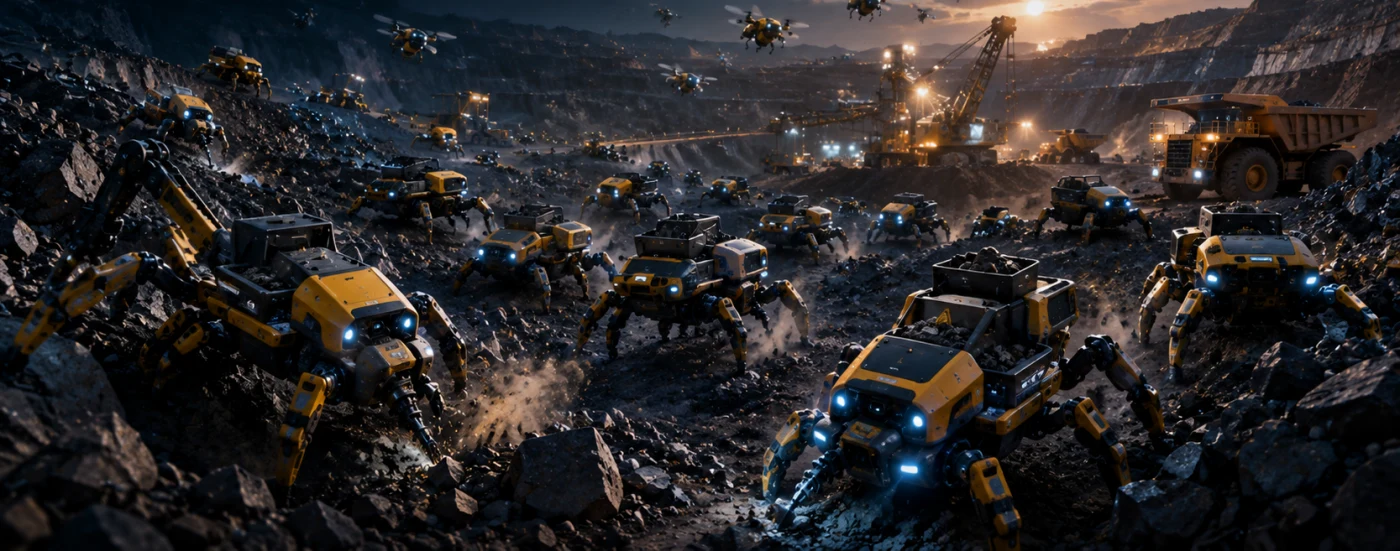
English translation from Unibot. Source published 2026-06-26.
Researchers at the University of Adelaide have created a new type of robotic system, inspired by bees and ants. The development promises to make mining safer, more efficient and more environmentally friendly.
Swarm principles in robotics
The paper, published in the journal Natural Sciences, examines how social insects work together to find and transport food. Scientists applied the same principles to teams of small robots.
The machines work together without a single control center - this allows them to respond more quickly to changing conditions. Mining is becoming increasingly difficult as companies move into deeper, more remote and inaccessible areas.
Automation has improved safety and productivity, but many existing systems are expensive, inflexible and vulnerable - once you give up central control, everything stops. To find an alternative, the Adelaide team decided to test whether natural “teamwork” could help solve these problems.
Test of Swarm Intelligence
Using small Zumo 2040 robots in a laboratory simulating a mine, scientists tried three approaches:
basic - the robot collects ore and immediately returns;
in the image of ants, robots divide tasks among themselves;
in the image of bees - first exploration and mapping of the site, then collection of resources.
Robots are not tied to a single center. They act like a swarm: everyone makes their own decisions, but everyone works together. Even if several machines fail, the system will continue to function.
Dr Joven Tan, who carried out the research as part of his PhD at the University of Adelaide. Source: University of Adelaide
Bee strategy takes the lead
Lead author Dr Joven Tan, who conducted the research as part of his PhD in the Department of Chemical Engineering, says nature is the best teacher.
“Social insects have evolved incredibly efficient ways of working together to solve problems. By transferring these ideas to robotics, we create systems that are more reliable, flexible and productive - for example, for mining.”
The results are impressive. The bee approach performed best in all tests. First, the robots explored the area and remembered where the resources were. This allowed:
reduce the distance traveled by up to 80%;
reduce energy consumption by about half;
deliver ore up to 60% faster than the basic approach.
The ant method also improved the performance: one robot was looking for resources, the other was transporting, the tasks were clearly divided.
The research was not limited to computer modeling. The team tested the approaches on real robots in a laboratory that recreated mining operations. Concepts work in practice.
From laboratory to quarry
Project leader and co-author Dr. Nune Melkumyan from the Department of Chemical Engineering is confident that ideas from nature can be turned into working technologies.
“Nature has spent millions of years perfecting ways to effectively interact in groups. By studying these systems, we create technologies that are more flexible, more reliable and more productive.” The researchers admit that widespread adoption in mines is still a long way off. We need to improve sensors, extend battery life, and teach robots to operate in unpredictable underground environments.
But the potential is huge.
“Swarm robots can work in dangerous or hard-to-reach areas of mines - this will reduce risks to people and increase productivity. They will also be useful in future space missions, where fully autonomous systems are indispensable. Our research proves: swarm robotics is no longer a theory. Such systems can be assembled, tested and launched in real conditions. And they have the potential to change the way we find, extract and transport resources.”