The Age of Automation: 6 Ways Order Picking is Changing Delivery
English translation from Unibot. Source published 2026-07-14.
The expectations of the modern supply chain have changed forever. Both consumers and business customers no longer consider two-day delivery a premium service. For them this is the basic norm.
To meet such demands, online stores and growing companies have to completely redesign traditional logistics. The era when warehouse workers with paper clipboards walked kilometers along aisles is giving way to slender, technological ecosystems.
A key process is at the heart of change
Turning a digital order confirmation into a physical package ready for shipping is the main challenge. When a business scales, handling the increasing volume of orders without losing accuracy becomes a major challenge.
Expanding operations often exposes deep system bottlenecks, from lost inventory to slow processing. The combination of advanced robotics, smart software and optimized manual labor allows logistics operators to eliminate these bottlenecks. The key is to make the journey from storage shelf to delivery van as smooth as possible.
We optimize the basis for order processing
Before a single item goes into a box, the warehouse must have a flawless sourcing and retrieval strategy. The introduction of intelligent picking and packaging processes can dramatically reduce the time for each order.
Such systems analyze incoming order data in real time. They group products by their physical location in the warehouse to create the most efficient routes for employees or autonomous carts. When these processes are set up correctly, warehouses can eliminate unnecessary movement.
Instead of running back and forth across a huge warehouse for each individual order, workers use batch or zone picking. Batch picking allows you to collect goods for several orders at once. Zonal selection assigns employees to specific areas: the shipping container moves along the conveyor, and at each stage a different part is added to it.
This order keeps the entire warehouse in an even, predictable rhythm. The fewer steps required to assemble an order, the faster the package will leave. This directly translates into satisfied customers and lower operating costs.
Integration of autonomous mobile robots
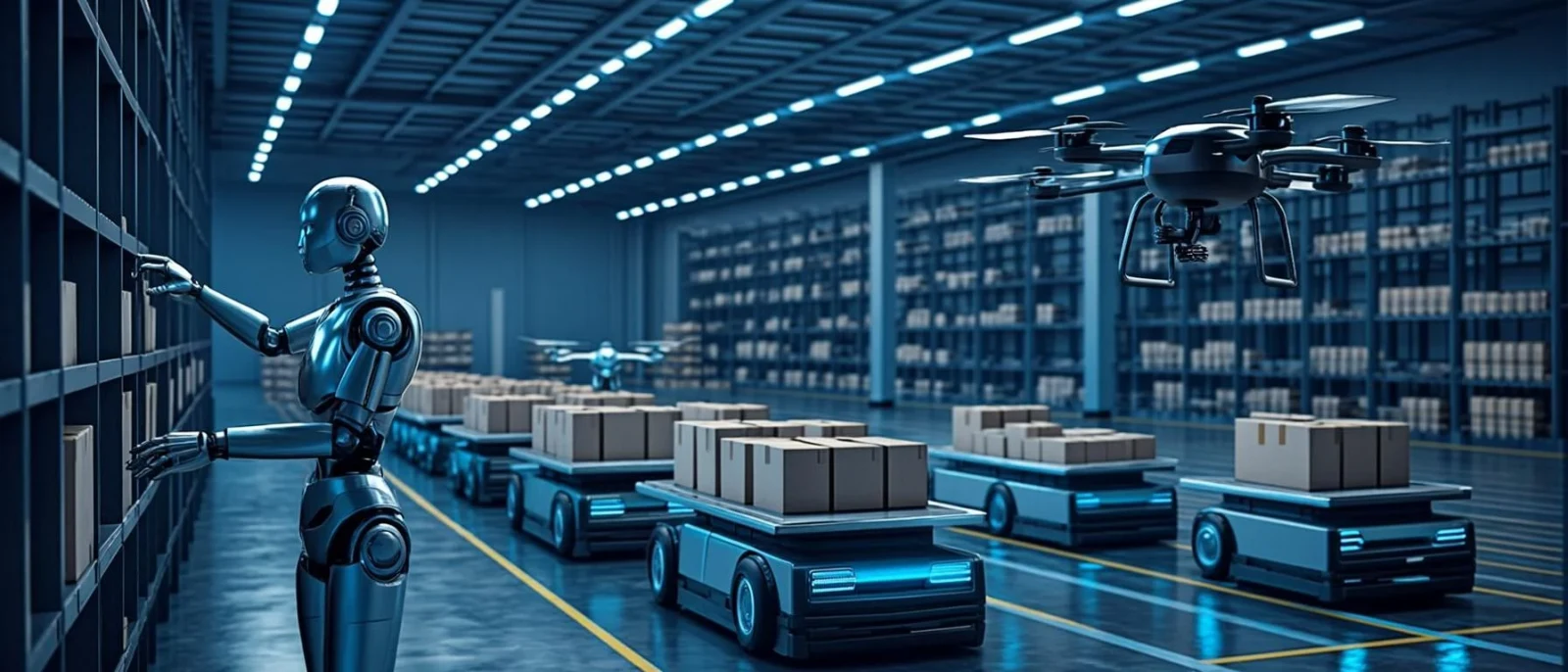
The introduction of robots is perhaps the most visible change in modern warehouses. Autonomous mobile robots (AMRs) are moving from a high-tech curiosity to an absolute necessity for large operations.
Unlike older automated carts that required magnetic tapes or wires in the floor, modern AMRs use on-board sensors, cameras and laser guidance. They navigate safely in dynamic environments. These smart machines are great at handling the most repetitive and physically demanding tasks.
Material Transport: AMRs can quickly transport heavy pallets or loaded containers from the receiving dock directly to long-term storage areas.
“Goods to person” system: instead of a person walking kilometers every day in search of goods, robots bring entire mobile racks directly to the packer’s stationary workplace.
Obstacle avoidance: if a forklift or employee gets in the way of the robot, the machine instantly recalculates the route without disrupting the overall workflow.
Autonomous assistants take on heavy work and long-distance transport. This allows people to focus on tasks that require fine motor skills and critical thinking, such as quality control or specialty packaging. This synergy significantly reduces fatigue in the workplace and dramatically reduces the risk of work-related injuries.
Maximum precision with smart software
A beautiful warehouse, stuffed with advanced robots, costs exactly as much as the program that controls this movement costs. Modern warehouse management systems (WMS) act as the digital brain of the entire supply chain.
These platforms provide absolute transparency: at any time you can see how much product is in stock, what is the status of orders and what is labor productivity. Imagine: an online store experiences a sudden surge in sales. Smart WMS dynamically rearranges the shipment queue - depending on delivery times and carrier arrival schedules.
The program seamlessly interfaces with barcode scanners and wearable devices, providing employees with precise visual cues. If a picker accidentally reaches for a blue shirt instead of a green one, the system instantly signals an error - even before the item reaches the packing table.
Eliminating mistakes at the root means avoiding a costly chain reaction. Fixing a shipping issue after the package has left the warehouse will result in returns, manual checks, re-shelf costs - and possibly loss of customer. The closer the accuracy is to the ideal, the more reliably the profit is protected and the stronger the brand reputation.
Advanced packaging strategies
The picking process does not end when the required items are collected. How they are packaged makes a huge difference. Efficient order picking and packaging relies heavily on intelligent cartoning programs.
This technology analyzes the exact dimensions and weight of each item in the order and instantly selects the smallest box or bag in which it can all be safely placed. Proper box sizing solves two of the biggest problems in modern logistics: environmental damage and volumetric weight tariffs.
Shipping huge boxes filled mostly with air and bubble wrap is no longer profitable. Major carriers calculate shipping costs based on how much space a package takes up on the truck, not just its actual weight.
Fit-to-fit packaging: Custom-made boxes minimize the need for filler such as plastic beads or paper liners.
Optimization of space in the truck: Small boxes of the same shape allow you to fit more orders into one truck - the transport is used as efficiently as possible.
Unboxing Experience: Customers love receiving compact, easily recyclable packaging rather than bulky boxes full of unnecessary junk.
Smart packaging stations are equipped with automatic tape dispensers and built-in scales. Each package is sealed, weighed and labeled in seconds. This prevents congestion from forming right before dispatch.
We design scalable infrastructure
Seasonality is one of the most challenging issues for any retail or B2B business. The infrastructure that copes with stable sales in April easily breaks down under the pressure of the pre-holiday rush in November and December.
True supply chain efficiency requires a model that scales instantly. And it does not require huge investments in real estate or equipment. Forward-thinking logistics companies are addressing this challenge with modular warehouse layouts and flexible hiring systems.
Standard shelving, easily reconfigurable conveyor lines and cloud software allow you to adapt the physical space to a changing assortment in a few hours. When there is a sudden influx of orders, the flexible pick and pack system evenly distributes the load between automation and live employees.
This flexibility ensures that even during peak seasons, surges in volume are handled without disruption and delivery times remain the same.
Continuous improvement based on data
The digital footprint that the modern supply chain leaves behind is a goldmine for improvement. Every barcode scan, every robot move, every second a package spends at a packing station generates valuable data.
By analyzing these metrics over time, warehouse managers can identify hidden inefficiencies that would otherwise go undetected. Predictive analytics tools go even further - they forecast future operational needs.
The system evaluates historical sales data, local weather patterns and regional purchasing trends. This way she predicts which products will be in high demand in the coming weeks. This allows fast-moving inventory to be pre-positioned closer to packing stations. Travel time is reduced even before the order has arrived.
The shift from reactive management to a proactive, predictive model keeps operations afloat - efficiently, cost-effectively and ahead of the competition.
A sustainable way forward
The future of logistics lies with those who know how to combine technological innovation with strategic human insight. Relying on manpower alone to keep up with the growth of global e-commerce is no longer an option.
True operational excellence requires a holistic approach. Smart software provides routes, autonomous cars take care of the physical workload, and human expertise ensures accuracy and quality. Investing in robust pick and pack techniques allows today's companies to transform complex supply chain headaches into powerful drivers of customer loyalty and sustainable business growth.