The founder of iRobot wants to have a robot companion in your home
English translation from Unibot. Source published 2026-05-07.
Two years ago, Colin Angle stepped down as CEO of iRobot, the company he co-founded and which remains the world's most successful home robot company. Almost immediately, he founded a stealth "physical AI" company called Familiar Machines & Magic (FM&M), which soon managed to attract a number of exceptionally talented robotics specialists, including Disney Research's Morgan Pope - which caught our attention.
“A physically embodied AI system designed to perceive, adapt, and interact with humans in a way that feels natural and consistent,” the press release states.
This robot is not a toy and is not intended exclusively for children. Rather, it is a device that adults can purchase for themselves and their families. He will recognize you, seek your attention, and actively help you create and maintain an ideal life routine.
Here are the (limited) technical details from the press release:
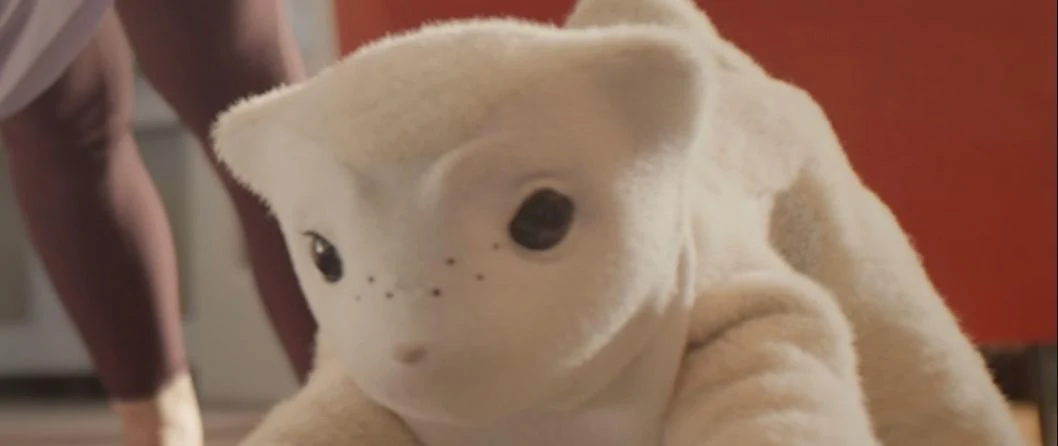
The first Familiar is a four-legged robot specifically designed to interact with humans; It has 23 degrees of freedom, allowing for both natural mobility and expressive behavior.
Familiar is covered in a proprietary tactile-sensitive cape, equipped with a computer vision system, a microphone array and an audio system for rich interactions.
Its onboard edge AI stack is powered by a custom small multimodal model optimized for social reasoning: it integrates vision, audio, language and memory to generate socially responsive behavior in real time.
FM&M CEO and co-founder Colin Angle said the first Familiar prototype was designed to resemble something like a highly abstracted bear. It deliberately looks neither dog nor cat—following the successful strategy of other social robots like Paro and Pleo: if you don't associate a robot's shape with a real animal, you don't transfer pre-formed expectations to it.
“Our goal is to position it as a family familiar that lives with you and helps promote healthy habits,” says Ainge.
He explains that comparing Familiar to a pet is a good analogy, but "pet-like" doesn't fully capture the range of its capabilities. Familiar acts more like a service animal in a narrow sense: it is able to recognize activities and intervene to motivate you to do more or less of them, depending on the situation. One simple example is screen time: Familiar can track how much time you spend on your phone, and if it's too much, actively try to get you involved in other activities, including going outside with it.
“The idea,” says Ange, “is that you can have technology in your home that is extremely loyal to you, gets to know you, helps you develop an ideal routine, and then plays a positive role.”
Fitting this amount of intelligence into a robot with which you can safely go for a walk (at the average speed of human walking) is an extremely ambitious task. I asked FM&M creative director Morgan Pope what convinced him of the idea's feasibility so much that he agreed to leave Disney Research to join the startup.
“Two recent advances have made this feasible,” Pope replies. “First, watching Disney's two-legged robots move flexibly across different terrain using reinforcement learning has proven that dynamic movement can be achieved without ideal, backlash-free drives or crazy-expensive hardware. Secondly, while I’m often skeptical of the hype around generative AI, it’s perfect here: it does a great job of creating a believable impression of intelligence, which helps the robot look cohesive and alive.”
The problem of social home robots
As a social home robot, Familiar has a lot of work to do to single-handedly revive a category that burned out between 2012 and 2019. A number of high-profile and lavishly funded startups, including Anki, Mayfield and Jibo, have failed to sustain social home robots as businesses, largely due to problems with long-term engagement. It's not enough to make a robot cute and charming for a short time; it should continue to captivate users, or at least provide value, after the initial novelty wears off. In other words, a flashy demo may be counterproductive—a serious problem, since robots are especially good at flashy demos.
“It’s about setting the right expectations and meeting them,” Angle says. "The Familiar lives in your world and plays by your rules, and if you don't spend time with it, pet it, and interact with it, then we haven't succeeded."
It is no coincidence: the term “familiar” really best describes this robot - a kind of vaguely magical inhumane creature with autonomy, but whose existence and motivation are fundamentally connected with a person. “This is not an attempt to replace a real friend,” Angle explains. “This is an artificial life that lives in your world, has its own character and goals, and a special connection with its guardian: it wants attention and wants the guardian to be active.”
This philosophy is the key differentiator for FM&M. Familiar is more than a companion; it has long-term goals that it tries to accomplish to purposefully improve your life, Angle says. He will try to establish a social connection with you to encourage you to spend time with him in the name of these goals, but the goals themselves are more important, that is, they are the end goal, and not just the social connection itself, which was the main attraction of the previous generation of social robots. “Within a few days of Familiar coming into your home,” Angle says, “he understands his role in your life. He tries to reinforce healthy routines, whether it's calling people over for dinner, snuggling with you while watching TV, or greeting you when you get home. And you will maintain this relationship through its development, in which both parties are actively involved - you also help him with the things necessary for the robot to continue to work."
Human-Familiar Interaction
The temptation to use recent advances in AI to make a robot like Familiar talk—especially given its regular interaction with humans to achieve specific goals—must be enormous. But, to their credit, FM&M managed to hold out. “I don’t think the technology exists today to allow AI to communicate with humans safely and responsibly,” Angle explains. As a result, Familiar does not yet speak, although it makes sounds and has many other means of communication. “Think about how much expression can be conveyed through a tail, twitching ears, blinking eyes and an eyebrow that can be happy, sad, angry or annoyed,” says Angle. This will probably resonate strongly with dog owners, a little less with cat owners, and very little with reptiles like me.
The reverse direction is more difficult. Those same advances in AI mean that Familiar could likely understand everything you say and carry out commands perfectly if it wanted to. But such behavior would destroy the illusion that the robot has its own desires, goals and character, so FM&M had to be careful. “The way we trained it from an AI perspective is really cool,” Angle explains. “We use a scoreboard of speech and visual inputs fed into a small multimodal model trained on stories, and given a set of inputs it goes through a generative process to decide at a high level what it’s going to do. This decision is passed to the behavior engine, which deploys behavior trees to the target and drives a unified reinforcement-learned movement model. There is nothing completely deterministic about your Familiar's behavior; he really tries to live his life, showing the variety of emotions dictated by his personality.”
Familiar is not a huge robot in the usual sense, but it’s not exactly a small device either. Since it has legs, there is always a risk that it will fall.
“The low center of gravity helps us a lot,” says Pop. “If we turn off the power, it gently settles down and does not turn over.” In addition, it is wrapped in soft rubber, fur and padding, so that even when kicked, the impact force will be small."
Interestingly, FM&M also uses “character experience” to reduce risks for both the robot and the user.
“We can effectively communicate danger through emotion,” Pop explains. “For example, if someone is carrying it at a height or placing it next to an open fire, the Familiar may become visibly frightened in order to convey that it does not like it.”
Although Familiar is not a toy and is not intended exclusively for children, it can provide your family with warm and attentive companionship.
In addition to physical safety, social robots must also consider emotional safety. The better they establish emotional connections with people, the more responsibility they have to ensure that those connections are positive.
“We take this very seriously,” Pop says. “We are guided by the principle of “do no harm”: you cannot provoke an unhealthy addiction or monopolize a person’s attention the way a telephone does. We carefully design the device so that its overall impact remains positive and never crosses the line into harm."
In addition, Familiar AI runs directly on the robot itself and does not transfer personal data to the cloud. In fact, it works fine in completely offline mode, although you will lose access to new features as they become available.
Along with the numerous engineering and HRI tasks that FM&M has to solve, there is another problem that seems boring at first glance, but perhaps the most difficult in the short term: marketing. The company should, of course, market the robot, but there is a real danger—one that has plagued many robotics companies in the past—of selling an idea of what a robot could be rather than showing what it actually is.
According to Pop, FM&M seems to understand that robots are most successful when the experience or task itself is secondary to the robot—in other words, it's not what the robot does that matters, but what it does.
“The best way to understand Familiar is that we're not just building a robot; we create relationships,” Pop explains.
Whether it's mobility or relationship issues, it's safe to say that a robot of this level of complexity won't perform perfectly every time. Fortunately, the FM&M team has been working on robots for a long time and is ready for this.
“We made a conscious effort to design it to be forgiving,” Angel says. “It’s not a precise machine in terms of movement or agility.” He is intentionally imperfect, but still exhibits the correct elements of behavior. By actively working to manage expectations to an achievable level, we want users to appreciate what he can do.”
Customer expectations, what they value, and the degree of leniency they are willing to accept largely depend on the cost of the Familiar.
“For the price of owning a pet, you get a device that can help you live a healthier life, feel cared for, and provide social benefits,” says Angel.
This can mean a lot depending on the type of pet: One estimate puts the minimum monthly expense for a cat at around $65, and closer to $100 for a dog. FM&M's press release emphasizes that today's announcement "is not a commercial product launch," with specific pricing and timing to follow.
While it's too early to predict the future of FM&M robots, Angel is already thinking about other areas where Familiar could be used.
“This first robot is designed as a platform with broad appeal and as a foundational opportunity for specialization in, for example, elderly care and parenting support,” Angle says. “We're designing machines from the ground up that focus on human connection, and the core technology can be adapted to other form factors.”
To do this, Familiar will need to succeed, and it is important to re-emphasize just how big of a task this will be. A legged robot designed to interact with a human in a home environment—everything FM&M does is extremely complex. With experience running and running iRobot, Angel is one of the few people who truly understands this; however, his excitement and optimism for Familiar did not wane.